 Xognosis EsotericaArcane Publishing Studio
Ask a room full of people what an enneagram is and most will describe nine personality types, a quiz, maybe a number they identify with. The symbol itself, a circle enclosing nine points joined by lines, has become shorthand for a typology of character.
Share
Ask a room full of people what an enneagram is and most will describe nine personality types, a quiz, maybe a number they identify with. The symbol itself, a circle enclosing nine points joined by lines, has become shorthand for a typology of character. Yet for the first half century of its documented life the figure carried no types at all. It arrived, so far as the historical record shows, in the teaching of G. I. Gurdjieff around the time of the First World War, and it described something very different: the way any process runs, stalls, and can be pushed to completion.
Gurdjieff presented the figure to his Russian pupils in the mid-1910s, and our main textual record of those lectures is P. D. Ouspensky's In Search of the Miraculous, published in 1949, the year Gurdjieff died. Chapter 14 gives the fullest early account. There the enneagram is a machine for thinking about processes: a chain of events laid out along the circle's six inner points, closed by the triangle 9-3-6, which Gurdjieff linked to his "law of three". The sixfold sequence comes from his "law of seven", the idea that processes do not run in straight lines but deviate at intervals. Ouspensky records the arithmetic behind it: the repeating decimal of one seventh, 0.142857, gives the order 1-4-2-8-5-7 in which the points are connected.
Gurdjieff made large claims for the figure. "All knowledge can be included in the enneagram," Ouspensky quotes him. "With the help of the enneagram, all knowledge can be interpreted. And in this connection it can be said: only what a man can put into the enneagram, he actually knows, that is to say, he understands." He also called it "perpetual motion, the same perpetual motion that men have sought since the remotest antiquity and could never find". That last flourish is Gurdjieff's own rhetoric rather than verifiable cosmology, and readers can weigh it as they wish. What is textually solid is the use: no personality typing appears anywhere in Ouspensky's account.
Secrecy was part of the presentation. Gurdjieff told his pupils that "the knowledge of the enneagram has for a very long time been preserved in secret", and that what he was now making available was incomplete and theoretical, of no practical use without instruction from someone who knew. The symbol also moved off the blackboard and into the body: from 1923 and 1924 onward, Gurdjieff's sacred dances, the "movements", used formations in which dancers traced the figure on the floor. (The Gurdjieff scholar Joseph Azize reads the enneagram of this tradition as a diagram of process and cosmic law, tied to the "Diagram of Everything Living" reproduced in Ouspensky's book.)
How old is the symbol really? Gurdjieff implied great age, and legend has obligingly supplied candidates: Pythagoras, Sufi orders, ancient monasteries. The documented record is less romantic. No pre-Gurdjieff text containing the figure is known to scholarship, and Gurdjieff remains the sole verified source for it. Even the Enneagram Institute, an organization descended from the typology tradition, states plainly that Sufi or "oral tradition" origin stories are erroneous, and that attaching a personality system to the symbol was the synthesis of one man in the 1960s. Oscar Ichazo, interestingly, called the figure the "Ninth Seal of Pythagoras", a claim that rests on his own testimony rather than on any surviving Pythagorean document. The honest summary: the symbol is first documented in 1910s Russia; the types are first documented in 1960s South America.
Oscar Ichazo (1931-2020), a Bolivian-born teacher who led self-development programs in South America through the 1950s and was teaching in Chile by the late 1960s, did something new with the old figure. He assigned qualities to the nine points: passions, virtues, fixations, holy ideas. He coined the term "Enneagon of Personality" for the result. The Enneagram Institute notes that Ichazo taught 108 "Enneagons" in all, and that the American movement kept only a few, chiefly the four that deal with personality structure, so even in its inventor's hands the typology was one chamber of a much larger house.
Ichazo's frame was essence versus ego. "We have to distinguish between a man as he is in essence, and as he is in ego or personality," he taught. "In essence, every person is perfect, fearless, and in a loving unity with the entire cosmos; there is no conflict within the person between head, heart, and stomach or between the person and others." Then, in his account, something happens: the ego begins to develop and karma accumulates. Whether his stories of the system's origins, drawn from his own travels and studies, hold up as history is a separate question from whether the map works. His claims rest substantially on his own word.
In 1970 a group of Americans, the psychiatrist Claudio Naranjo (1932-2019) and the writer John Lilly among them, traveled to Arica, Chile to study with Ichazo. Naranjo then taught his own interpretation of the material at Esalen and in Berkeley in the early 1970s, framing it with the psychiatric vocabulary of his profession. From there it spread fast. Two Jesuit students of Naranjo adapted the system for Christian programs at Loyola University Chicago, a move Ichazo fiercely objected to. The book wave followed: Don Riso in 1987, Helen Palmer in 1988, Richard Rohr in 1995. By the first International Enneagram Conference at Stanford in 1994, roughly 1,400 attendees had gathered around what had begun as a Chilean workshop.
One pedigree claim deserves a specific caution. Commentators have noted a structural parallel between the nine types and the eight logismoi, the thoughts of temptation catalogued by the fourth-century desert monk Evagrius Ponticus, with "love of self" added as a ninth. That is a parallel drawn by modern observers, not a documented line of transmission.
The enneagram began as Gurdjieff's diagram of how processes move and where they go wrong; the nine personality types were layered onto the symbol by Oscar Ichazo in the 1960s and popularized by Claudio Naranjo in the 1970s. Two uses, two centuries, one circle.
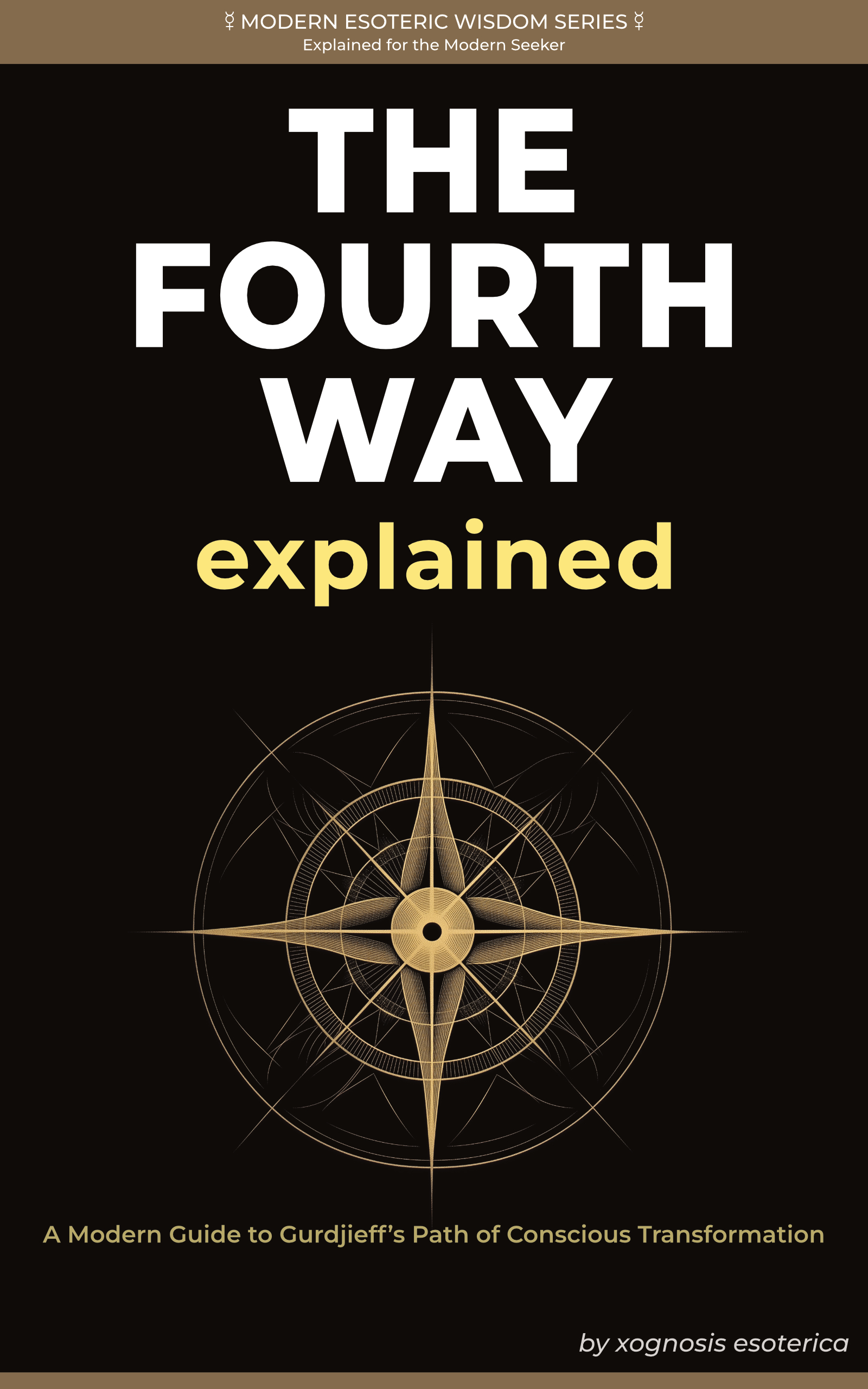
Does the older meaning still matter if you only came for your number? It does, because the diagram Gurdjieff drew was built to answer a different and arguably harder question. Where the quiz asks "which type am I?", Gurdjieff's diagram asks "where does this process I am living inside tend to break?" For readers who want the source material rather than the quiz, chapter 14 of Ouspensky remains the place to start, and our edition of The Fourth Way Explained walks through the laws of three and seven and the rest of that system in plain language.
Read the book
Related Articles
Continue through articles sharing this topic.
In 1908 a small book appeared in Chicago under the byline "Three Initiates." In 1912 a Russian journalist finished a treatise on the fourth dimension, a…
7 min read
Pick a shelf of spiritual books at random and you will find, somewhere in the first twenty pages, the same accusation: you are not actually awake.
7 min read
A man walks down a street in St Petersburg, around 1916, trying to hold one unusual question in his mind: am I here?
6 min read
Every origin story attached to Gurdjieff's teaching comes in two layers. One layer can be documented: a man of uncertain age arrives in Moscow, gathers…
6 min read