 Xognosis EsotericaArcane Publishing Studio
Pick a shelf of spiritual books at random and you will find, somewhere in the first twenty pages, the same accusation: you are not actually awake. A Buddhist verses collection says it. A Gnostic gospel says it. A Russian mystic's students said it with unusual bluntness.

Share
Pick a shelf of spiritual books at random and you will find, somewhere in the first twenty pages, the same accusation: you are not actually awake. A Buddhist verses collection says it. A Gnostic gospel says it. A Russian mystic's students said it with unusual bluntness. The books disagree about nearly everything else, about what the problem is, what causes it, and whether effort or knowledge or a quiet third thing dissolves it. But the opening move, the diagnosis, repeats across two millennia and at least three continents. That repetition is the real spine of an esoteric catalog, and it is worth looking at closely, because the differences between the diagnoses are more interesting than the similarity.
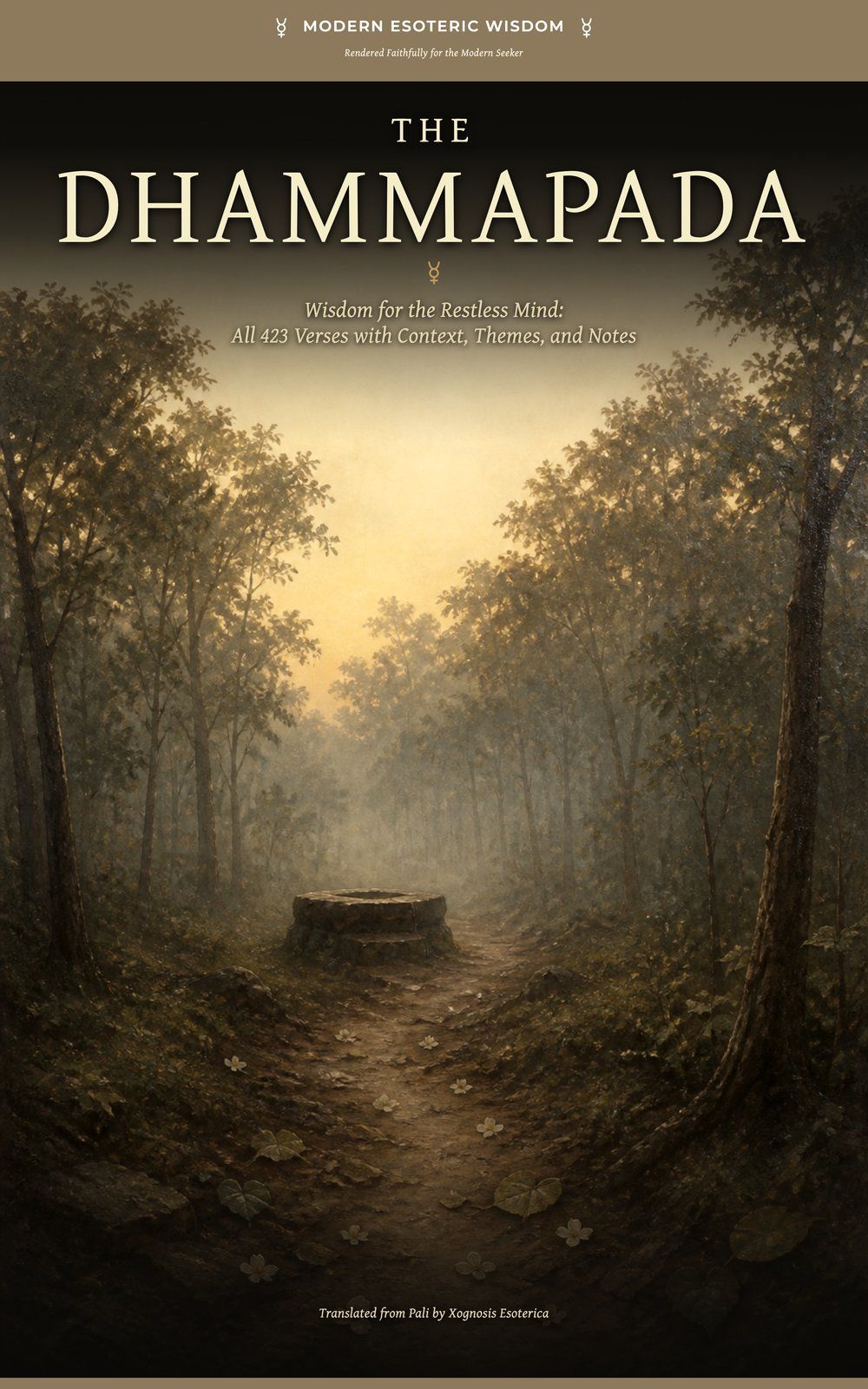
The Dhammapada, a collection of verses from the Pali canon traditionally dated to around the third century BCE, with older oral material behind it, frames the human problem as heedlessness. Not sin, not ignorance exactly: inattention. The translator Acharya Buddharakkhita renders verse 21 this way:
"Heedfulness is the path to the Deathless. Heedlessness is the path to death. The heedful die not. The heedless are as if dead already."
That final clause does the strange work. Spiritual death, on this reading, is a present condition: the heedless are "as if dead already." Verse 29 sharpens the image into the sleeper metaphor directly: "Heedful among the heedless, wide-awake among the sleepy, the wise man advances like a swift horse leaving behind a weak jade."
Two things are worth noticing about the Buddhist framing. First, the remedy is effortful and incremental. The wise one keeps heedfulness, in the text's own figure, "as his best treasure" (verse 26), something cultivated and guarded. Second, the tradition that the Buddha spoke these verses verbatim is a matter of faith rather than history; the honest attribution is to the text, not to the historical Buddha as a person. Our own edition, The Dhammapada, translated and annotated, treats the verses as historical poetry, not as a transcript.
Some seventeen centuries before Gurdjieff described modern humanity as living in "waking sleep," the Gospel of Thomas put a similar image into the mouth of Jesus. Scholarly estimates place its composition in the first or second century CE, likely in Greek, preserved in the Coptic copy found at Nag Hammadi in December 1945. Saying 28 reads, in Mark M. Mattison's translation:
"I found them all drunk; I didn't find any of them thirsty... They came into the world empty and plan on leaving the world empty. Meanwhile, they're drunk. When they shake off their wine, then they'll change."
The metaphor shifts here. The Dhammapada's sleeper can rouse himself through sustained attention. Thomas's drunk has a substance in him that must wear off, and the saying's sadness is that nobody is even thirsty, nobody is looking for water. Attribution matters: most scholars treat this as early Christian composition, so the careful phrasing is "the Gospel of Thomas has Jesus say," not "Jesus said."
A related Gnostic diagnosis appears in the Gospel of Mary, composed in Greek probably in the second century CE, surviving in a fifth-century Coptic copy that is missing pages 11 through 14. What remains includes a blunt line on page 8: "That's why you get sick and die, because you love what tricks you." Here the problem runs deeper than inattention: attachment to a deception. The sleeper is charmed rather than careless, in love with the very thing that keeps him unconscious. (The Mary of the text is named only as Mary; the identification with Mary Magdalene is the common scholarly reading, not a certainty, and the missing pages mean the central dialogue survives only in fragments. Our Gospel of Mary edition is built around those gaps rather than papering over them.)
A third variation comes from the Gospel of Truth, a second-century Valentinian text, also from Nag Hammadi, where sleep becomes forgetfulness. In Mattison's translation of pages 17-18: "Forgetfulness came into being because the Father was unknown, so when the Father comes to be known, forgetfulness won't exist anymore." Page 24 extends the point: "As someone's ignorance dissolves when they gain knowledge, and as darkness dissolves when the light appears, so also need dissolves in completion." Attribution of this text to Valentinus himself is a scholarly hypothesis, not a settled fact. The structural claim, though, is clear: you are asleep the way an amnesiac is asleep, and knowledge, gnosis, is the thing that wakes you.
The Fourth Way teaching of G. I. Gurdjieff, recorded principally by P. D. Ouspensky in In Search of the Miraculous (published in 1950, after Ouspensky's death in 1947, from notes covering the years 1915 to 1917 and after), radicalizes the claim. The writer P. L. Travers, a literary contemporary, put it this way in an essay on Gurdjieff: the teaching "repeatedly insists that man is asleep," and awakening, when it comes, is awakening "not merely to consciousness but to conscience."
Here the sleeper is neither careless nor enchanted nor forgetful. He is mechanical. Things happen to him; he does not do them. In Ouspensky's record, Gurdjieff's account of ordinary man is blunt: he has no real consciousness and no real will of his own.
Gurdjieff's biography before 1912 is deliberately obscured by his own accounts, which mix memoir and invention, so any story of his Central Asian wanderings belongs to legend unless independently documented. The teaching on sleep, though, is well documented through Ouspensky's records and contemporaries. Our volume, The Fourth Way Explained, sets out the system's account of self-remembering and work on being as the proposed cure.
It would be tidy to say the traditions all teach the same truth in different costumes. They do not, and flattening them is the fastest way to misunderstand all three.
The Dhammapada says you are asleep through heedlessness, and attention is the cure. The Gnostic texts say you are asleep through ignorance or deception, and knowledge is the cure. The Fourth Way says you are asleep mechanically, and only sustained work on being can wake you. Same diagnosis, three different diseases.
The Buddhist path is voluntarist: rouse yourself, keep guard, advance like the swift horse. The Gnostic path is cognitive: the sleep dissolves when the true knowledge arrives, the way darkness dissolves when light appears. The Fourth Way path is practical and skeptical of both: nothing dissolves on its own, and self-remembering is an effort made against a machine that resists it. A reader who moves between these books notices something else. Each tradition is certain the others' cures are insufficient, or at least incomplete. The Pali verses would call gnosis without heedfulness a treasure left unguarded. The Valentinian would call heedfulness without knowledge a lamp in a darkened room whose owner has forgotten his own name.
The repeated accusation explains why these books sit comfortably on one shelf. They disagree on cosmology, on authority, on what a human being ultimately is. The opening move is what they share: the refusal to accept ordinary consciousness as consciousness. Every one of them looks at a person going about an ordinary day and declines to call that person awake, and each supplies a vocabulary for the refusal: heedless, drunk, forgetful, mechanical.
That is also why reading them together is better than reading one. The comparison keeps each tradition honest. The Buddhist text guards against mystifying sleep into a metaphysical drama. The Gnostic texts guard against reducing sleep to a bad habit. Gurdjieff guards against assuming the universe owes you a wake-up call for being well informed. If you want to run the comparison yourself, the pairing of Gnosticism Explained with the Fourth Way volume makes the sharpest contrast, since both promise awakening through knowledge, and mean almost opposite things by it.
The books are old or new, Eastern or Western, pious or suspicious of piety. The accusation stands in all of them. What you do after hearing it is where they part ways, and where the reading gets interesting.
Read the book
Related Articles
Continue through articles sharing this topic.
Esoteric literature has a way of swallowing beginners whole. You pick up one book about alchemy, and within a week you have six tabs open about Renaissance…
7 min read
In January 1896 the German scholar Carl Reinhardt bought a Coptic papyrus codex in Cairo.
7 min read
Every few decades, someone translates the esoteric classics again. New Enoches appear. New Pistis Sophias.
6 min read
For roughly seventeen centuries, if you wanted to know what the Gnostics taught, you had to ask the people who wanted them destroyed.
6 min read
Related Books
Catalog volumes sharing this article’s lead tag.