 Xognosis EsotericaArcane Publishing Studio
In 1908 a small book appeared in Chicago under the byline "Three Initiates." In 1912 a Russian journalist finished a treatise on the fourth dimension, a mystic of Greek-Armenian descent arrived in Moscow on New Year's Day, and a Swiss psychiatrist published a volume about libido that would end his friendship with Freud.
Share
In 1908 a small book appeared in Chicago under the byline "Three Initiates." In 1912 a Russian journalist finished a treatise on the fourth dimension, a mystic of Greek-Armenian descent arrived in Moscow on New Year's Day, and a Swiss psychiatrist published a volume about libido that would end his friendship with Freud. None of these four events announced itself as a turning point. Yet within a generation their ideas had converged on a single proposition: that the old esoteric vocabulary of spirit, soul, and hidden worlds could be rewritten as a set of operations performed on the mind, by the mind. This is the story of how metaphysics became practical psychology, and why its fingerprints are still on the meditation timer in your pocket.
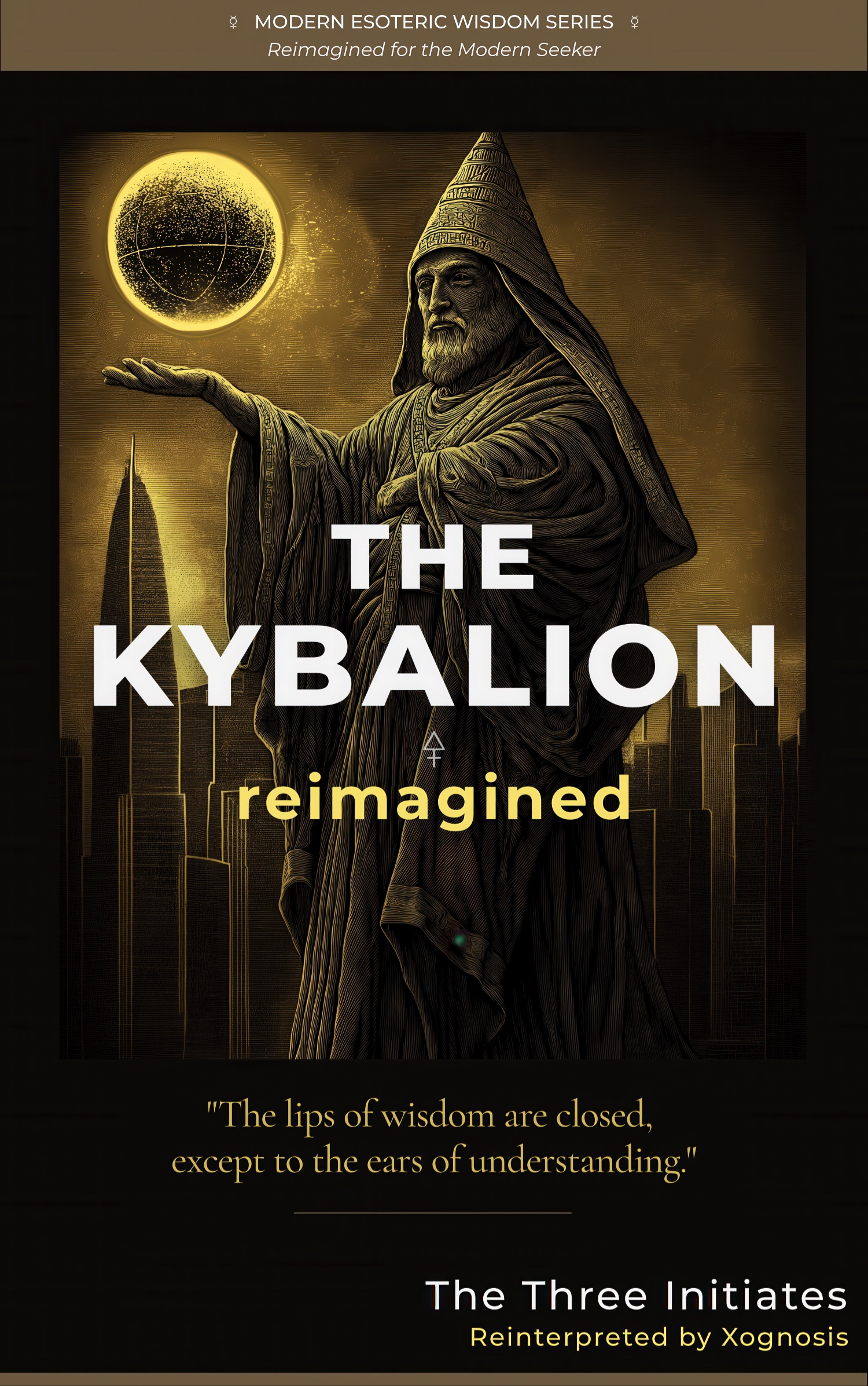
The Kybalion presents itself as the distilled wisdom of ancient Egypt and Greece, passed down from Hermes Trismegistus. That framing is legend. Modern scholarship tells a different story: the book was almost certainly written by William Walker Atkinson, an American New Thought writer, and published by Chicago's Yogi Publication Society in 1908. Even the word "Kybalion" itself appears to have no meaning in ancient Greek; researchers including Nicholas Chapel and Philip Deslippe have argued the title was likely invented to sound old. The principle of vibration, one of the book's seven axioms, has been traced not to Hermetic sources at all but to the eighteenth-century associationist philosopher David Hartley.
So the ancient lineage is the marketing. The product is something else, and the product is psychology. Read the actual text and the metaphysics keeps collapsing into self-help:
"An understanding of this great Hermetic Principle of Mentalism enables the individual to readily grasp the laws of the Mental Universe, and to apply the same to his well-being and advancement."
That sentence, from Chapter II, is the whole program in miniature. "THE ALL IS MIND; The Universe is Mental," the book declares, and then, having opened with the boldest possible metaphysical claim, it immediately turns the claim into a technique. The famous hermetic formula "As above, so below; as below, so above" is followed by maxims like "Nothing rests; everything moves; everything vibrates" and "Every Cause has its Effect; every Effect has its Cause," each paired with advice about how to use the principle in daily life. The book even names the practice: the very next chapter is titled "Mental Transmutation." The reader is not asked to worship hidden forces. The reader is asked to work on his own mind, with predictable, practical results. For a modern edition that sets the text in its actual historical context, see The Kybalion Reimagined.
Pyotr Demianovich Ouspensky was a journalist, a man who wrote for Moscow newspapers and had an appetite for the impossible. In 1912 he published Tertium Organum in Russian, a book whose subtitle announces "The Third Canon of Thought" and whose ambition is to stand after Aristotle's Organon and Bacon's Novum Organum. The claim was extravagant. The method was characteristically twentieth-century: Ouspensky argued that space and time are not ultimate realities, and he used the fourth dimension as a rigorous metaphor for aspects of experience our three-dimensional minds cannot properly represent.
What matters for our story is the direction of the argument. Mystical states, in much older esoteric literature, read as visitations: graces, possessions, ascents. In Ouspensky's hands they became a problem in perception, a limitation of the cognitive instrument that might, in principle, be corrected. The mystic's insight is treated as data about consciousness rather than testimony about the other world. When the English translation was published in New York in 1922 and became a bestseller, this psychological reading of esoteric experience reached the Anglophone public at scale.
On January 1, 1912, George Gurdjieff arrived in Moscow and began attracting his first students, among them the sculptor Sergey Merkurov. That arrival is one of the few hard facts in Gurdjieff's biography. His birth year is contested, ranging across scholarly sources from 1866 to 1877. His tales of travels to Central Asia, Egypt, Tibet, and a mysterious Sarmoung monastery come almost entirely from his own book Meetings with Remarkable Men, which researchers do not consider a reliable autobiography. The origin story is legend, told by the man himself. The teaching is another matter, because we can watch it work on students.
And the teaching, from the beginning, was psychological. Gurdjieff's central claim was that ordinary human beings live in a state of waking sleep, mechanical reaction masquerading as conscious life, and that a specific kind of inner work can wake them up. Ouspensky, who became his pupil in 1915 and later made the label "the Fourth Way" central to the teaching (Gurdjieff himself never used the phrase in his own writings), recorded the doctrine in memorable form: man lives his life in sleep, and in sleep he dies, as reported in Ouspensky's In Search of the Miraculous. The aim of the work, Gurdjieff told students in Paris decades later, was to have a constant sensation of oneself. The scaffoldings of esoteric cosmology were present, but the first instruction was always attention: self-observation, self-remembering, the deliberate division of attention so that one is aware of the world and of oneself perceiving it. A clear modern walkthrough of that system is The Fourth Way Explained.
The fourth event belongs to institutional psychology. In 1912 Carl Jung published Wandlungen und Symbole der Libido, which appeared in English in 1915 as Psychology of the Unconscious. The book treated mythological and religious imagery, the raw material of the old esoteric traditions, as structures of the psyche rather than errors to be corrected, and it cost him: his reading of libido as generalized psychic energy diverged from Freud's strictly sexual one, and in January 1913 the two agreed to part company.
Here a distinction is owed. That Jung engaged with mythology, gnosis, and symbolic systems in the 1912 book is historical fact. The claim that this was the moment esoteric content formally entered psychological literature is interpretation, a framing historians argue over. What is not in dispute is the door it opened: after Jung, the psychologist could legitimately study the same material the occultist had always studied, with a different vocabulary and institutional backing.
Is there a documented line from these texts to the breathing exercise on your phone? No, and any article claiming one should be read with suspicion. What can be said honestly is this. Contemporary researchers have noted that Gurdjieffian self-remembering is close to Buddhist notions of awareness and to popular definitions of mindfulness, and that the Pali term sati and the Sanskrit smṛti both carry the literal sense of remembering. That is an observed structural resemblance reported by scholars, not a proven genealogy.
But the resemblance is instructive all the same. The 1908-1912 generation recast esoteric practice as mental training: attention, observation of states, the assumption that the ordinary mind is asleep or mechanical and can be worked on deliberately. Strip away the cosmology, keep the exercise, and you have the template of the modern mindfulness app, which promises that a technique, practiced regularly, changes experience. The Kybalion promised mental transmutation for well-being and advancement. The app store promises reduced stress in ten minutes a day. The pitch has barely aged. Readers who want the deeper historical roots of the "hidden knowledge" framing those traditions drew on can start with Gnosticism Explained.
To say esotericism "became" psychology in these years is a framing, not a documented event, and it should be held lightly. The softer claim is fully supported: in 1908 and 1912, four influential works, by a New Thought writer publishing anonymously, a Russian journalist, a Caucasus mystic of uncertain age, and a Swiss psychiatrist, each recast esoteric ideas as operations of mind. Within a decade of the 1922 Tertium Organum bestseller, that recasting was ordinary. The temples had closed their doors, or rather, the doors had been relabeled, and behind them the work being done looked very much like practice.
Read the book
Related Articles
Continue through articles sharing this topic.
Every few decades, someone translates the esoteric classics again. New Enoches appear. New Pistis Sophias.
6 min read
Two texts, separated by something like two millennia and with no documented line of transmission between them, open with the same move.
6 min read
Every few years someone rediscovers the Kybalion and announces, with the confidence of a person quoting scripture, that it preserves the ancient wisdom of…
6 min read
In 1908 a small volume appeared in Chicago under the byline "Three Initiates." It claimed to transmit the secret doctrines of ancient Egypt, carried a…
6 min read