 Xognosis EsotericaArcane Publishing Studio
In the winter of 1770, a tall Scottish traveller stood at a marshy spring in the Ethiopian highlands called Gish Abay and, by his own account, obliged his guide to drink a toast.
Share
In the winter of 1770, a tall Scottish traveller stood at a marshy spring in the Ethiopian highlands called Gish Abay and, by his own account, obliged his guide to drink a toast. James Bruce had walked and ridden for two years through Egypt, the Red Sea coast, and the mountains of Tigray to reach what he believed was the source of the Nile. The toast was to "His Majesty King George III and a long line of princes", as his Travels records. But the prize that would outlive him was not the river. Tucked among the manuscripts he carried out of Abyssinia three years later were copies of a book that Europe had lost for a thousand years: the Book of Enoch.
First Enoch is an ancient Jewish writing, a composite of several works assembled around the last centuries before the Common Era. It tells of the Watchers, angels who descended to earth, taught forbidden arts to humankind, and fathered the giants named in Genesis; of Enoch's tours of heaven; and of a final judgement rendered in apocalyptic terms. Early Christian writers read it and quoted it. Then, in the Greek- and Latin-speaking churches, the full text quietly disappeared. By roughly 800, when the Byzantine chronicler George Syncellus preserved short Greek excerpts of Enoch in his Chronographia, the complete work had already slipped out of Western transmission. For medieval and early modern Europe, Enoch existed mostly as fragments and second-hand quotation.
Ethiopia was the exception. There the book had been translated into Ge'ez, the classical literary language of the Ethiopian Orthodox Church, and copied continuously for well over a millennium. Enoch was scripture that never stopped being read in the highlands, even as scholars in Paris and Oxford debated whether it had ever existed in full.
Bruce travelled in Egypt and Abyssinia from 1768 to 1773. He reached the imperial capital of Gondar on 14 February 1770, witnessed civil war and court politics, and in November 1770 visited the source of the Blue Nile at Gish Abay, the scene of the toast. He then traced the Blue Nile down to its confluence with the larger river. When he made his way back to Europe, arriving in France in March 1773 and in London in June 1774, his baggage included three copies of the Book of Enoch in Ge'ez. He presented one to Louis XV for the French royal library, the collection that later became the Bibliothèque nationale de France, and one to the Bodleian Library in Oxford. He kept the third for himself.
The common description of this as a rediscovery needs a caveat, and honesty demands it be stated plainly. Enoch was never unknown in fragments; Syncellus and other Greek witnesses had kept the memory of the book alive among scholars. What Bruce's copies made possible was something different: the recovery of the complete text, in the Ethiopic form in which it had survived, for European scholarship. And it is equally wrong to say he rescued the book from oblivion. Ethiopian churches had preserved it without interruption. His contribution was access, not salvation.
Access, however, did not come quickly. Bruce published his five-volume Travels to Discover the Source of the Nile in 1790, and Europe refused to believe a word of it. The stories of Abyssinian court life, the geography, the sheer scale of the journey: readers found it all too much, and the book was widely disbelieved. The standard biographical account has Bruce "offended by the incredulity with which his story was received", and he retired to his estate at Kinnaird. Later exploration showed his account to be substantially accurate, but that vindication came too late to comfort him. The Enoch manuscripts sat in Oxford, unread by anyone able to work with them.
The man who finally opened the book for English readers was Richard Laurence, Regius Professor of Hebrew at Oxford and later Archbishop of Cashel. In 1821 he published The Book of Enoch the Prophet, the first English translation, described in the standard account as produced "from a manuscript in the Bodleian Library brought from Abyssinia by James Bruce". Laurence's work carried a further significance: he is credited with having "revived the study of Ethiopic, which had been neglected in England since the time of Walton". The language Bruce's haul had made available needed someone to learn it, and Laurence was that someone.
His translation landed in a Europe already primed for it. Romantic scholarship, growing interest in apocryphal literature, and the first stirrings of scientific biblical criticism meant Enoch found readers immediately. For the first time since late antiquity, the full Watchers narrative, the astronomical chapters, the parables, and the dream visions were available in English. Exactly which Bodleian manuscript Laurence worked from is a question for library catalogues rather than narrative histories: the Bruce deposits include a sixteenth-century copy now shelved as MS. Bruce 74, and no exact identification should be asserted without checking the shelfmarks.
The nineteenth century brought more Ethiopic manuscripts to Europe, and with them the need for a proper critical edition. That work fell to R. H. Charles, the Irish scholar who made Enoch his life's study. His edition of the Ethiopic text appeared at Oxford in 1893, followed in 1906 by The Ethiopic Version of the Book of Enoch, a full critical edition collating the manuscripts then known. In 1912 he published the English translation most modern readers first encountered, rendered from his own edited Ethiopic text. The chain runs unbroken: Ethiopian scribes, Bruce's mules and chests, a Bodleian shelf, Laurence's Ge'ez, and finally Charles's critical apparatus. Charles's translation fixed the shape in which 1 Enoch is read today, and it remains a standard reference alongside more recent editions.
Bruce did not discover the Book of Enoch, and he did not save it. Ethiopian churches had kept it alive in Ge'ez for over a thousand years while Europe held only fragments. What his three copies did was carry a complete, continuously transmitted text back into the hands of scholars, and within fifty years that text reshaped how the origins of Jewish apocalyptic literature were understood.
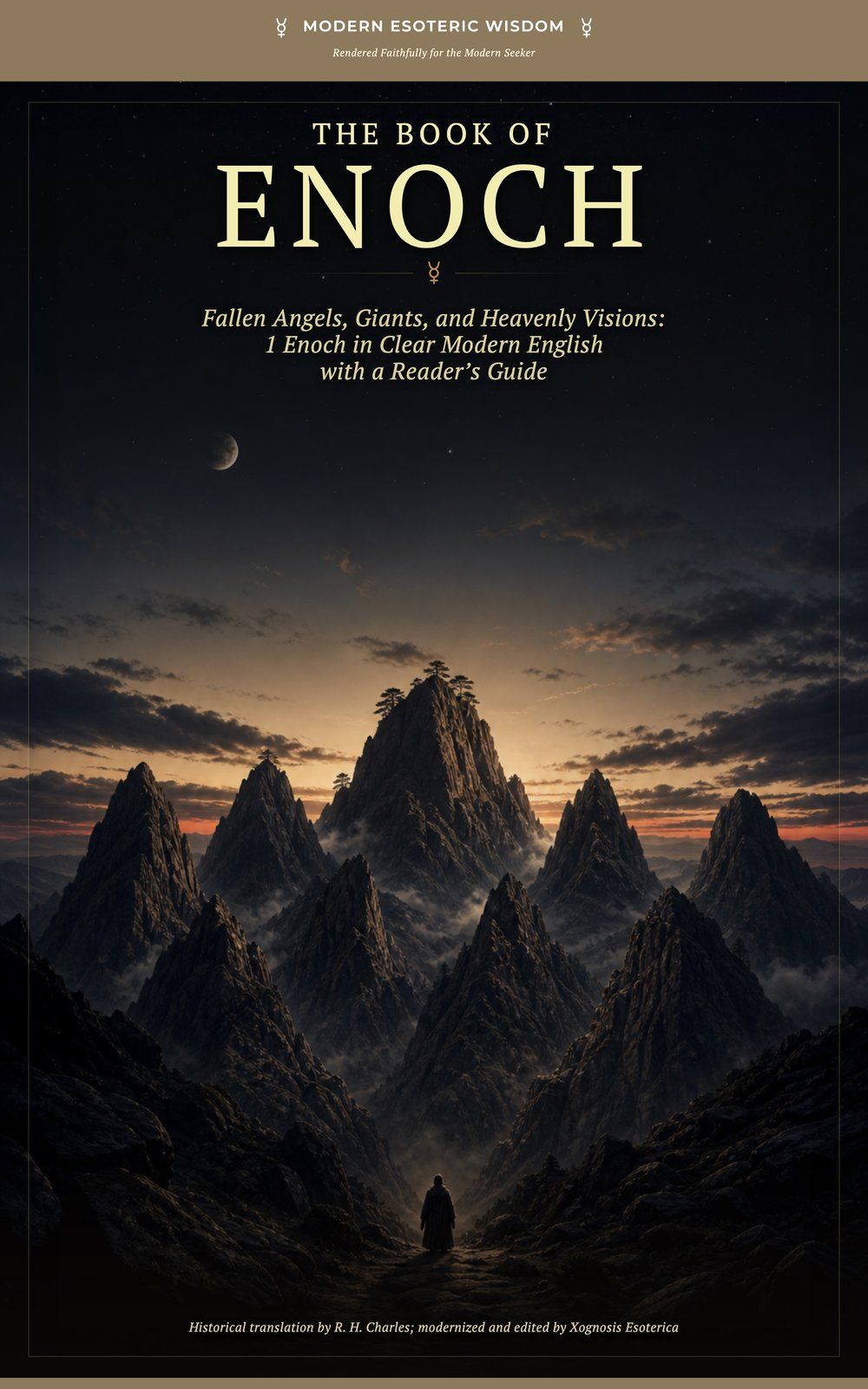
Readers who want to meet the text itself can do so in our edition of the Book of Enoch, which follows the lineage of translations that Bruce's manuscripts made possible.
The skeleton of this account is documented fact: the dates of Bruce's travels, the three copies, their destinations, the 1821 and 1912 publications. Around that skeleton, legend has grown. Anecdotes about famous figures mocking Bruce to his face circulate, but the specific jeers were not verified for this article and are left out here. The toast at the Nile source rests on Bruce's own Travels, a source with an interest in a good scene. And the framing that matters most is the one stated above: Enoch's survival belongs to Ethiopia. Bruce, Laurence, and Charles are the couriers and interpreters of that survival, and the history is generous enough to give each of them a real role without inflating any of them into a saviour.
Read the book
Related Articles
Continue through articles sharing this topic.
Prague, 27 March 1587. Two English alchemists stand summoned before a bishop of the Church, accused of necromancy, in a city where the Emperor keeps…
6 min read
In September 1583 a Polish aristocrat slipped out of England after four months of banquets, borrowed money, and conversations with angels.
7 min read
In the spring of 1587, in a castle town in Bohemia, two Englishmen and their wives signed a document they believed God himself had demanded. The men were Dr.
6 min read
On the evening of 17 April 1584, in a rented house on Szczepańska Street in Cracow, Edward Kelley stood up in the middle of a session, told John Dee that…
7 min read