 Xognosis EsotericaArcane Publishing Studio
Prague, 27 March 1587. Two English alchemists stand summoned before a bishop of the Church, accused of necromancy, in a city where the Emperor keeps astrologers on salary and defenestration is a recognized form of argument.
Share
Prague, 27 March 1587. Two English alchemists stand summoned before a bishop of the Church, accused of necromancy, in a city where the Emperor keeps astrologers on salary and defenestration is a recognized form of argument. The man facing their answers is Germanico Malaspina, bishop of San Severo and papal nuncio, the Pope's own eyes at the court of Rudolf II. The one who talks back is Edward Kelley, scryer and partner to Dr. John Dee, and the spirits he claims to see in a black obsidian mirror have by now drawn the attention of two rival powers. When we imagine angelic conversations, we picture candles and a quiet room. What the historical record shows is something stranger: a séance with a seat at the table of European politics.
To understand how the angels got mixed up in diplomacy, start with the Emperor. Rudolf II moved the imperial court to Prague in 1583, and under him the city became the capital of exactly the sciences we now file under "esoterica." As the standard summary of his reign puts it, "astrology and alchemy were regarded as mainstream scientific fields in Renaissance Prague," and Rudolf "spared no expense in bringing Europe's best alchemists to court." Among the names that court attracted: Edward Kelley and John Dee.
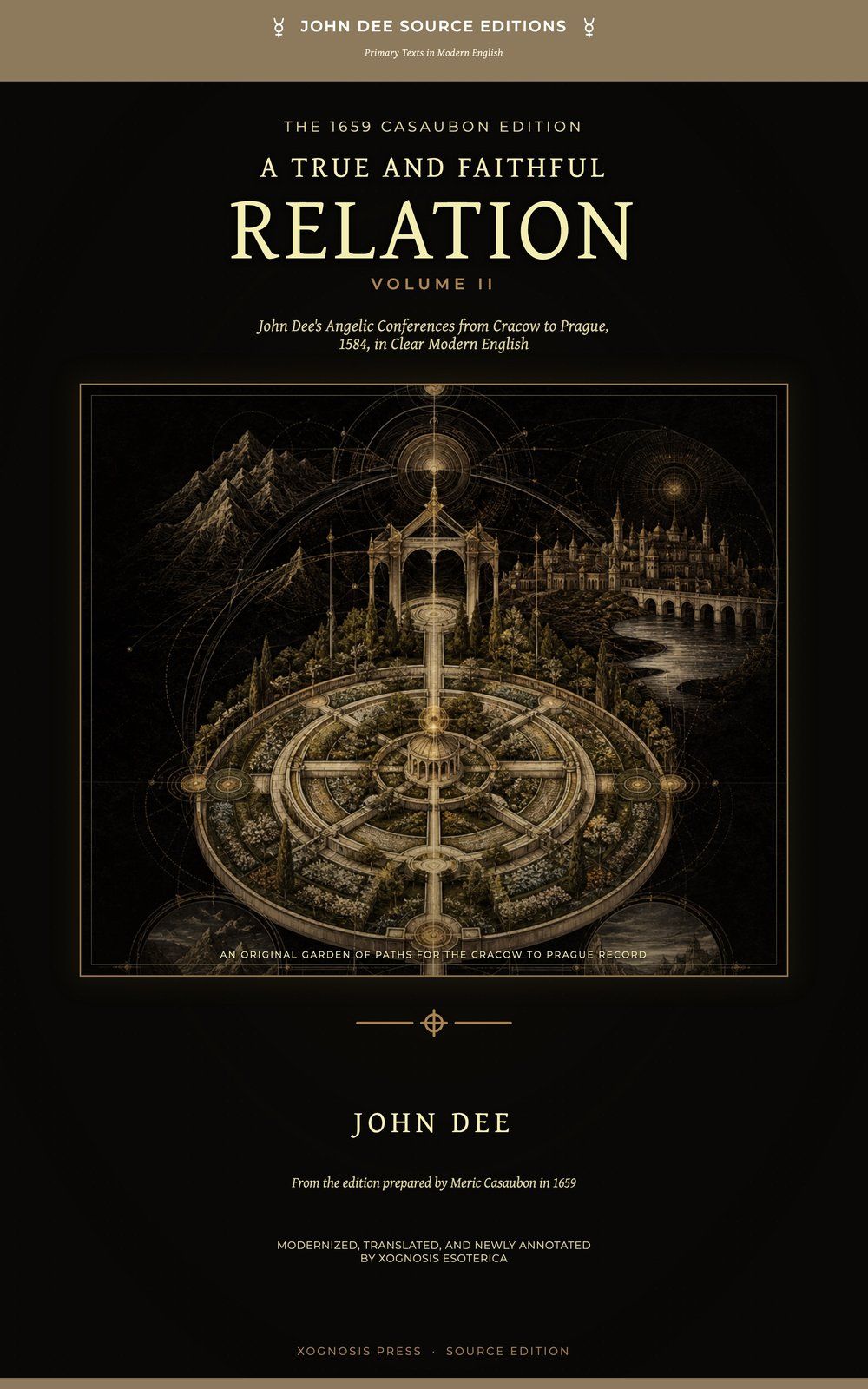
This was not fringe patronage. A ruler who read the heavens for guidance needed men who could read them for him. And Rudolf's court sat in a fissure of the age: the Emperor practiced a religious tolerance that extended toward Protestants and Jews, while Counter-Reformation agents, Malaspina among them, worked the court and produced, in the words of one account, a "political chaos" that "threatened to provoke civil war." Into that fissure walked Dee and Kelley in 1584, fresh from Cracow and an audience with King Stephen Bathory of Poland. The journey there, beginning with Dee's departure from England in the company of the Polish lord Albert Laski in 1583, is documented in the action records themselves, which Volume II of our edition of A True and Faithful Relation carries from Cracow on 10 April 1584 to Dee's entry into Prague on 8 October of that year.
Before the angels ever spoke of emperors, the man recording their words was already suspected of trading in secrets. Dee was, in the words of one biographical summary, "mistrusted for his connection with the English monarch, Elizabeth I, for whom some thought Dee was a spy." The suspicion followed him across the Continent. From Central Europe he wrote a covert letter to Francis Walsingham, Elizabeth's spymaster, that survives: "I am forced to be brief... That which England suspected was also here."
Here the honest historian has to draw a line. Dee's movements, his audiences with Rudolf II in Prague Castle and with Bathory, and his letter to Walsingham are documented facts. What they add up to is contested. Intelligence work, patronage hunting, and sincere religious mission were not mutually exclusive categories in the sixteenth century, and scholars still argue over which mixture Dee represented. The diaries do not settle the question, because the diaries are themselves the puzzle: a record of angelic speeches made by a man whose judgment everyone had reason to question or cultivate.
And yet the content of the conversations is what makes the political reading hard to dismiss. Across the Prague and Trebon years, the angels did not confine themselves to metaphysics. They commented on imperial and papal politics, warned and encouraged, and made what can only be called interventions in the household's worldly strategy. Dee and Kelley found patronage with William of Rosenberg in 1586 and settled at his estate in Trebon; the angelic conferences continued alongside, and sometimes entangled with, these arrangements. The publisher's own summary of the later records, Volume III of A True and Faithful Relation, describes their contents as including "political appeals, religious controversy," and the dating bears this out: the volume runs from 1585 to 1607 across Prague, Trebon, Krakow, and London, which places the Malaspina crisis of March 1587 squarely inside its pages.
That crisis deserves its own telling. Summoned before the nuncio over accusations of necromancy, both men required to defend themselves, Kelley did not grovel. He criticized what one account renders as the "poor conduct of many of the priests," and the criticism so infuriated Malaspina that, according to the same account, "he was tempted to toss Kelley out of the window." The anecdote has a sourced but colorful flavor, and defenestration was, notoriously, a Prague tradition. Treat it as a reported episode rather than established fact. What is not in dispute is the structure around it: the papal establishment treating the angels as a matter worth an official hearing, which is itself a kind of testimony. Rome did not send a nuncio to investigate things it considered trivial.
The political story has a bitter second act. In 1587, in Bohemia, came the revelation attributed to the angel Uriel that the two household couples should share their wives. Dee broke off the conferences soon after; whether the angels were a channel of intelligence or a lever of manipulation, that lever now visibly moved against the man who held it. Kelley, meanwhile, ascended the worldly ladder even as Dee's collapsed. Rudolf II knighted him on 23 February 1590 (some accounts say 1589) as "Sir Edward Kelley of Imany and New Lüben." The knighthood is documented fact, and it says something sobering: an Emperor paid honors to a scryer. Then the fall. Arrest in May 1591, imprisonment at Krivoklat, release in 1595, re-imprisonment at Hnevin at Most, and death in 1597 or 1598. The sources themselves disagree on the manner: during an escape attempt, or by poisoning. Both versions circulate; neither can be stated flatly.
Dee outlived the reckoning and returned to England and Mortlake, where the diaries survived through the collections of Sir Robert Cotton until Meric Casaubon published them in 1659. That publication fixed, for centuries, the image of Dee as the dupe and Kelley as the fraud. The image conveniently omits the courts, the nuncios, the Emperor, the spymaster. Fools do not usually get hearings before bishops.
Where does this leave the "politics inside the actions"? Three layers should be kept distinct. First, the documented events: the Central European sojourn, the audiences, Rosenberg's patronage, the knighthood, the imprisonment, the 1659 publication. Second, the textual interpretation: reading the angels as a channel through which political intelligence and worldly advice moved is an argument about what the records show, and a defensible one, but it is an interpretation, and Dee's own motives remain genuinely disputed. Third, legend: the window-tossing temper of Malaspina, the disputed death, the folklore that later grew around Rudolf's Prague. Each layer rewards a different kind of attention, and each contaminates the others when blurred.
One caution belongs on the record. The verification behind this article rests on tertiary summaries rather than the primary 1659 text itself; direct quotation from Casaubon's edition awaits a checked scan, and the Malaspina hearing date comes through a single tertiary chain. Scholarly monographs (Glyn Parry's study of Dee, Deborah Harkness on the angel conversations, R. J. W. Evans on Rudolf's world) are the right next stop for anyone who wants the footnoted version.
The angels of the action records never floated free of the world. They spoke into a court where Emperors funded alchemists, popes sent investigators, and spymasters read the mail, and the men who transcribed them moved through all three currents at once. Read the politics out of the record and the angels turn vaporous; read it back in, and the séance becomes one of the great front offices of sixteenth-century intrigue.
Read the book
Related Articles
Continue through articles sharing this topic.
Two books sit at the far ends of the esoteric shelf, and they answer the same question in opposite ways.
6 min read
In the summer of 1552, two of the most restless minds in Europe were, as far as anyone can tell, in the same city at the same time.
6 min read
Open a modern edition of A True and Faithful Relation and you meet a problem before you meet a single angel.
7 min read
Open a page of John Dee's Monas Hieroglyphica at random and you see a strange object: a single compound sign, part astronomical, part alchemical, drawn once…
6 min read