 Xognosis EsotericaArcane Publishing Studio
The most famous demons in Western tradition got their names from a filing system. When the Book of Watchers, the opening section of 1 Enoch, wanted to explain how evil entered the world, it sent two hundred angels down onto Mount Hermon and then did something the Bible never does: it named them.

Share
The most famous demons in Western tradition got their names from a filing system. When the Book of Watchers, the opening section of 1 Enoch, wanted to explain how evil entered the world, it sent two hundred angels down onto Mount Hermon and then did something the Bible never does: it named them. Twenty names, leader first, in ranked order. Readers of the Ethiopic text, which is how most people meet 1 Enoch, know these figures as Semjaza and Azazel. The Aramaic fragments dug out of Qumran Cave 4 tell a slightly different story, and it is a story about names, copying, and how a scapegoat became a demon king.
Start with what the biblical text actually says. Genesis 6 is terse: "That the sons of God saw the daughters of men that they were fair; and they took them wives of all which they chose." Their children become "mighty men which were of old, men of renown." No angel is named. No mountain is named. The passage gives the plot in a few sentences and leaves the cast anonymous.
Centuries earlier in the textual record, Leviticus 16 does carry the name Azazel, but in a different setting entirely. In the scapegoat rite, Aaron casts lots over two goats: "one lot for the LORD, and the other lot for the scapegoat." The King James rendering "scapegoat" stands where the Hebrew text has the name Azazel. Whatever Azazel originally designated in that ritual, and scholars still debate it, Leviticus gives it no biography, no sin, and no fall.
The Book of Watchers, composed in the third century BCE by the standard scholarly dating, and possibly earlier, took those spare verses and built a tragedy with a speaking cast. Eleven Aramaic manuscripts of 1 Enoch came out of the Qumran caves, paleographically dated from roughly 200 BCE down to about 1 BCE, and four of them were copied before the settlement at Qumran itself was built.
In September 1952, as J. T. Milik tells it, he "was thrilled to identify the first Aramaic fragment of Enoch" among a mass of tiny pieces the Bedouin had unearthed. His 1976 edition of the Cave 4 material showed that about half of the Book of Watchers survives in Aramaic, including the name list of chapter 6. Three copies witness the list: 4Q201, the oldest Enoch manuscript known, 4Q202, and 4Q203.
Milik's reconstructed reading of the list in 4Q201 runs: "And these are [the names of their leaders]: Semihazah who [was their chief; Ar'teqo]ph, the second to him; Ramt'el, [third] to him; Kokab'el, [fourth to him; -'el], fifth to him; Ra'mi'el, [sixth to him]..." The list runs on in ordinals to twenty. The fragments bear the structure physically: each angel is numbered, "fifth to him," "tenth to him," after Semihazah. One name, the fifth, remains unrestored. That is the only gap Milik acknowledged among the twenty.
The names themselves are theologically loaded but meteorologically ordinary. Milik read them as built from weather, stars, and places: Kokab'el, which he glossed as "Star of God"; Baraq'el, "Lightning of God"; Matar'el, "Rain of God"; 'Anan'el, "Cloud of God"; Setaw'el, "Winter of God". These glosses are Milik's, printed in his table of the chiefs of tens, and other etymologies circulate in the literature. Two names he singled out as especially pointed. The eleventh, Hermoni, "takes his name from mount Hermon," the very summit the story says they descended upon. And Dani'el is, in Milik's reading, the Canaanite hero Dan'el whose wisdom is sung in Ugaritic poems.
The teaching list in chapter 8 matches names to subjects with mechanical neatness. Milik noticed the design: the star-angel teaches stars, the lightning-angel teaches lightning-signs, the sun-angel teaches the sun. His summary of the scheme is worth quoting: "(1) theophoric proper name, (2) phrase 'taught the signs of'... (3) first component term of the theophoric name, taken up just as it is or put into the absolute plural". The catalogue is almost a curriculum written into the roster.
Milik also argued, and this is his reconstruction rather than a fact on the page, that the story runs on two chiefs. "The writer imagines two chiefs of the fallen angels, a king (Semihazah) and a sage ('Asa'el), each presiding over about ten Watchers," he wrote, drawing on what he saw as a Babylonian model of antediluvian kings and sages. Semihazah leads the descent and swears the oath; Asa'el leads the corruption. In the Ethiopic text of chapter 6, Semjaza voices the fear that drives the pact: "I fear ye will not indeed agree to do this deed, and I alone shall have to pay the penalty of a great sin."
The guilt is not shared evenly. When the archangels bring the accusation in chapter 9, they name only two culprits: "Thou seest what Azazel hath done, who hath taught all unrighteousness on earth" and "Semjaza, to whom Thou hast given authority to bear rule over his associates." The punishments come in pairs. Raphael binds Azazel and casts him into the desert of Dudael; Michael binds Semjaza and his associates. And the sentence on Azazel carries the heaviest line in the book: "the whole earth has been corrupted through the works that were taught by Azazel: to him ascribe all sin."
Here the manuscript evidence tightens the story. In the Aramaic fragments, the tenth angel is Asa'el, "God has made" in Milik's gloss. Milik argued that the Greek witnesses of the Book of Watchers also transmit this form, writing that the tenth angel there "is certainly 'Asa'el... and not 'Azaz'el as is generally assumed". On his reading, the Ethiopic chapters 8 through 10 substituted the better-known ritual name from Leviticus, Azazel, for the fallen sage.
Whether one fully accepts Milik's argument, which he himself framed against the general assumption, the drift is documented. A Qumran Hebrew pesher, 4Q180, from around the turn of the era, already uses the Azaz'el form for the chief of the fallen angels. Milik described the later tradition plainly: "Later 'Azaz'el will supplant Semihazah, or else 'Asa'el... in his capacity as chief of the fallen angels." The scapegoat of Leviticus had absorbed the star-teaching sage of Enoch, and that fused figure went on to a long career in later Jewish and Christian demonology. That is reception history, layered over the older texts, and it should be kept distinct from what the Aramaic actually says.
There is a caution running alongside all of this. What most readers hold is the Ethiopic text, a translation of a translation, and the earliest complete Ethiopic manuscripts date only to the fourteenth century. As Loren Stuckenbruck put it, "although descended from a Second Temple Period tradition, the Ethiopic version of Enoch is not in itself a Second Temple Period text."
The demons did not arrive with their names attached. The Aramaic fragments show a ranked roster of weather and star spirits led by Semihazah and Asa'el; the Azazel who dominates later demonology is a name that won the copying war.
One appendix belongs here, because the Qumran caves hold it. The Book of Giants, an Enochic companion work that survives only in fragments, names the giant offspring as well as the angels. The two giant sons of Semihazah are Ohyah and Hahyah. In one dream scene, the fragments read: "they came to [Semihazah, their father, and told him] their dreams". Their names survive, slightly modified, in Manichaean fragments in Iranian languages, copied centuries later in a tradition far from the Dead Sea.
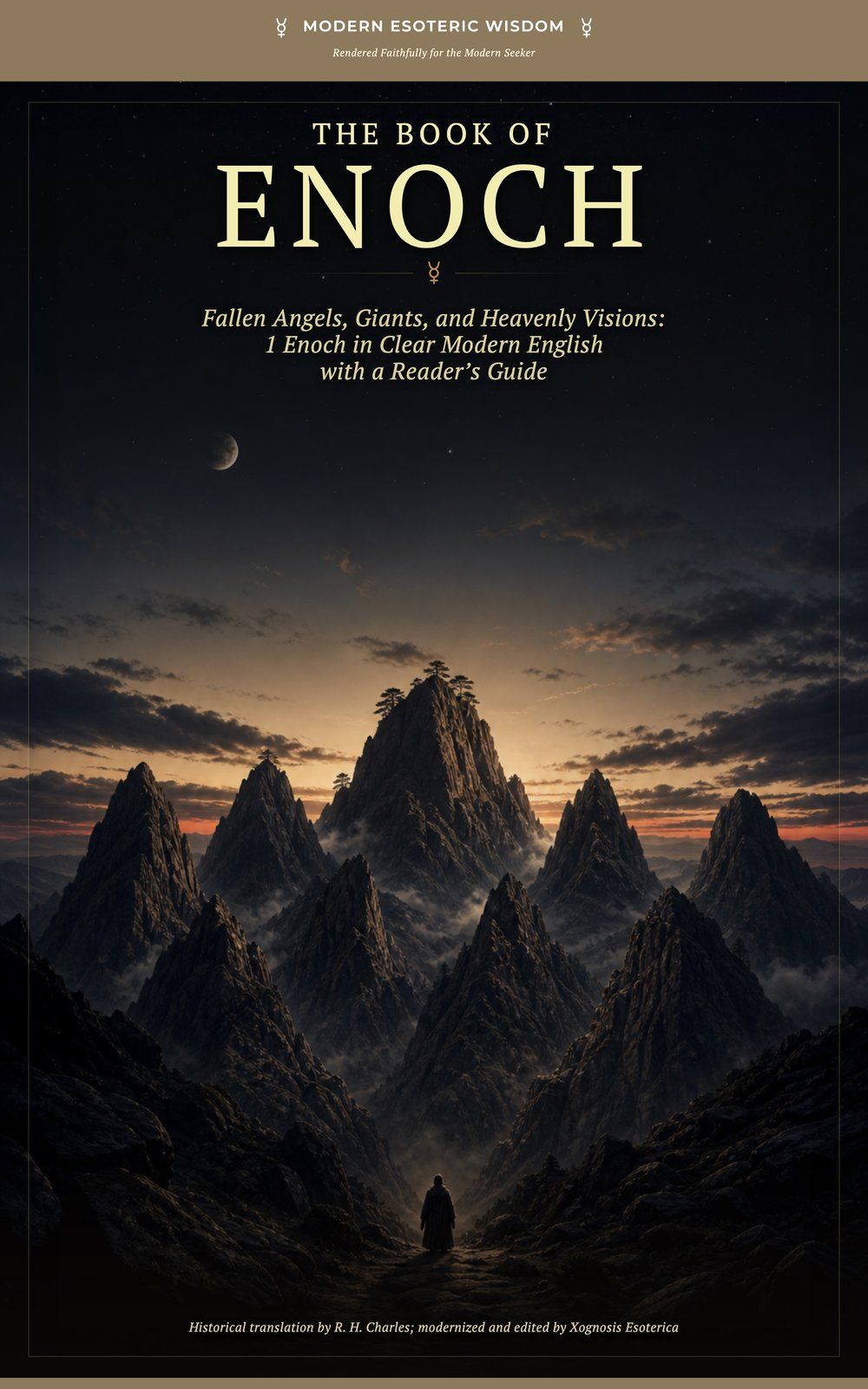
So the next time a demon's name sounds ancient and inevitable, remember where it came from: a list, numbered in ordinals, scratched onto leather by a scribe whose copy is now shards. Our own edition of The Book of Enoch works through these chapters in clear modern English with a reader's guide, for anyone who wants to follow the names from Hermon to Dudael themselves.
Read the book
Related Articles
Continue through articles sharing this topic.
Prague, 27 March 1587. Two English alchemists stand summoned before a bishop of the Church, accused of necromancy, in a city where the Emperor keeps…
6 min read
In September 1583 a Polish aristocrat slipped out of England after four months of banquets, borrowed money, and conversations with angels.
7 min read
In the winter of 1770, a tall Scottish traveller stood at a marshy spring in the Ethiopian highlands called Gish Abay and, by his own account, obliged his…
6 min read
In the spring of 1587, in a castle town in Bohemia, two Englishmen and their wives signed a document they believed God himself had demanded. The men were Dr.
6 min read