 Xognosis EsotericaArcane Publishing Studio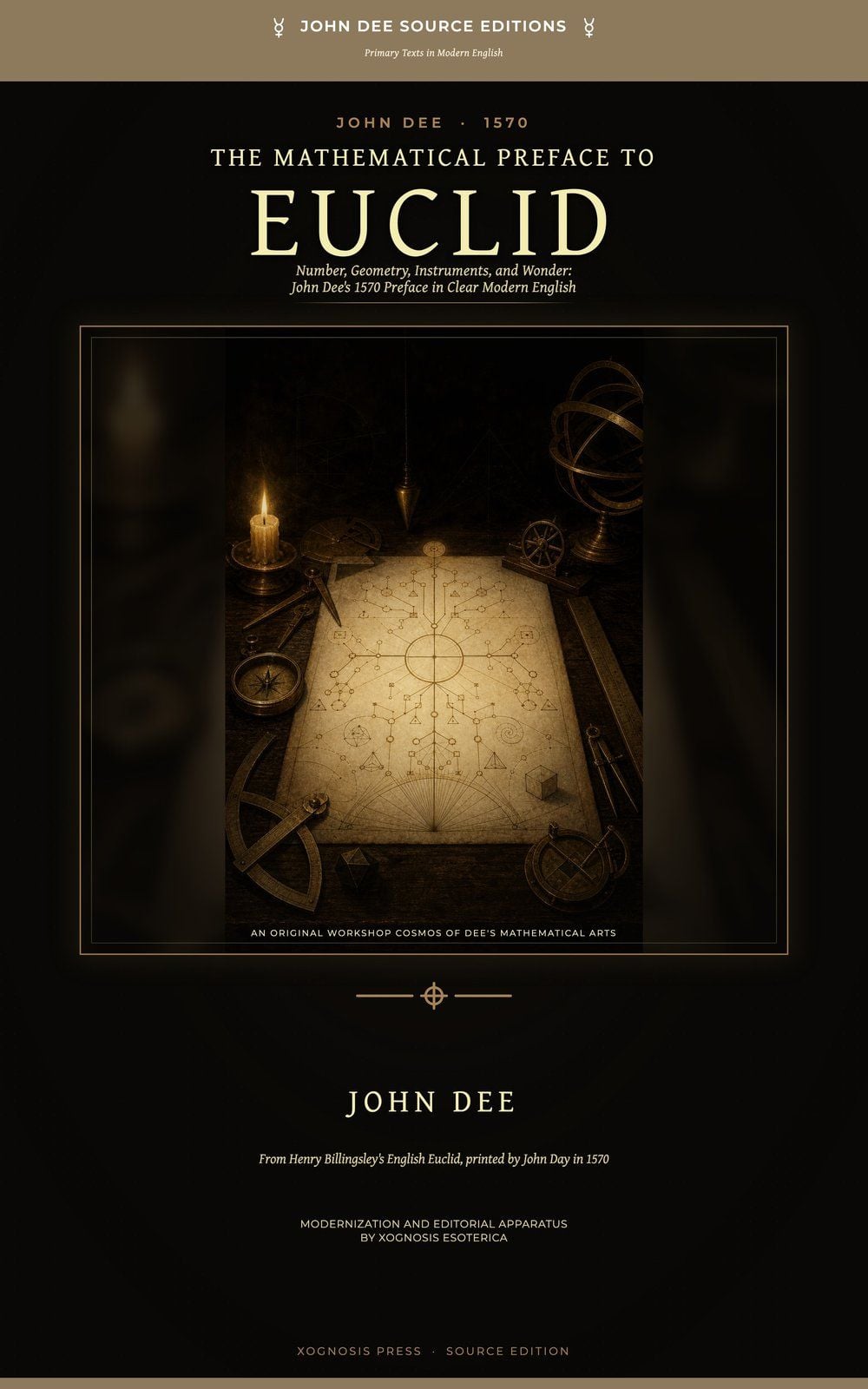
Number, Geometry, Instruments, and Wonder: John Dee's 1570 Preface in Clear Modern English
A complete modern-English Source Reading Edition of John Dee's 1570 Mathematical Preface and appended Groundplat, preserving source order and consequential terminology while adding historical orientation, disclosed witness restorations, an original visual reconstruction, a searchable 72-node hierarchy, glossary, bibliography, and index.
Synopsis
John Dee's 1570 Mathematicall Praeface introduced English readers to a vision of mathematics far broader than calculation alone. Written for Henry Billingsley's first complete English translation of Euclid's Elements and printed in London by John Day, it begins with the status of mathematical objects, moves through number and magnitude, and branches into a wide-ranging catalogue of arts. Optics, astronomy, music, surveying, mechanics, medicine, architecture, navigation, image making, artificial marvels, and Archemastrie all enter Dee's order of knowledge. This edition offers a complete modern-English reading of the Preface and its appended Groundplat. Spelling, punctuation, and difficult syntax have been modernized with documentary restraint. Dee's source order, technical claims, examples, qualifications, and historically consequential terminology remain visible. Statements about astrology, medicine, prophecy, marvels, and national policy are presented as parts of a sixteenth-century argument, with context that neither endorses them as current fact nor dismisses their historical importance. What this edition includes: - Editorial orientation. A concise introduction to Dee, Billingsley, John Day, the 1570 English Euclid, and the intellectual setting in which practical mathematics, Renaissance Platonism, theology, craft, and learned magic could meet. - Selective reader notes. Notes appear only when a source recovery, safety issue, historical category, or material reconstruction would otherwise invite misunderstanding. - The Groundplat, two ways. Originally printed as a large folding tree, it receives two complementary treatments: an original path-only reconstruction for a visual overview, and a complete searchable 72-node hierarchy that preserves every branch in accessible text. - Reference apparatus. A glossary, bibliography, and detailed index support further study. Documented sources. The text is based on the CC0 EEBO Text Creation Partnership transcription A00429. Project Gutenberg ebook 22062 is used only as a named collation aid at explicit gaps in that controlling witness. Substantial restorations are disclosed, and no EEBO page images are reproduced. For readers of Renaissance intellectual history, the history of science, Western esotericism, early modern technology, and the changing boundaries among mathematics, natural philosophy, craft, and wonder. Read this edition to follow Dee's ambitious order of knowledge from its first principles to its practical and marvellous arts.
From the blog
Journal articles that draw on this volume.
Open a copy of the 1570 English Euclid to the propositions on solid geometry and the page rises to meet you.
6 min read
In February 1570 a foldout sheet left John Day's London press tucked inside the first English translation of Euclid's Elements.
7 min read
In 1570, at the back of a book about triangles, one of England's greatest mathematicians paused to defend himself against the suspicion that he was a…
6 min read
Related essays
No essays share this tag yet — editorial will curate them soon.
Related art
Art references appear when gallery entries align with this book's tags.
Related labs
No related content available yet.