 Xognosis EsotericaArcane Publishing Studio
Open a copy of the 1570 English Euclid to the propositions on solid geometry and the page rises to meet you. Pasted among the printed diagrams are flaps of paper that lift into three-dimensional solids standing off the leaf they are glued to. Fold them flat again and the book closes like any other.
Share
Open a copy of the 1570 English Euclid to the propositions on solid geometry and the page rises to meet you. Pasted among the printed diagrams are flaps of paper that lift into three-dimensional solids standing off the leaf they are glued to. Fold them flat again and the book closes like any other. It is a strange sensation the first time, and the instinct to call it a toy is wrong by several centuries. This is a geometry textbook, the first English translation of Euclid's Elements ever printed, and it carries the earliest known fold-up paper models bound into a printed book.
The translator was Henry Billingsley, a London merchant who would later become sheriff and then Lord Mayor. The printer was John Day. The year was 1570, and the book appeared under the full thunder of its period title: The Elements of Geometrie of the Most Auncient Philosopher Euclide of Megara. The Linda Hall Library, which holds a copy, describes it simply as "the first English translation of Euclid, which he called Elements of Geometrie," and notes that the book is "famous mostly because of the pop-up geometrical figures that are spread throughout Book 11, on solid geometry."
Book XI is where Euclid leaves the flat page behind. Its propositions concern planes at angles to one another, solids, their volumes and intersections. A reader can work through the first ten books with a diagram drawn in ink, because a triangle drawn on paper is a triangle. A tetrahedron drawn on paper is a drawing of a tetrahedron, and the distinction starts to matter. Somewhere in the production of this edition, someone decided that the gap between drawing and solid should be closed physically. The diagrams for Book XI's propositions were cut, folded, and pasted so that lifting the flaps raises the figure into the third dimension.
The University of Oklahoma's History of Science Collections holds a copy that, in the words of its exhibit page, "retains the original pop-ups," a phrasing that carries a quiet warning. Many surviving copies have lost their flaps to centuries of handling, and copies that retain the solids intact are rare enough to be remarked on. What survives in the OU copy is a working instrument, paste-and-paper apparatus attached to a proposition, so the reader can hold the proof in a hand.
There is also the question of who the book was for. The OU exhibit frames the translation as carrying "pedagogical aids for young tradesmen who knew no Latin." That is an interpretation of intent, a reading of the book's audience rather than a documented statement by Billingsley, but it is a persuasive one. An English Euclid made geometric reasoning available to readers outside the universities and the clergy, the people who needed to gauge casks, lay out fortifications, and navigate by the stars. For a reader meeting solid geometry without a Latin school behind him, a model that stands up off the page is a genuine aid, and the vernacular text and the paper solids belong to the same project.
Then there is the translator himself, and here fact and legend begin to blur in a documented way. Billingsley was by trade a merchant, an amateur linguist by inclination, and eventually one of the chief officers of the City of London. As the Linda Hall essay puts it, "Since mayors of London have seldom been scholars, it has usually been assumed either that Dee did the translation, or that Billingsley had considerable help from a real scholar." The Dee in question is John Dee, the mathematician, navigator, and practitioner of the occult sciences, who contributed the book's long Mathematical Preface and has attracted credit for the translation ever since.
The legend has a surface plausibility. Dee had a formidable mathematical mind; Billingsley was a merchant who rose through the city's government. But the documentary trail points the other way. In 1879 the American mathematician George Bruce Halsted, then a tutor at Princeton, examined a surviving copy of the 1533 Basel printed Greek text of Euclid in the Princeton library and reported his findings in the American Journal of Mathematics. That copy, in the Linda Hall account, carries "copious annotations and corrections in Greek in the same neat hand that is clearly Billingsley's." The merchant had worked through the Greek original himself, correcting as he went. R. C. Archibald revisited the question of the translation's sources in a much-cited 1950 study. The legend of Dee the hidden translator survives because it makes a tidier story than the truth, which is that a London tradesman with a gift for languages did the work and the famous scholar wrote the front matter.
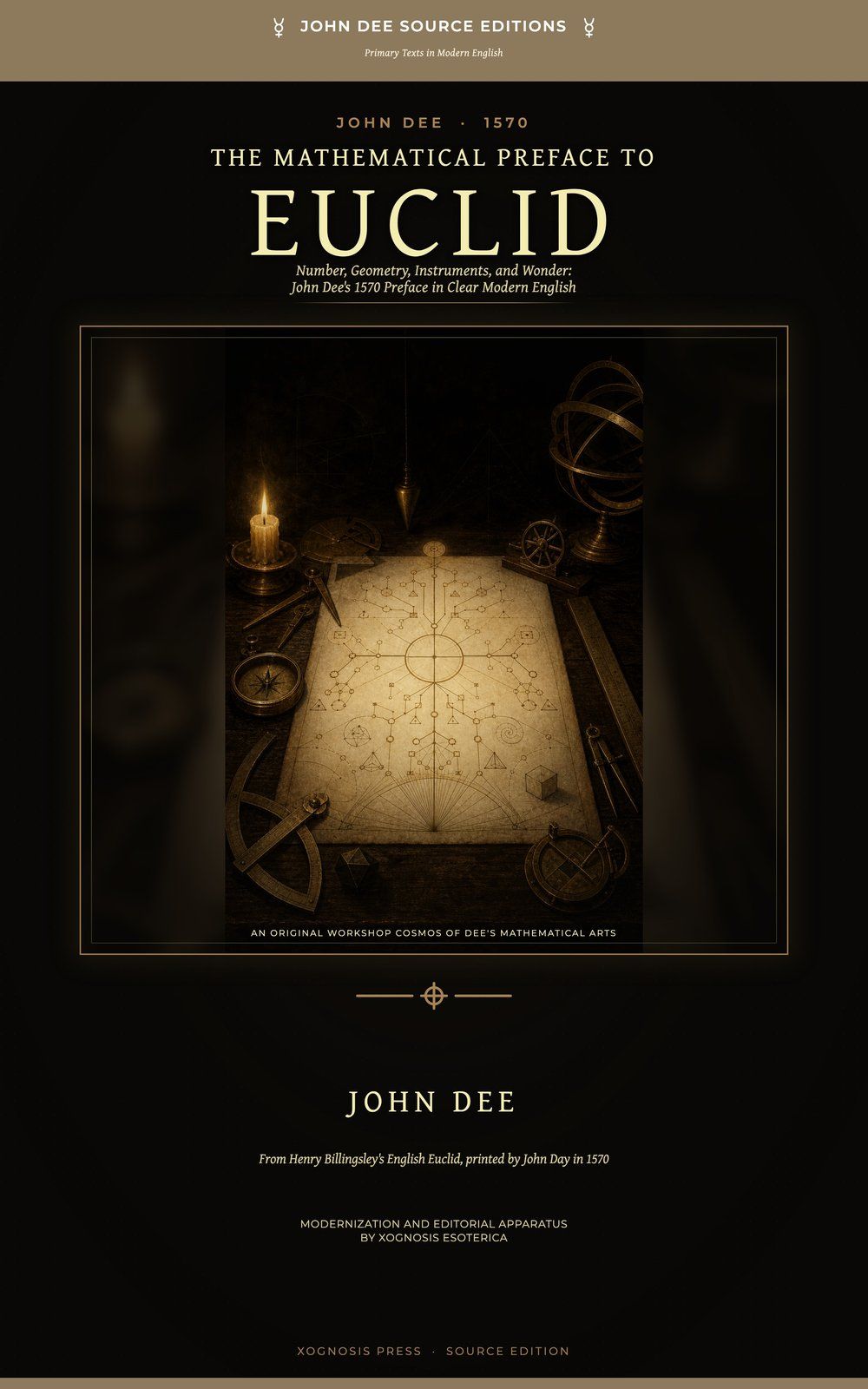
Dee's preface deserves attention of its own. It surveys the sciences and their uses, arguing for mathematics as the key to everything from architecture to astrology. Xognosis publishes this distinctive piece of Elizabethan mathematical culture as a standalone volume, The Mathematical Preface to Euclid, for readers who want the document in full.
A claim this good deserves to be checked, and it does not fully survive the check. Movable paper devices are older than printing: volvelles, the rotating paper discs used in medieval astronomy and divination manuscripts, go back centuries before 1570. If "pop-up" means any interactive paper mechanism in a book, Billingsley's Euclid was not first.
What it does hold is narrower and more interesting. It is the earliest known printed book with cut-and-fold paper models pasted onto its pages so that flat diagrams rise into three-dimensional solids, and it put that mechanism in the service of the most austere textbook in the Western tradition. The toy-like form and the rigor of the content are not in tension. Both belong to the same ambition, which was to make abstract structure stand up where a reader could see it.
The first English Euclid, printed in 1570, pasted fold-up paper solids onto the propositions of Book XI, making it the earliest known printed book with three-dimensional paper models built into its pages. The flaps were pedagogy, not decoration: geometry you could lift with a fingertip.
Billingsley died on 22 November 1606, having lived the double life the legend could not quite absorb: merchant and Lord Mayor on one side, careful Greek scholar on the other. The paper solids survive in a scatter of libraries, fragile and mostly lost elsewhere, which is the fate of anything built to be handled. That some copies keep them at all is the kind of luck a book like this earns only occasionally.
Read the book
Related Articles
Continue through articles sharing this topic.
There is a story about alchemy that almost everyone knows. For centuries, so it goes, clever men wasted their lives stirring molten metals and muttering…
6 min read
Ask most people who Jabir ibn Hayyan was and you will get a biography with the confidence of an encyclopedia entry: born at Tus in 721, son of a druggist,…
6 min read
Somewhere in Europe, probably in Italy, in the first decade of the fourteenth century, an alchemist sat down and wrote one of the most detailed laboratory…
6 min read
In the spring of 1576, a forty-eight-year-old mathematician named John Dee spent his days on board a cluster of ships tied up on the Thames, teaching…
6 min read