 Xognosis EsotericaArcane Publishing Studio
In 1570, at the back of a book about triangles, one of England's greatest mathematicians paused to defend himself against the suspicion that he was a summoner of devils. The book was the first English translation of Euclid's Elements, printed in London by John Daye.
Share
In 1570, at the back of a book about triangles, one of England's greatest mathematicians paused to defend himself against the suspicion that he was a summoner of devils. The book was the first English translation of Euclid's Elements, printed in London by John Daye. The defence came in the "Mathematicall Preface" written by John Dee, the scholar, navigator, astronomer, and advisor to the crown, and it is one of the strangest and most moving passages in the history of mathematics. Dee wanted to know why a man who had done nothing but study nature and number should be "robbed and spoiled of his honest name and fame."
The question was not paranoid. In Tudor England, the label "mathematician" sat uncomfortably close to the label "conjurer", and Dee's neighbours needed little convincing to make the jump.
The scholarly treatment of this confusion is J. Peter Zetterberg's 1980 article "The Mistaking 'the Mathematicks' for Magic in Tudor and Stuart England," published in the Sixteenth Century Journal. Its argument is stated plainly in its title: English men and women of the sixteenth and seventeenth centuries commonly failed to distinguish mathematics from magic. The horoscope, the almanac, the mysterious symbols, the instruments that predicted where a planet would be: to an unlettered public this all looked like one trade. The man who could calculate an eclipse, so the reasoning went, could probably do worse things besides.
John Henry, writing in History of Science in 2008, points to this same entanglement of the mathematical and the magical around figures like Dee, and treats Zetterberg's article as the standard citation for the theme. Historians of Renaissance science have been circling this problem for decades, because it explains something otherwise puzzling: why the finest mathematical mind of his generation spent part of his most public piece of mathematical writing answering an accusation of devil-worship.
One caution belongs here. The familiar image of Dee as a wizard in a pointed hat, the Merlin of the Tudor court, owes much to romantic and occult-revival writing from the nineteenth century onward. That is legend layered on top of history. The Tudor confusion itself is fact, documented in the scholarly record, and Dee's answer to it survives in his own words.
Dee's Preface is, on its face, a manifesto for the mathematical sciences. He surveys the arts that flow from number and geometry: arithmetic, geometry, astronomy, navigation, architecture, the science of statics, and a long catalogue of mechanical crafts. It is an enthusiastic, even chaotic inventory of everything mathematics could do for Elizabethan England, written to persuade practical men that Euclid mattered to them.
But near the end, in a passage the 1570 printing itself labels, in its margin, "Apologicall", the tone changes. Dee turns from promotion to personal grievance, and the grievance is the conjurer rumour.
To make his case that marvellous feats need no demons, he points to automata reported from Nuremberg: an artificial fly that flew about a banquet table and returned to its maker's hand, and an artificial eagle that flew out to greet the Emperor. Machines, Dee insists. Natural, mathematical, mechanical contrivances. Then comes the Preface's central question:
"And for these, and such like marueilous Actes and Feates, Naturally, Mathematically, and Mechanically, wrought and contriued: ought any honest Student, and Modest Christian Philosopher, be counted, & called a Coniurer?"
The injustice cuts him because the charge is backwards as well as foolish. In Dee's telling, the philosopher seeks knowledge from God and "no worldly gaine or glory," while his accusers supply nothing but "the folly of Idiotes, and the Mallice of the Scornfull." The passage closes with his darkest line, the fear that such a man might be "in hugger mugger" condemned as "a Companion of the Helhoundes, and a Caller and Coniurer of wicked and damned Spirits." Condemned in secret, that is, without trial or answer.
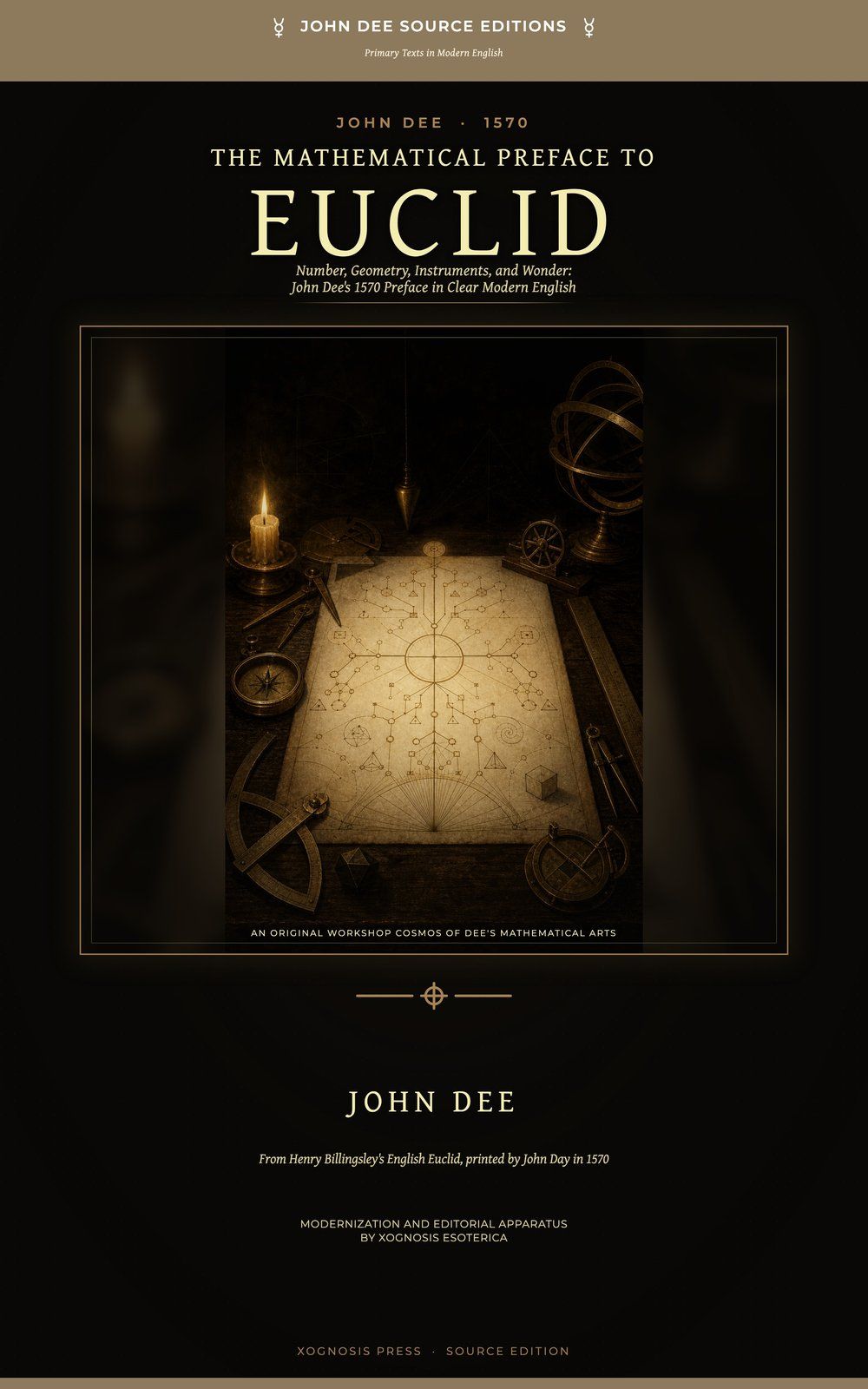
The original spelling survives in the 1570 printing, and readers can judge the full force of it in the Xognosis edition of the Mathematical Preface to Euclid.
Dee did not expect to be believed on assertion alone, so he offered a ledger. "Should I," he asks, "for my xx. or xxv. yeares Studie: for two or three thousand Markes spending: seuen or eight thousand Miles going and trauailing, onely for good learninges sake" now be treated as a dealer in damned spirits?
The figures are his own, from the same digression, and they sketch a life. Born in London in 1527, Dee studied at Cambridge from the early 1540s, then crossed to the continent to study at Louvain, where he absorbed the mathematical Renaissance then flowering in the Low Countries. By his own count he had spent two decades or more in study, a sum of two to three thousand marks, and seven or eight thousand miles of travel, all for learning's sake. The man defending himself against a magician's reputation was, by the standards of his century, one of Europe's best-travelled and best-read mathematical scholars.
This is what makes the slander bite in the text. Dee was not a marginal figure dabbling in occult arcana at the edge of town. He had advised on navigation for England's voyages of discovery, collected one of the great private libraries of Europe, and wrote the Preface as a public intellectual addressing his nation. The conjurer rumour followed him anyway.
Honesty cuts both ways, and Dee gave his accusers material. Six years before the Euclid Preface, in 1564, he published the Monas Hieroglyphica at Antwerp: a short, dense treatise built around a single invented symbol that Dee claimed unified celestial and terrestrial influences under one glyph. Its reasoning is closer to allegory and kabbalistic wordplay than to geometry, and it appealed to exactly the sort of reader who also read books of natural magic. Later, from 1582 to 1589, Dee kept the famous spiritual diaries recording conversations with angels conducted with the scryer Edward Kelley. Those sessions postdate the Preface, but they show that Dee himself believed the boundary between mathematical learning and higher knowledge was permeable.
In 1583, a mob plundered his house and library at Mortlake, an event commonly reported in the standard biographies and usually connected to this same atmosphere of suspicion. The episode needs little embellishment: the most learned man in England, looted by his own neighbours.
So the honest reading is layered. The Tudor confusion of mathematics with conjuring was real and is well documented in modern scholarship. Dee's published answer to it is real, and fierce. And Dee's own later practice ensured that the magician reputation would outlive the Tudor gossip that first fastened it on him. Readers curious about the hermetic side of his project can find it in the Xognosis edition of the Monas Hieroglyphica.
Dee never got the public vindication he wanted in his lifetime. He died at Mortlake in 1609, poor and out of fashion. But his "Apologicall" digression outlived the rumour it answered, because it was bound into a book that mattered. Every reader who worked through Billingsley's Euclid to learn geometry encountered, at the front, a man insisting that mathematics was godly knowledge and that calling its practitioners conjurers was the malice of fools.
History has largely agreed with him. The "mathematicks" were mistaken for magic for another century or more in England, as Zetterberg's title records, but the mistake eventually died of exposure. What remains is the voice: a tired, angry, precise man, defending wonder itself from the charge that it required devils.
Read the book
Related Articles
Continue through articles sharing this topic.
Two books sit at the far ends of the esoteric shelf, and they answer the same question in opposite ways.
6 min read
In the summer of 1552, two of the most restless minds in Europe were, as far as anyone can tell, in the same city at the same time.
6 min read
Open a modern edition of A True and Faithful Relation and you meet a problem before you meet a single angel.
7 min read
Open a page of John Dee's Monas Hieroglyphica at random and you see a strange object: a single compound sign, part astronomical, part alchemical, drawn once…
6 min read