 Xognosis EsotericaArcane Publishing Studio
In February 1570 a foldout sheet left John Day's London press tucked inside the first English translation of Euclid's Elements. It was a diagram of everything mathematical a person might know: two principal sciences at the root, dozens of named arts branching below them, each with a one-line definition in early modern English.
Share
In February 1570 a foldout sheet left John Day's London press tucked inside the first English translation of Euclid's Elements. It was a diagram of everything mathematical a person might know: two principal sciences at the root, dozens of named arts branching below them, each with a one-line definition in early modern English. Henry Billingsley had done the translating. John Dee, mathematician, astrologer, and resident of Mortlake, had supplied the preface, and at the end of that preface he promised his reader a summary. "And that you may the easier perceiue, and better remember, the principall pointes, whereof my Preface treateth," he wrote, "I will giue you the +Groundplatt+ of my whole discourse, in a Table annexed: from the first to the last, somewhat Methodically contriued." The result is one of the strangest and most ambitious documents of the sixteenth century: a knowledge tree that tries to stand between all of nature and all of heaven.
Dee dated his work precisely, and the dates survive on the sheet itself. The Groundplat caption reads "An. 1570. Febr. 3." Dee signed the preface at Mortlake six days later, on 9 February, and Day's imprint colophon closes the volume on 25 February of the same year. All three dates fall inside a single month of the printer's calendar.
The original was printed, in the words of the Project Gutenberg transcribers who later made it widely accessible, "in the form of a stemma, or tree, on an oversized fold-out page." That physical form matters. A reader of the 1570 Euclid opened the sheet and saw a ruled, branching structure, the principals at the top and the applied arts fanning out below. Any modern version you encounter, including the transcription this article draws on, is a rearrangement, a flattening of that diagram into lists.
The tree opens with a declaration rather than a definition: "Sciences, and Artes Mathematicall, are, either Principall, which are two, onely, Arithmetike [or] Geometrie." Everything else on the sheet derives from those two. Stephen Johnston, in a 2012 study of Dee's geometry writing, describes the preface as placing "great stress on the fundamental role of arithmetic and geometry," and the Groundplat is that argument made visible. Arithmetic and geometry are the roots; the rest of the mathematical world grows from them.
The historian Jennifer Rampling notes that the Groundplat "laid out the applications of geometry and arithmetic not only in the fields of mathematics and natural philosophy, but also in 'thinges Supernaturall, æternall, & Diuine'" (her quotation is from a label on the tree itself). That is the scheme in miniature. Each principal divides into simple and mixed forms, and each carries a "vse" branch with ascending and descending applications: downward into measurement, machinery, and navigation, and upward toward things Dee considered immortal and indivisible.
Dee himself was explicit about the strange position this gave mathematics. "A meruaylous newtralitie haue these thinges Mathematicall," he wrote, "and also a straunge participatiõ betwene thinges supernaturall, immortall, intellectual, simple and indiuisible: and thynges naturall, mortall, sensible, compounded and diuisible." He grounded this in a threefold division of existence: "All thinges which are, & haue beyng, are found vnder a triple diuersitie generall," namely supernatural, natural, and mathematical. Mathematics was the middle country, sharing borders with both. He ranked it second only to theology: "next to Theologie, it is most diuine, most pure, most ample and generall, most profounde, most subtile, most commodious and most necessary."
Counting the named arts and sciences on the sheet, excluding the root and the unlabeled application branches, gives 39: the two principals, arithmetic and geometry in their "vulgar" derivative forms, the measuring arts, and then 19 further arts that Dee says bear "propre names." Count every ruled box and side-label, including the simple and mixed divisions and the application headings, and you reach roughly 50. Count every printed division on the physical foldout and you can arrive at a figure in the low seventies, which is the count our title uses. No consulted scholarly source states a node total; the counting rule is ours, and readers should know that the "72 nodes" of the headline depend on how generously you count. What is not in dispute is the ambition.
Some branches are familiar. Navigation, Dee wrote, "demonstrateth, how, by the Shortest good way, by the aptest direction, and in the shortest time: a sufficient Shippe, betwene any two places (in passage nauigable) assigned, may be conducted." That is a practical art for an island nation expanding its sea trade, and Dee worked to establish navigation as a mathematical discipline in its own right, drawing on the Portuguese mathematician Pedro Nunes.
Others are stranger. Thaumaturgike "geueth certaine order to make straunge workes, of the sense to be perceiued: and of men greatly to be wondered at." Zographie, an early theory of perspective drawing, "demonstrateth and teacheth, how, the Intersection of all visuall Pyramids... may be, by lines, and proper colours represented." And at the applied end sits Archemastrie, which "teacheth to bring to actuall experience sensible, all worthy conclusions, by all the Artes Mathematicall purposed." Dee was assembling, on one sheet, navigation next to wonder-working, surveying next to a theory of how the eye meets a pyramid of light.
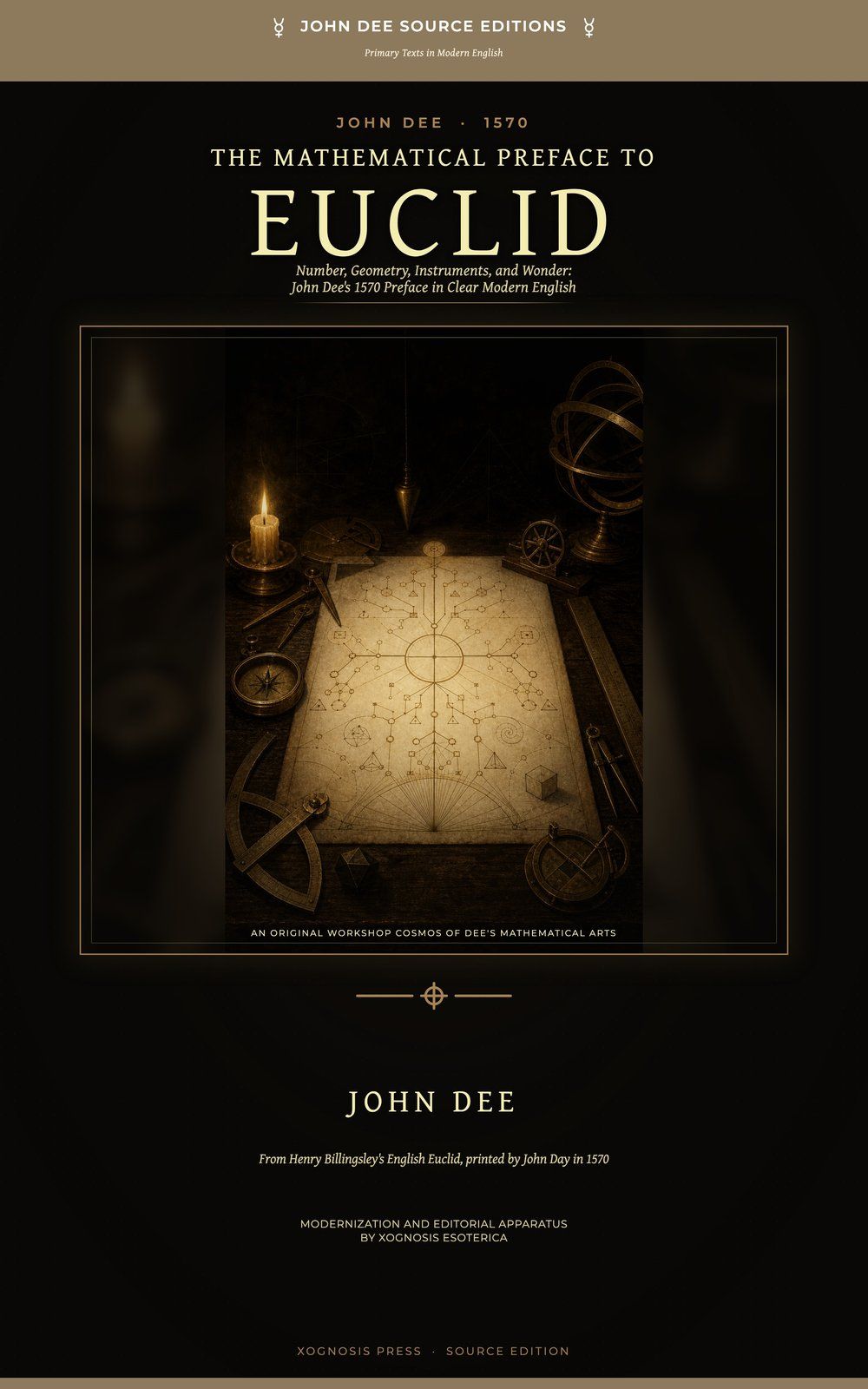
Readers who want the full preface in a modern presentation can find it in the Xognosis edition of the Mathematical Preface to Euclid.
Here the article's framing parts company with the documents and becomes argument. Look at the Groundplat with modern eyes and you see a directed graph: named nodes, hierarchical edges, one-line descriptions, a designed structure meant to be traversed. It is a knowledge graph, drawn four centuries before anyone used the term. Dee even motivated it the way an information designer would, as a memory aid so the reader "may the easier perceiue, and better remember" the contents of a long text.
There is a second claim worth making carefully. Dee stands near the end of a period when a single person could reasonably aim to survey the whole of mathematics and its applications, write the classification, and defend every branch on the sheet. He was that person: consultant to explorers and courtiers, keeper of one of England's great libraries, translator, mathematician, and cataloguer. Within a generation or two, the expansion of printed science pushed such a total survey out of any one person's reach, and the work retreated into specialisms. Whether Dee was truly the last such figure is a matter of interpretation. That he was among the last to try, and that the Groundplat is the attempt made visible, is what the document itself shows.
A caution against a common blur. Dee is popularly remembered as the occultist who conversed with angels through the medium Edward Kelley. That is a later chapter: the scrying sessions began in the 1580s, more than a decade after the Groundplat was printed. The 1570 Dee of this foldout belongs to his natural-philosophical and mathematical program, and the tree belongs there too. Its supernatural branches reflect his sincere placement of mathematics between nature and divinity, as his threefold scheme states, and that is a theological and philosophical position, not a grimoire.
One small error should be flagged rather than repeated silently: the 1570 title page identifies its author as "Euclid of Megara," repeating a then-common confusion with the philosopher of that name. The Elements is the work of Euclid of Alexandria. The slip belongs to the original printers, and it survives in every faithful transcription.
The Groundplat is a single foldout sheet on which one man tried to arrange all mathematical knowledge, from theology's neighbor down to the steering of ships, in one traversable diagram. It is best read as the last confident map of a territory about to outgrow every cartographer.
Read the book
Related Articles
Continue through articles sharing this topic.
Two books sit at the far ends of the esoteric shelf, and they answer the same question in opposite ways.
6 min read
In the summer of 1552, two of the most restless minds in Europe were, as far as anyone can tell, in the same city at the same time.
6 min read
Open a modern edition of A True and Faithful Relation and you meet a problem before you meet a single angel.
7 min read
Open a page of John Dee's Monas Hieroglyphica at random and you see a strange object: a single compound sign, part astronomical, part alchemical, drawn once…
6 min read