 Xognosis EsotericaArcane Publishing Studio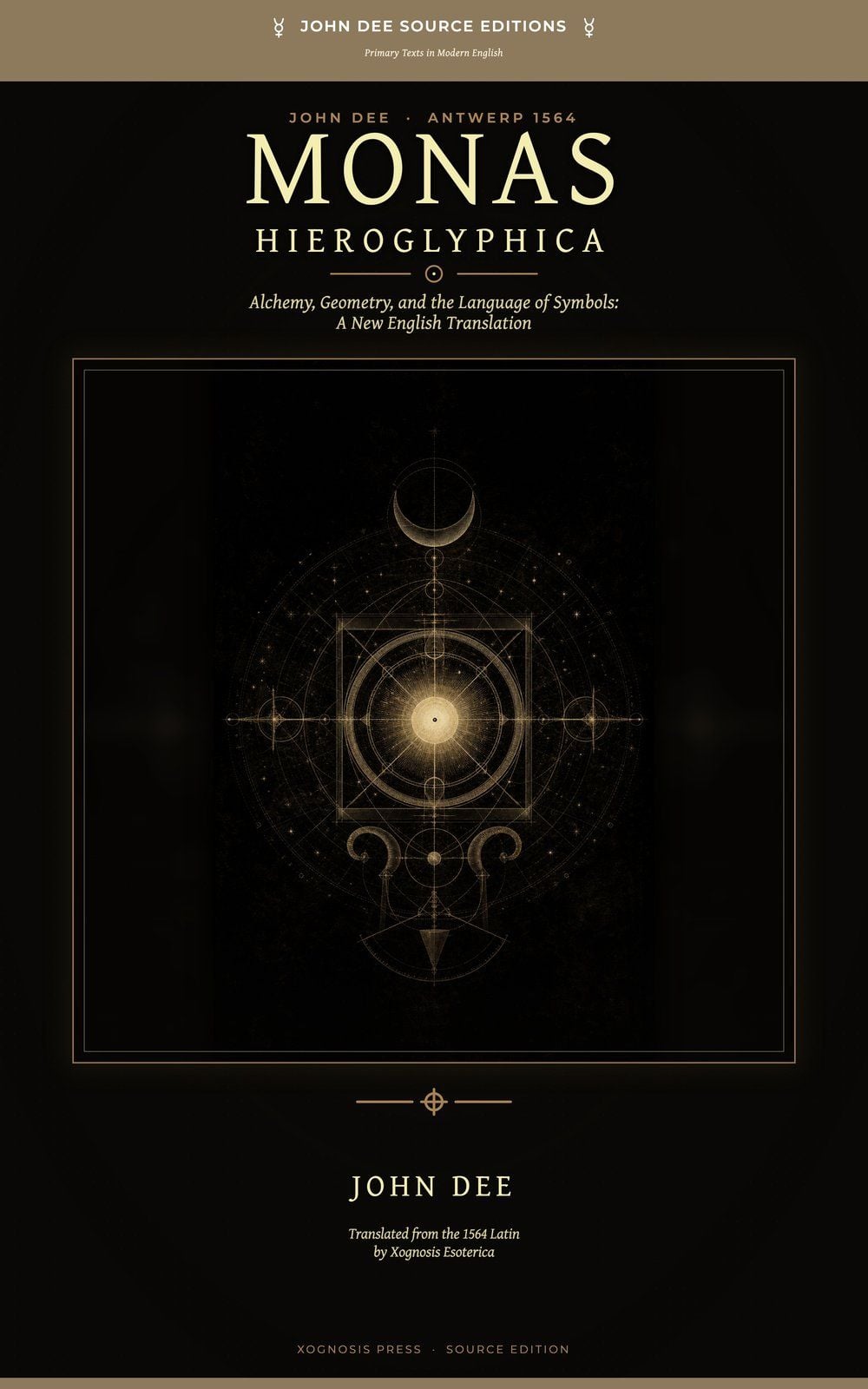
Alchemy, Geometry, and the Language of Symbols: A New English Translation
A new English translation and source reading edition of John Dee's compact 1564 work, controlled against the Wellcome witness and preserving its twenty-four-theorem order, meaningful typography, mathematical and alchemical language, and visual argument. Historical orientation, linked notes, twenty-six figures, glossary, sources, and index support close study. Translated from the 1564 Latin by Xognosis Esoterica.
Synopsis
John Dee wrote Monas Hieroglyphica at Antwerp in 1564. In twenty-four compact theorems, he joins point, line, circle, the Sun and Moon, planetary characters, formal numbers, alchemical operations, Christian Cabala, and a single compound sign. Each theorem carries earlier shapes and terms into a new use, which makes the exact wording and placement of the figures part of the argument. This edition translates the Antwerp Latin directly into modern English. It preserves the source order, meaningful capitals, technical names, mathematical relations, Greek forms, and open syntax where a smoother phrase would narrow the sense. The digitized Wellcome copy controls the reading. Another copy of the same 1564 edition supports collation, while its machine text serves only as a locating aid. What this new translation includes: - All twenty-four theorems in source order - Twenty-six source figures with captions and descriptions - Historical orientation, linked notes, glossary, sources, and index - Direct checking against the 1564 Wellcome witness All twenty-six source figures remain beside the parts of the work they serve. Captions identify each source locus, concise alternatives describe the visible structure, and original geometric reconstructions make the densest diagrams readable at a small size. Damaged words, uncertain labels, and source-language problems are marked openly. One Hebrew formula remains a clearly labelled publication hold pending qualified review. A historical orientation sets Dee's dedication to Maximilian and his instructions to printer Willem Silvius within the dates of the Antwerp production. A compact guide traces geometry, number, planetary signs, alchemical language, and Cabala without treating them as interchangeable. Linked translation notes, a detailed glossary, sources, a list of figures, and an index support close reading without claiming that the whole Monad has one settled decoding. For readers of Renaissance intellectual history, Western esotericism, alchemy, the history of mathematics, and early printing. Read the theorems in order, follow each sign through its changing roles, and consult the linked apparatus whenever a difficult term or figure requires context.
From the blog
Journal articles that draw on this volume.
Two texts carry the name of Enoch. One is a Jewish pseudepigraphon, composed in segments starting around the third century BCE, quoted in the New Testament,…
7 min read
Over twelve days in January 1564, if we take him at his word, John Dee wrote out one of the strangest books in the alchemical canon.
7 min read
Somewhere right now a tattoo needle is tracing a design that a mathematician composed, by his own account, in Antwerp over twelve days in January 1564.
7 min read
Related essays
No essays share this tag yet — editorial will curate them soon.
Related art
Art references appear when gallery entries align with this book's tags.
Related labs
No related content available yet.