 Xognosis EsotericaArcane Publishing Studio
Two texts carry the name of Enoch. One is a Jewish pseudepigraphon, composed in segments starting around the third century BCE, quoted in the New Testament, and preserved complete only in ancient Ethiopic.
Share
Two texts carry the name of Enoch. One is a Jewish pseudepigraphon, composed in segments starting around the third century BCE, quoted in the New Testament, and preserved complete only in ancient Ethiopic. The other is a body of angelic diaries, an alphabet, and a "Book of Secrets" delivered to the Elizabethan mathematician John Dee and his scryer Edward Kelley from 1582 until their parting in 1589. The first has no special alphabet. The second was written down in London and Cracow and Prague. Readers meet the word "Enochian" attached to both, and the confusion is old, deliberate in places, and worth untangling.
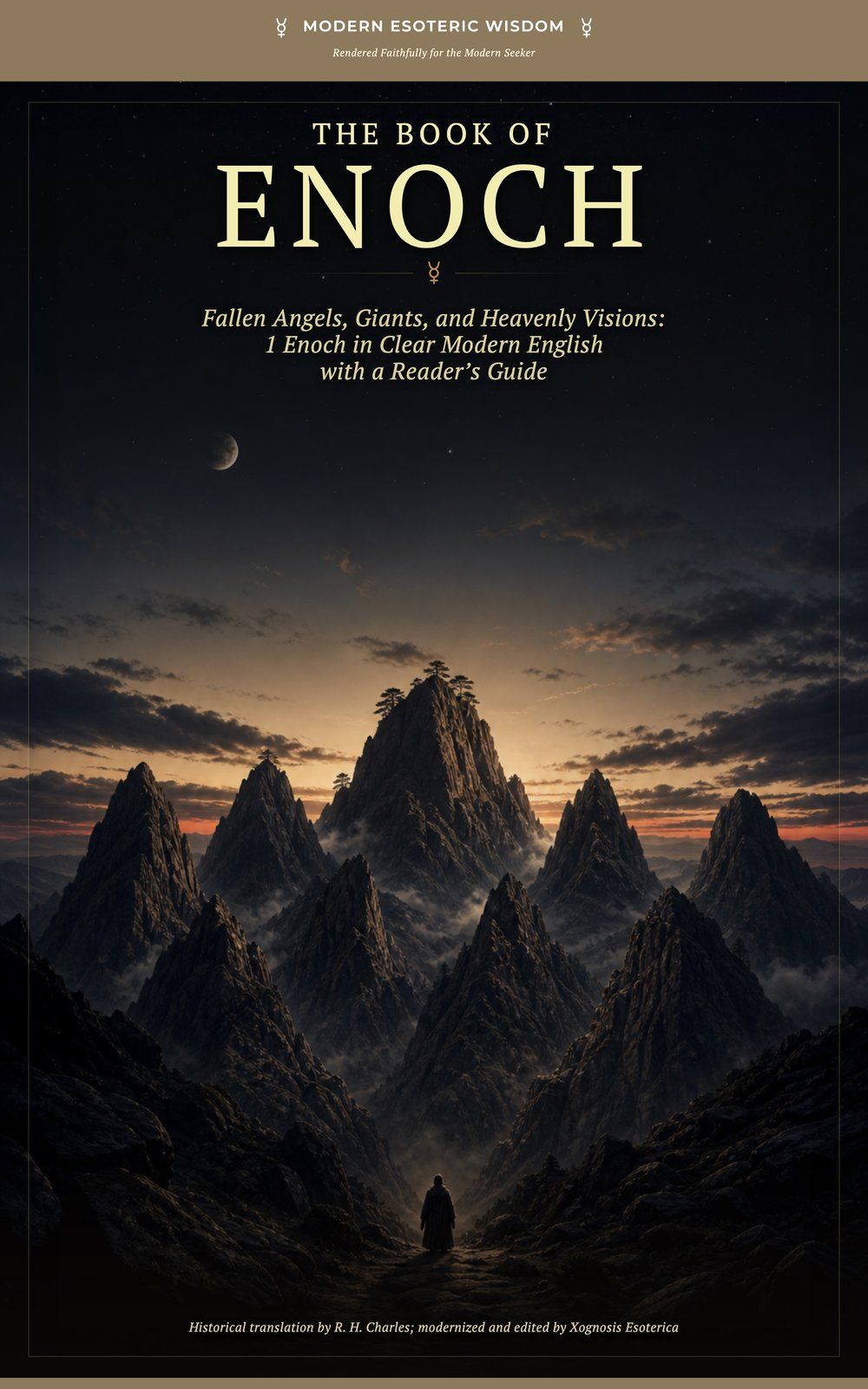
The Book of Enoch (1 Enoch) is a composite work. Its oldest sections, including the Book of Watchers with its story of the angels who descended to earth, are generally dated to the third century BCE. As the scholar Kenneth Atkinson summarizes the current view, "Many experts place First Enoch's composition in Palestine or the eastern Jewish diaspora during the late third or second century BCE." The book was written in Aramaic or Hebrew, translated into Greek, and from Greek into Ge'ez, the ancient literary language of Ethiopia. It survives complete only in Ge'ez.
For centuries Western readers knew it only in fragments. The Byzantine chronographer George Syncellus preserved Greek excerpts of the early chapters around 800 CE. A verse of the opening chapter crossed into the New Testament itself, quoted almost verbatim in the Epistle of Jude: "And Enoch also, the seventh from Adam, prophesied of these, saying, Behold, the Lord cometh with ten thousands of his saints, To execute judgment upon all..." (Jude 14-15, KJV). R.H. Charles, whose translation remains a standard English version, judged that "the influence of 1 Enoch on the New Testament has been greater than that of all the other apocryphal and pseudepigraphical books put together."
The complete text reached Europe through an odd channel. The traveller James Bruce returned from Abyssinia in 1773 with three Ge'ez copies. One he consigned to the library at Paris, "a very beautiful and magnificent copy of the prophecies of Enoch, in large quarto." Another, he wrote, was "amongst the books of Scripture, which I brought home, standing immediately before the Book of Job, which is its proper place in the Abyssinian Canon." The third he presented to the Bodleian Library in Oxford. Richard Laurence, Archbishop of Cashel and formerly Professor of Hebrew at Oxford, published the first English translation from the Bodleian manuscript in 1821. Note what Bruce's remark reveals: nothing was "lost" in the sense the old title pages implied. The book had been in continuous ecclesiastical use in Ethiopia all along, and the Ethiopian church reveres it as Scripture to this day. Our own edition, The Book of Enoch in clear modern English, modernizes Charles's translation for exactly this readership.
The Qumran discoveries settled a long argument. "Eleven Aramaic manuscripts of First Enoch were discovered in the Qumran caves," Atkinson reports, with paleographical dates "from approximately 200 BCE until 1 BCE." Jozef Milik's 1976 edition of the Cave 4 fragments established the Aramaic original for parts of the book. The ancient Enoch, in short, is textually secure, pre-Christian, and alphabetic in the ordinary sense: it was written in the scripts of its languages, with no secret characters of its own.
The second Enoch begins on 22 December 1581, when Dee, a philosopher, court astrologer, and leading mathematician of his century, began recording conversations with angels through a scryer. Kelley, who had arrived at Dee's house at Mortlake on 10 March 1582 under the name Edward Talbot, became the principal medium. The diaries survive as British Library Sloane manuscripts 3188 and 3189, and the later actions were printed by Meric Casaubon in 1659 as A True and Faithful Relation, of which our Volume II reading edition covers the Cracow and Prague conferences of 1584.
By 1583 the angels were dictating the book now known as Liber Loagaeth, "the Book of the Speech from God" in the practitioner-scholar Aaron Leitch's phrasing: great tables of 49 rows by 49 columns, written in the newly delivered angelic alphabet, in a language the angels called the Angelical or Adamical tongue, the speech of Eden restored. Dee had already proposed a single glyph compressing the powers of the planets in his Monas Hieroglyphica of 1564, available in a new English translation; the angelic material extended that ambition from symbol to speech.
Here is where the two Enochs touch. On 18 April 1583, in the Forty-third Action, Dee asked the angels about the lost Book of Enoch mentioned in Jude. The answer, as transcribed by Joseph Peterson from the manuscript, was that "Nothing remayned of Enoch" except what the angels could now show, and Dee was told he would find the books after sleeping a set number of days. Peterson's editorial judgment is precise: "Dee took this to mean Liber Loagaeth was the book of Enoch referred to by the angel." That is a fact about Dee's belief, recorded in his own diary. It is not evidence about any historical Enoch. A later owner of the manuscript, buying it for a guinea, inked a note reading "The Book of Enoch, revealed to Dr. John Dee by the Angels," and the mislabel was off and running.
Dee himself never called the language Enochian. His journals use "Angelical," "Adamical," "Celestial Speech," and "Language of Angels." As Leitch puts it, "Today, the language Dee and Kelley received from their scrying sessions is often referred to by the misnomer 'Enochian.'" The legend that the patriarch Enoch was the last human to know the tongue comes from the angelic frame of the diaries, and it should be read as the record's own claim, not as history.
The welding of the two Enochs began in print with Casaubon in 1659. His preface moves directly from Dee's revelations to the ancient text: "A thousand years and above, before either of them was born, was the BOOK OF ENOCH well known in the world; and then also was Lingua Adami... much talked of." The 1659 volume even carries a plate captioned "A Specimen of the Tables or Book of Enoch," showing Dee's tables under the ancient name (the caption is known from a modern transcription of the printing). Casaubon, who believed the spirits were real and diabolical, gave the confusion a durable documentary form.
The confusion hardened into a system in the late nineteenth century. The Hermetic Order of the Golden Dawn, founded in London in 1888, took Dee's fragmentary records and built from them a working ceremonial curriculum, and it labeled the material "Enochian" throughout. Israel Regardie's publication of the Order's papers between 1937 and 1940 fixed that name before the public. The Adeptus Minor syllabus required candidates to "receive and make copies of the Enochian Tablets, the Ritual of the Concourse of the Forces," and even "to study and play Enochian chess." Aleister Crowley carried the system further: after two preliminary attempts in Mexico in 1900, he and Victor Neuburg traversed the thirty Aethyrs in the Algerian desert in November and December 1909, an account published in 1911 as The Vision and the Voice, whose introduction describes conjurations "in a language which they called 'Enochian', or 'Angelic'."
There is a genuine irony in the Order's apologetic. A note Regardie reprints asserts that before Dee and Kelley "there is absolutely no trace of any part of the Enochian magical system or Angelical language in Europe." That is the revival reading its own history backwards.
The Book of Enoch is a pre-Christian Jewish work preserved in Ethiopic and, in part, in Aramaic fragments from Qumran. "Enochian" is the name later occultists gave to the angelic language Dee and Kelley recorded in the 1580s. The two share a patriarch's name and almost nothing else.
Keeping the distinction clear does both texts a kindness. The ancient book deserves to be read as what it is, an apocalyptic work of Second Temple Judaism that shaped Christian scripture. Dee's records deserve to be read as what they are, one of the strangest and most carefully documented episodes in the history of Western magic, conducted by a man who had already written one of its most ambitious books of symbols.
Read the book
Related Articles
Continue through articles sharing this topic.
Prague, 27 March 1587. Two English alchemists stand summoned before a bishop of the Church, accused of necromancy, in a city where the Emperor keeps…
6 min read
In September 1583 a Polish aristocrat slipped out of England after four months of banquets, borrowed money, and conversations with angels.
7 min read
In the winter of 1770, a tall Scottish traveller stood at a marshy spring in the Ethiopian highlands called Gish Abay and, by his own account, obliged his…
6 min read
In the spring of 1587, in a castle town in Bohemia, two Englishmen and their wives signed a document they believed God himself had demanded. The men were Dr.
6 min read