 Xognosis EsotericaArcane Publishing Studio
Somewhere right now a tattoo needle is tracing a design that a mathematician composed, by his own account, in Antwerp over twelve days in January 1564. The wearer may know this. A surprising number do not.
Share
Somewhere right now a tattoo needle is tracing a design that a mathematician composed, by his own account, in Antwerp over twelve days in January 1564. The wearer may know this. A surprising number do not. The glyph in question, John Dee's Monas Hieroglyphica, has escaped the book that explained it and now lives on forearms, thighs, t-shirts, vinyl center labels, and resin charms, its theorems left behind like packing material. What survives is the shape. The shape, it turns out, travels much better than the argument.
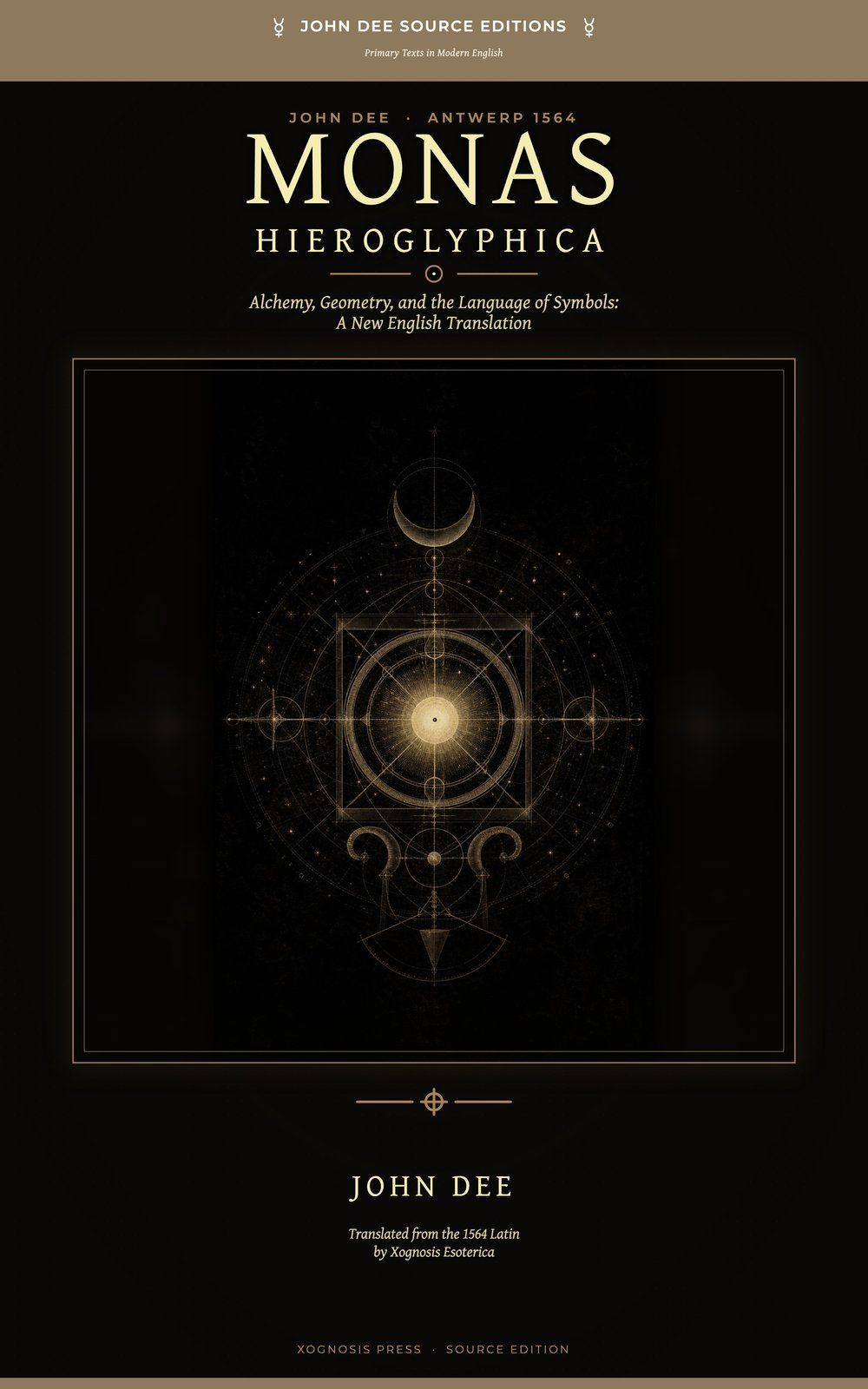
Dee published the book at Antwerp in 1564, at the shop of Gulielmus Silvius, the royal typographer, in a slim volume dedicated to Maximilian, King of the Romans, Bohemia, and Hungary. The book is a chain of twenty-four theorems, and the glyph they serve is an assembly job: the signs of the moon, sun, the four elements, and Aries or fire, stacked into a single figure. Cardiff University's library, which holds a 1564 copy, describes it as "a symbol of Dee's own devising which carried associations with both creation and unity." Dee had already used the figure in his 1558 Propaedeumata Aphoristica, so the 1564 book was less an invention than a public unveiling.
What he claimed for it is worth stating precisely, because the modern afterlife depends on nobody stating it. By his own signed closing remark he began the work on 13 January 1564 and finished it on the 25th of the same month, at Antwerp. That twelve-day window is Dee's testimony, not an independently verified fact, but the swiftness fits the book's character. It is dense, compressed, and certain of itself. Theorem XII grounds the construction in planetary signs: "The very ancient wise men and Magi have transmitted to us five hieroglyphical signs of the planets, all of which are composed out of the signs used for the Moon and the Sun, together with the sign of the Elements and the hieroglyphical sign of Aries, the Ram."
Dee also guarded it. Theorem XX reads: "O God! pardon me if I have sinned against Thy Majesty in revealing such a great mystery in my writings which all may read, but I believe that only those who are truly worthy will understand." The woodcut of the final figure carries a caption in the same spirit: "Here the vulgar eye will see nothing but Obscurity and will despair considerably." Scholars still argue over what the theorems actually establish. Cardiff's librarians note that readings of the book as a lost oral textbook, or as a cryptography system, are beliefs held by some readers rather than settled conclusions.
Buried near the end is the passage that makes the whole modern story oddly faithful. Theorem XXIII presents the glyph's proportions "which must be observed by those who wish to engrave them upon their seals or their rings, or to utilise them in some other manner." Dee himself set rules for putting the monad on jewelry. Every pendant and signet ring currently shipping from a print-on-demand seller is, in the narrowest sense, continuing a practice the author sanctioned, though nothing suggests he imagined Shein.
The rest is accretion. The theorems are mathematical and alchemical argument, not a protective charm in the modern sense. Nothing in the 1564 text promises anything to a person who wears the figure. That guarantee is supplied by merch culture on its own authority.
The glyph did not drift into pop culture directly from Antwerp. It traveled through a reputation that others built for Dee after his death. Szonyi and Wymer trace the arc in a 2011 study of Dee as a cultural figure. Ben Jonson name-checks him in The Alchemist (1610), the first literary reference to Dee by name, in a passage built to end on the word hieroglyphic: "And here's now mystery and hieroglyphic!" Jonson's audience, they write, would have taken the phrase as pointing at the Monas, "that mysterious work of alchemy, occult philosophy, and speculation about the origin of language that provided Dee with international fame since its publication in 1564."
Later links in the chain recast him further. Casaubon's 1659 edition of the angel diaries presented Dee as gullible, and broadsheets hardened the necromancer image. The spy story, the one where Dee signed letters to Elizabeth I with a cipher that became 007, has a documented origin in Donald McCormick, writing as Richard Deacon, in a later biography of Ian Fleming. It is legend with a paper trail, not record. The Rosicrucian association is similarly argued rather than proven; Cardiff's librarians point out there is no evidence Dee belonged to any such society, or that one existed before his death in 1608.
The modern artistic afterlife is better documented. The press kit for Derek Jarman's 1979 Tempest put the monad on its cover with the actor playing Prospero at the center, and a simplified monad topped Prospero's staff. Throbbing Gristle used Dee's Enochian language on stage in 1984. Damon Albarn and Rufus Norris staged the opera Dr Dee in Manchester on 1 July 2011. The glyph had been a fixture of experimental culture for decades before it became a consumer product.
The current wave has a name attached. In May 2016 the rapper Ghostemane released a track called "John Dee" with an official video that has since passed 37 million views on YouTube. The emblem fans associate with him, dating to the Blackmage era, is described by one commercial logo database as "a stylized esoteric symbol of Monas Hieroglyphica," its inverted moon read as a crown, its ring as the sun, its cross as the elements. That derivation is asserted by the database and repeated by fans and sellers. No statement from the artist himself surfaced in my research, so treat it as widely reported rather than confirmed.
The tattoo record survives in fan communities rather than industry press. One Reddit thread from December 2022 collects placements: an entire thigh, an upper back, a finger, a left forearm, a wrist, sternum placements spotted on Pinterest. The same thread stages the whole argument. One commenter warns that "too many people tattoo themselves things like that just for aesthetic." Another advises learning what the symbol means first. And one user describes laser removal of an occult tattoo after it was adopted by neo-Nazis, a reminder that a symbol's meaning is not fixed by its wearer.
Dee engraved rules for his glyph on rings and seals, but the meaning was never in the metal. Every generation that wears the monad without the theorems repeats his own wager from 1564: the figure is legible, the argument is reserved for those willing to read.
The merch trail runs from Redbubble ("hieroglyphic monad Classic T-Shirt", a poster, a sticker under two dollars, tagged with John Dee and Alchemy beside mass-culture keywords) through pages of Etsy listings to a Shein t-shirt. The Tunisian band Primordial Black titled its 2024 debut EP Monas Hieroglyphica. A mobile quiz game carries a Monas card. One print-on-demand edition of the book bills Dee as a fourteenth-century sorcerer, two centuries off, which tells you exactly how the text erodes as the glyph circulates.
A logo database even claims Dee "did not write details about each part of the emblem," so the full meaning "is still unknown." That paraphrase distorts Dee's epistle, which promises oral explanation rather than admitting ignorance. But it shows the mechanism: each retelling strips a little more book away, until only the mark remains.
The book itself is still worth the trip. Our new translation of the Monas Hieroglyphica, made from the 1564 Antwerp Latin with all twenty-four theorems and figures, restores what the t-shirt leaves out. Read it before the needle, or after. Dee only asked that you be worthy of understanding.
Read the book
Related Articles
Continue through articles sharing this topic.
Two books sit at the far ends of the esoteric shelf, and they answer the same question in opposite ways.
6 min read
In the summer of 1552, two of the most restless minds in Europe were, as far as anyone can tell, in the same city at the same time.
6 min read
Open a modern edition of A True and Faithful Relation and you meet a problem before you meet a single angel.
7 min read
Open a page of John Dee's Monas Hieroglyphica at random and you see a strange object: a single compound sign, part astronomical, part alchemical, drawn once…
6 min read