 Xognosis EsotericaArcane Publishing Studio
Over twelve days in January 1564, if we take him at his word, John Dee wrote out one of the strangest books in the alchemical canon. The theorems were composed between January 13 and 25, according to his own closing note; the dedication followed within the week; and by the end of March, the printer Willem Silvius, royal typographer at…
Share
Over twelve days in January 1564, if we take him at his word, John Dee wrote out one of the strangest books in the alchemical canon. The theorems were composed between January 13 and 25, according to his own closing note; the dedication followed within the week; and by the end of March, the printer Willem Silvius, royal typographer at Antwerp, had finished a slim quarto of twenty-eight leaves. Dee called it the Monas Hieroglyphica, and its entire argument is carried by a single invented sign: one composite glyph, printed on the title page and then taken apart, theorem by theorem, like a watch being disassembled by its maker. The book's twenty-four theorems are the disassembly instructions. Read them in order, and the sign builds itself under your eyes.
Dee begins with almost nothing. Theorem 1 opens: "The very First and most Simple Representation, of not only existing things, but also things hidden in the Folds of Nature, and also in the exhibition of the Bringing Forth of Light, is made by means of a straight Line and a Circle." This is the whole toolkit. Everything the monas will become is already implicit in a line and a circle, and Dee says so before he draws anything else.
Theorem 2 goes one step further down. "A Circle cannot be skillfully crafted without the Line," he writes. "Likewise, the Line cannot be crafted without the Point. Thus, Things come into being by way of the Point and a Monad." The point is the atom of his system, the indivisible beginning, and he gives it a job immediately: the central dot of the glyph is the Earth, "around which both the Sun, as well as the MOON, and the rest of the Planets complete their Courses." A dot becomes a planet. The grammar of the sign is astronomical from the third theorem onward.
Next come the luminaries, drawn as any schoolchild knew them. The Sun, Dee writes, "we represent... by a Complete Circle with a Visible Center." The Moon is her crescent, and Theorem 4 fixes their hierarchy with courtly language: "The Semicircle of the Moon is shown here to be Above the Circle of the Sun. Nonetheless, the Moon obeys the SUN as her Master and King." The crescent sits visually on top, yet submits in rank. Dee is already making the sign argue, and the argument is an alchemical one: the marriage of solar and lunar influences, which he presents as his doctrine throughout. Read it as a Renaissance magus's cosmology, not a finding.
By Theorem 6 the two luminaries have settled into position: "Here we see the SUN and the MOON resting on a Rectilinear Cross." The cross is the last major element, and Dee loads it with more freight than any Christian reading would suggest. "Geometers teach that a LINE IS PRODUCED BY THE FLOWING OF A POINT," he notes in Theorem 7, and in Theorem 8 he reaches for linguistic archaeology: "It is not without reason that the Oldest Latin Philosophers decided to signify the number TEN by using the Rectilinear CROSS made from 4 Straight lines." Lower down, the cross sits between two lunar half-circles, and that member, inverted, is the zodiac's ram: a later theorem concedes that it carries "our Aries sign (only Mystically inverted)." Around Aries and fire Dee builds his most elaborate claims, including a mirror whose curved line can, he says, reduce stones and metals to powder by concentrated sunlight. All of this is his interpretation, offered with total confidence and no apparatus beyond geometry, etymology, and tradition.
Here is the feature most modern readers miss. The Monas is set in type, and Dee treats the printed letter as a philosophical instrument. In Theorems 16 and 17 he turns to the letters L, V, and X, and to the Roman numerals hidden inside them, arguing that the shapes of the alphabet preserve cosmic truths for those who know how to read them. The capitalizations matter too. In the English rendering, words like SUN, MOON, POINT, and MONAD stand in small capitals where Dee's Latin emphasized them, marking the load-bearing terms of each theorem. The page is an instrument to be parsed.
Dee also cites his authorities inside the text. Theorem 14 gives us "its Father is the SUN and its Mother the MOON," lines Dee attributes to "the Thrice-Great Hermes," an unmistakable echo of the Emerald Tablet. Theorem 15 quotes the legendary Ostanes: "For Nature delights in Nature." These are Dee's attributions to tradition; he marks them as inherited, not original to him. The title-page motto, rendered in the modern English text as "Mercury, when made perfect by a sharp, stable point becomes the parent and king of all the planets", is likewise Dee's own emblem text, despite its ancient cadence. Nothing here is an old saying unless Dee names its source, and sometimes not even then.
The frame around the theorems is nearly as interesting as the theorems. In the dedication to Emperor Maximilian II, Dee writes that the work is "this my offspring, the HIEROGLYPHIC MONAD, (Conceived in London, yet Born in Antwerp)," and adds: "My Mind has been pregnant with it continuously for the past 7 years, yet... it took me only 12 days to bring it forth." The gestation metaphor is deliberate self-presentation, aimed at a dedicatee Dee had courted in person at Maximilian's Hungarian coronation at Pressburg in September 1563. Whether the twelve days are a literal diary or a rhetorical figure, we cannot verify. The dates in his closing note are his own testimony, and the Princeton catalog entry confirms only the printed result: Antwerp, Silvius, 1564, in Latin, with a woodcut title page and diagrams.
The later life of the book belongs to reception history, and should be kept distinct from what Dee wrote. English sources were quiet about it early on. Praise surfaced in the 1591 edition of Ripley's Compound of Alchymy; Heinrich Khunrath reproduced the glyph in his Amphitheatrum sapientiae aeternae (1595, expanded 1609); it appears in the Chymical Wedding of Christian Rosenkreutz (1616) and in Zetzner's great Theatrum Chemicum (1659-1661). Rosicrucian circles adopted the sign as an emblem of their imaginary lineage, something Dee never lived to see. Princeton's curators record that Dee discussed the book in person with Elizabeth I and later presented a copy to Rudolf II in Prague, though neither audience is dated. Dee himself, meanwhile, asked Maximilian for approval in the dedication; no imperial act of endorsement is documented.
The Monas Hieroglyphica makes its argument in ink before it makes it in words: a point becomes a line, a line a circle, a circle the Sun, and twelve days of January 1564 compress into one sign meant to be read the way the heavens are read.
Dee knows exactly how he wants you to leave the book. Theorem 24 begins: "In the Beginning of this Little Book, we started with a Point, a Straight Line, and a Circle. Now, at the End, like a Circle Completing Itself, we have a POINT, LINE, and our ELEMENTS Flowing Out of our MONAD, which is Analogous to the Equinoctial when a Circuit is completed in 24 Hours." The twenty-four theorems mirror twenty-four hours; the day and the book are both circuits; the end returns to the beginning with everything changed. THUS, he concludes, "we shall Consummate and Conclude with the METAMORPHOSIS of ALL THE TRANSPOSITIONS OF PARTS OF A QUATERNARY (defined by the Number 24)."
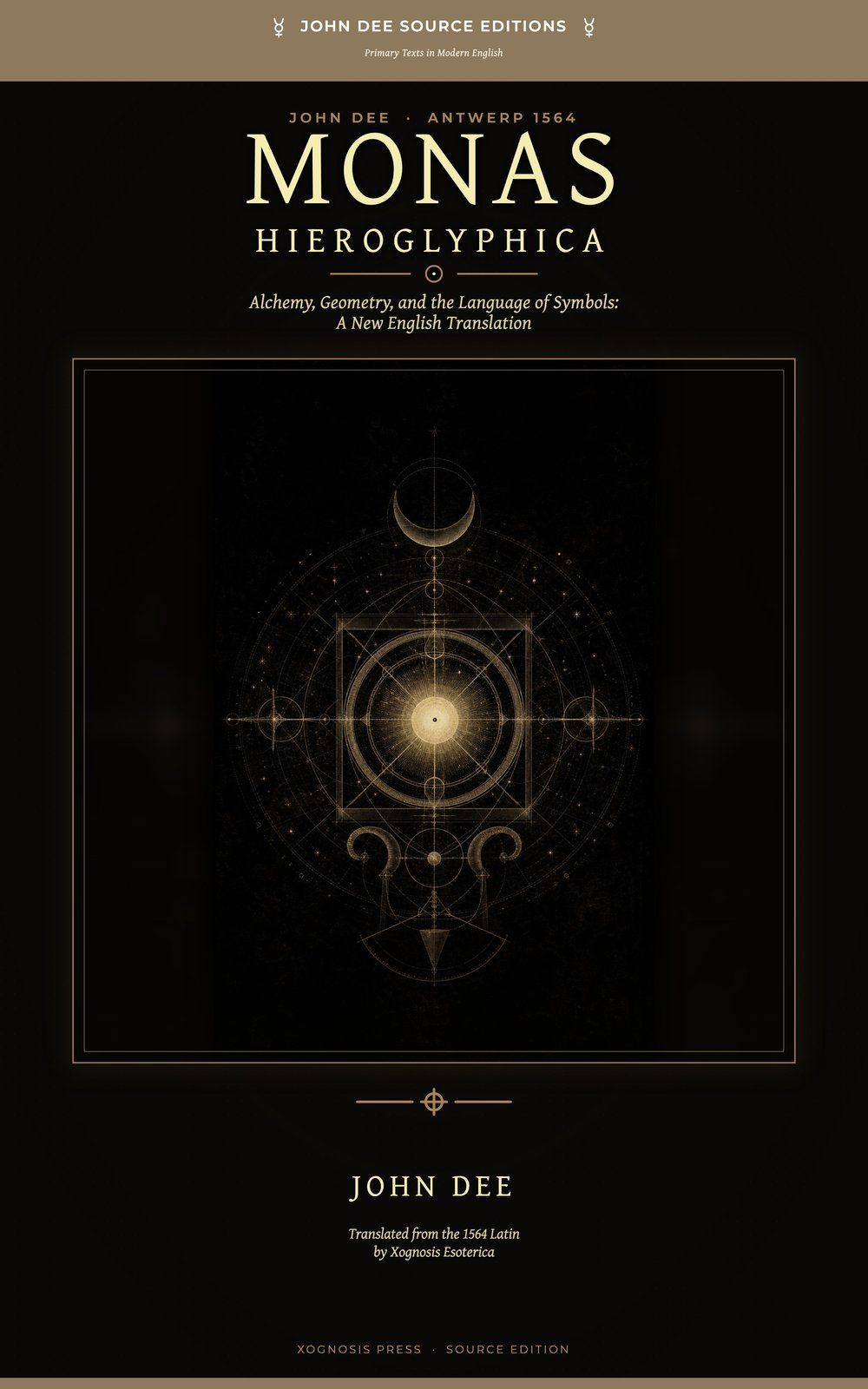
Whether the sign does what Dee believed it does, reveal a unity behind metals, planets, letters, and numbers, is a question he answers only by demonstration and assertion. But the construction itself is genuinely elegant, and it can be followed without believing a word of the cosmology. That is the pleasure of reading him at first hand, and the reason a fresh reader might want the whole text with the theorems in sequence. Our own edition, Monas Hieroglyphica, exists for exactly that route in. Quotations in this article follow the 2010 Egan English rendering of the 1564 Latin; C.H. Josten's 1964 Ambix translation, listed below, is the standard scholarly second rendering. Dee rewards a pinned translation, because his letterforms and capitals carry part of the case.
Read the book
Related Articles
Continue through articles sharing this topic.
Two books sit at the far ends of the esoteric shelf, and they answer the same question in opposite ways.
6 min read
In the summer of 1552, two of the most restless minds in Europe were, as far as anyone can tell, in the same city at the same time.
6 min read
Open a modern edition of A True and Faithful Relation and you meet a problem before you meet a single angel.
7 min read
Open a page of John Dee's Monas Hieroglyphica at random and you see a strange object: a single compound sign, part astronomical, part alchemical, drawn once…
6 min read