 Xognosis EsotericaArcane Publishing Studio
Two texts, separated by something like two millennia and with no documented line of transmission between them, open with the same move. The Dhammapada, a verse anthology preserved in the Khuddaka Nikaya of the Theravada Pali canon, begins its first chapter with a claim about the priority of mind.
Share
# Mind Comes First: What the Kybalion and the Dhammapada Actually Claim
Two texts, separated by something like two millennia and with no documented line of transmission between them, open with the same move. The Dhammapada, a verse anthology preserved in the Khuddaka Nikaya of the Theravada Pali canon, begins its first chapter with a claim about the priority of mind. The Kybalion, a small American book of Hermetic philosophy published in Chicago in the early 1900s, makes the same claim its first principle and prints it in capitals. Neither text knew of the other. The older one could not have; the younger one almost certainly did not in any direct sense, since its claimed Egyptian lineage rests on its own say-so. And yet a reader who picks up both books in the same week will notice the rhyme immediately.
The opening pair of verses is among the most quoted passages in Buddhist literature. In Acharya Buddharakkhita's translation, published by the Buddhist Publication Society in 1985, verse 1 reads: "Mind precedes all mental states. Mind is their chief; they are all mind-wrought. If with an impure mind a person speaks or acts suffering follows him like the wheel that follows the foot of the ox." Verse 2 mirrors it: with a pure mind, "happiness follows him like his never-departing shadow."
Thanissaro Bhikkhu, translating the same Pali verses independently, renders them differently: "Phenomena are preceded by the heart, ruled by the heart, made of the heart." The difference between "mind" and "heart," between "mental states" and "phenomena," is worth pausing on. Translation is interpretation, and these two respected translators show how much room the original leaves. What survives every rendering is the structure of the claim: whatever follows, whether suffering or happiness, tracks back to the quality of the intentional mind that preceded it.
Notice what kind of claim this is. It is ethical and psychological. It concerns the consequences of acting from a corrupted or a purified intent. It is a claim about how experience is shaped for the one acting, not a thesis about what the universe is made of.
The Kybalion appeared under the byline "Three Initiates," published by the Yogi Publication Society of Chicago; standard references give 1908 for first publication, though the digitized printing bears a 1912 copyright line. Scholarship attributes the book, with reasonable confidence though not certainty, to William Walker Atkinson (1862-1932), a prolific New Thought writer. That attribution is an inference from stylistic and bibliographic evidence, built up by several researchers over the past two decades. It should be held as the best current answer rather than settled fact.
The book presents seven principles, and the first is the Principle of Mentalism, stated in Chapter II as: "THE ALL IS MIND; The Universe is Mental." The chapter goes on to describe the phenomenal world as "a Mental Creation of THE ALL," saying the universe "has its existence in the Mind of THE ALL." This is a metaphysical claim about the substance of reality, not a psychological claim about the actor's intent.
The book also claims a pedigree. Chapter I asserts that "from old Egypt have come the fundamental esoteric and occult teachings" that influenced later philosophies, and that "the most ancient teachings of India undoubtedly have their roots in the original Hermetic Teachings." This is legend, presented as history. No pre-1908 document of any ancient compilation called the Kybalion is known, and the book itself says its precepts "have never been written down, or printed, so far as we know," which makes the lineage claim unfalsifiable by design. Modern assessment holds that the book owes far more to the New Thought movement of its own era than to ancient Hermetic texts. There is a certain irony here worth savoring: the American book claiming that Indian teachings derive from Hermetic ones, while quietly echoing the opening sentiment of an Indian text compiled on the order of two thousand years earlier.
Set the two first statements side by side and the convergence is real. Both texts place mind first in the order of explanation. Neither begins with matter, or with gods, or with ritual. Both insist that what you take to be given experience is downstream of mentality, and both draw a practical conclusion from that priority. The Kybalion's Chapter III makes the practical turn explicit: "Mind (as well as metals and elements) may be transmuted, from state to state; degree to degree; condition to condition; pole to pole; vibration to vibration. True Hermetic Transmutation is a Mental Art." If mind comes first, then work on mind is work on everything downstream of it. The Dhammapada's ox-wheel and shadow images make the same practical turn in miniature: purify the intent and the consequence changes.
The divergence matters just as much. The Dhammapada's opening verses make a claim about intentional action and its fruits. The Kybalion's Mentalism makes a claim about the universe's constitution. Reading the Buddhist verses as a statement of cosmic idealism, which happens often in casual comparisons, flattens them into something they are not saying. The honest formulation is that both traditions treat mind as the operative first cause in their respective accounts, while disagreeing, or simply never asking the same question, about what kind of cause it is.
Two traditions with no documented contact both put mind first in the order of explanation: the Dhammapada as an ethical claim about where suffering and happiness originate, the Kybalion as a metaphysical claim about what the universe is. The overlap is striking precisely because the coincidence is unengineered.
If the resemblance is not the result of transmission, what is it a result of? The most economical answer is that both texts are responding to a problem any serious contemplative tradition faces: experience presents itself as arriving from outside, and yet the quality of experience varies dramatically with the state of the one experiencing it. Any tradition that watches this closely enough, Buddhist compilers in ancient India or American New Thought authors in the early twentieth century, will tend to write mind into the first premise.
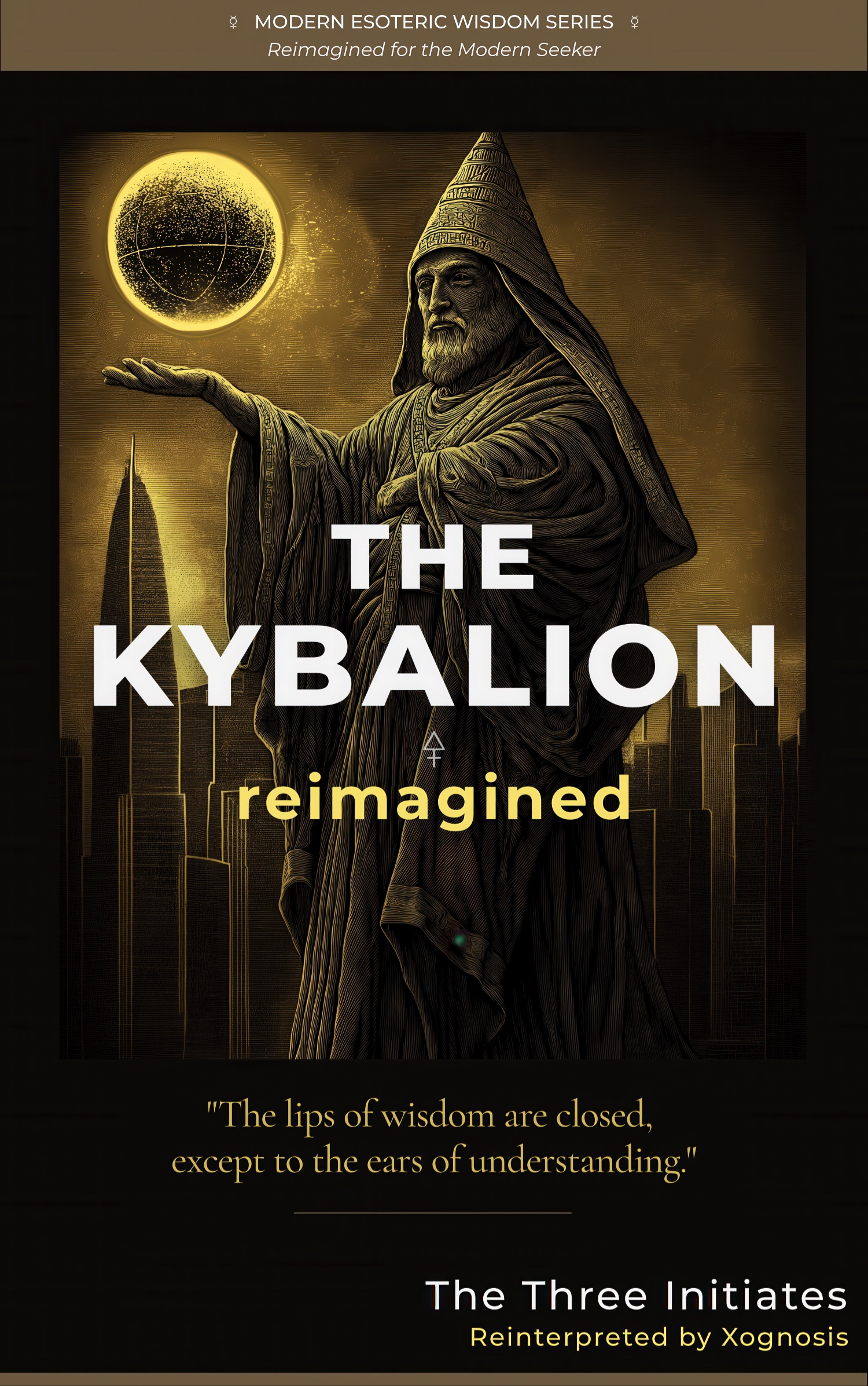
That is an interpretation, and should be read as one. What is fact is narrower and firmer: the texts exist, they say what they say, and the younger one's story about ancient Egyptian origins is its own legend rather than history. Readers who want to weigh the two openings against each other can find both books in annotated editions, in The Kybalion Reimagined and in our translated and annotated Dhammapada. Reading the first chapter of one and then the first principle of the other takes ten minutes. The rhyme does the rest.
Read the book
Related Articles
Continue through articles sharing this topic.
In 1908 a small book appeared in Chicago under the byline "Three Initiates." In 1912 a Russian journalist finished a treatise on the fourth dimension, a…
7 min read
Every few decades, someone translates the esoteric classics again. New Enoches appear. New Pistis Sophias.
6 min read
Every few years someone rediscovers the Kybalion and announces, with the confidence of a person quoting scripture, that it preserves the ancient wisdom of…
6 min read
In 1908 a small volume appeared in Chicago under the byline "Three Initiates." It claimed to transmit the secret doctrines of ancient Egypt, carried a…
6 min read