 Xognosis EsotericaArcane Publishing Studio
Every few years someone rediscovers the Kybalion and announces, with the confidence of a person quoting scripture, that it preserves the ancient wisdom of Hermes Trismegistus. The book encourages this.
Share
Every few years someone rediscovers the Kybalion and announces, with the confidence of a person quoting scripture, that it preserves the ancient wisdom of Hermes Trismegistus. The book encourages this. It presents its teachings as the substance of Hermetic learning handed down orally from teacher to student across millennia, and it attributes its aphorisms to a mysterious source called "The Kybalion" as though quoting an old text. The trouble is that no ancient text by that name is known, and the word itself has no meaning in Greek; Nicholas E. Chapel, in a 2013 study of the book's supposed Hermetic pedigree, judged the word a likely invention. What the book actually is, on the evidence, is a 1908 New Thought synthesis, most likely written by the American occultist William Walker Atkinson, that borrows vocabulary from two older traditions without belonging to either. The interesting question is not whether the Kybalion is a fraud. It is what happens when you set its seven principles beside the texts it claims to descend from.
The Corpus Hermeticum is a collection of seventeen Greek treatises composed roughly between 100 and 300 CE in Roman Egypt, a dating established by modern scholarship and reflected in Brian Copenhaver's 1992 translation, the standard English edition. The Renaissance believed something very different. When a Greek manuscript reached Florence in the 1460s, Cosimo de' Medici ordered Marsilio Ficino to set Plato aside and translate Hermes first, because Hermes was thought to be older than Plato himself, an Egyptian sage who had glimpsed revelation before the philosophers arrived. That legend collapsed in 1614, when Isaac Casaubon showed the Greek was post-classical and the works could not predate Plato.
The treatises are theological and, in the scholarly sense, salvation-oriented. The most famous of them, the first, known as Poimandres, opens with a vision of Light and the divine Mind. In G.R.S. Mead's public-domain translation, the voice of the divine tells the visionary: "That Light, He said, am I, thy God, Mind, prior to Moist Nature which appeared from Darkness; the Light-Word (Logos) [that appeared] from Mind is Son of God." The treatise then describes the soul's descent through the seven planetary spheres and its possible ascent back up them, stripping off vices at each stage, toward a stated goal: "This the good end for those who have gained Gnosis - to be made one with God." Deification. Union with God. That is the engine of the ancient texts, and it runs on piety, revelation, and a salvation the reader works toward.
The Kybalion runs on something else: axioms, causality, and a tone that would not be out of place in a course on personal power. Where the Corpus prays, the Kybalion instructs.
Any honest comparison has to keep three distinct layers separate, because the Kybalion blends them and the blending is where confusion enters.
The first layer is the Corpus Hermeticum itself: Greek pseudepigrapha of the Roman imperial period, theological, reverent, aimed at transformation through knowledge of God.
The second is the Emerald Tablet. "As above, so below" comes from here, not from the Corpus. The Tablet's earliest known versions are Arabic recensions from the 8th to 10th centuries, embedded in works like the Book of the Secret of Creation; a Latin translation circulated in Europe from the 12th century, and the text was first printed in Nuremberg in 1541. Isaac Newton made an English translation of it, which begins: "Tis true without lying, certain and most true. That which is below is like that which is above and that which is above is like that which is below to do the miracle of one only thing." Note the actual wording. The snappy two-part maxim everyone quotes is Blavatsky's popularized paraphrase of the Tablet's second verse, and the Kybalion inherited her wording rather than the text's own phrasing. It calls the maxim "the old Hermetic axiom," which is half true: old and Hermetic in the broad alchemical sense, but not Corpus Hermeticum, and not ancient Egyptian.
The third layer is the Kybalion itself, published in Chicago in 1908 by the Yogi Publication Society under the pseudonym "Three Initiates." The 1912 printing digitized at sacred-texts.com is the version most readers encounter. Philip Deslippe's 2011 scholarly edition lays out the evidence identifying Atkinson, a prolific New Thought writer, as the likely author; Chapel in 2013 and Mitch Horowitz in 2019 agree on "likely," and honest writing should stop at that word.
Set against that background, the seven principles sort into two piles.
Mentalism has a genuine, if loose, ancestor. "THE ALL IS MIND; The Universe is Mental," the Kybalion declares, and the Corpus does teach a cosmos generated by divine Mind, Nous. Horowitz has argued that the book's philosophical mentalism echoes notions in the ancient Hermetica, and the parallel is real, though the ancient texts make Mind a God to be united with, not a universe to be manipulated. The Kybalion even paraphrases Acts 17:28 in this section, "we 'live and move and have our being'," which shows its instincts are as much Christian New Thought as anything Hermetic.
Correspondence, as noted, descends from the Emerald Tablet by way of Blavatsky. Polarity and Gender have a family resemblance to Hermetic male-female dyads that appear throughout the ancient treatises, a connection Chapel credits.
Then there is Vibration. "Nothing rests; everything moves; everything vibrates." Chapel traces this principle not to any Hermetic source but to the philosophy of David Hartley, an 18th-century British thinker. There is nothing wrong with Hartley. There is something wrong with presenting his idea, or the rhythm principle, or cause and effect formulated as cosmic law, as recovered Egyptian wisdom. Rhythm in particular reads as New Thought's then-current fascination with energy and vibration, dressed in Hermes' name.
The Kybalion's own epigraph makes the strongest claim to be tested: "The Principles of Truth are Seven; he who knows these, understandingly, possesses the Magic Key before whose touch all the Doors of the Temple fly open." It attributes this saying to "The Kybalion" itself, a self-citing loop with no ancient referent.
The fair verdict is uneven, and this is worth getting right precisely because the book still reads well. Its mentalism gestures toward a real Hermetic doctrine. Its correspondence maxim belongs to a different tradition than it implies. Its vibration principle is 18th-century philosophy. And its entire purpose, self-mastery and mental power in this life, is foreign to the Corpus, which asks the reader to ascend toward God. Chapel's conclusion stands: the book is too bound up with New Thought to represent the historical Hermetic tradition.
The Kybalion is not a lost Hermetic text; it is a 1908 American book that speaks fluently in borrowed Hermetic vocabulary. Reading it alongside the Corpus Hermeticum, in Copenhaver's or Mead's translation, is the only reliable way to hear where the echoes are real and where the voice is Atkinson's.
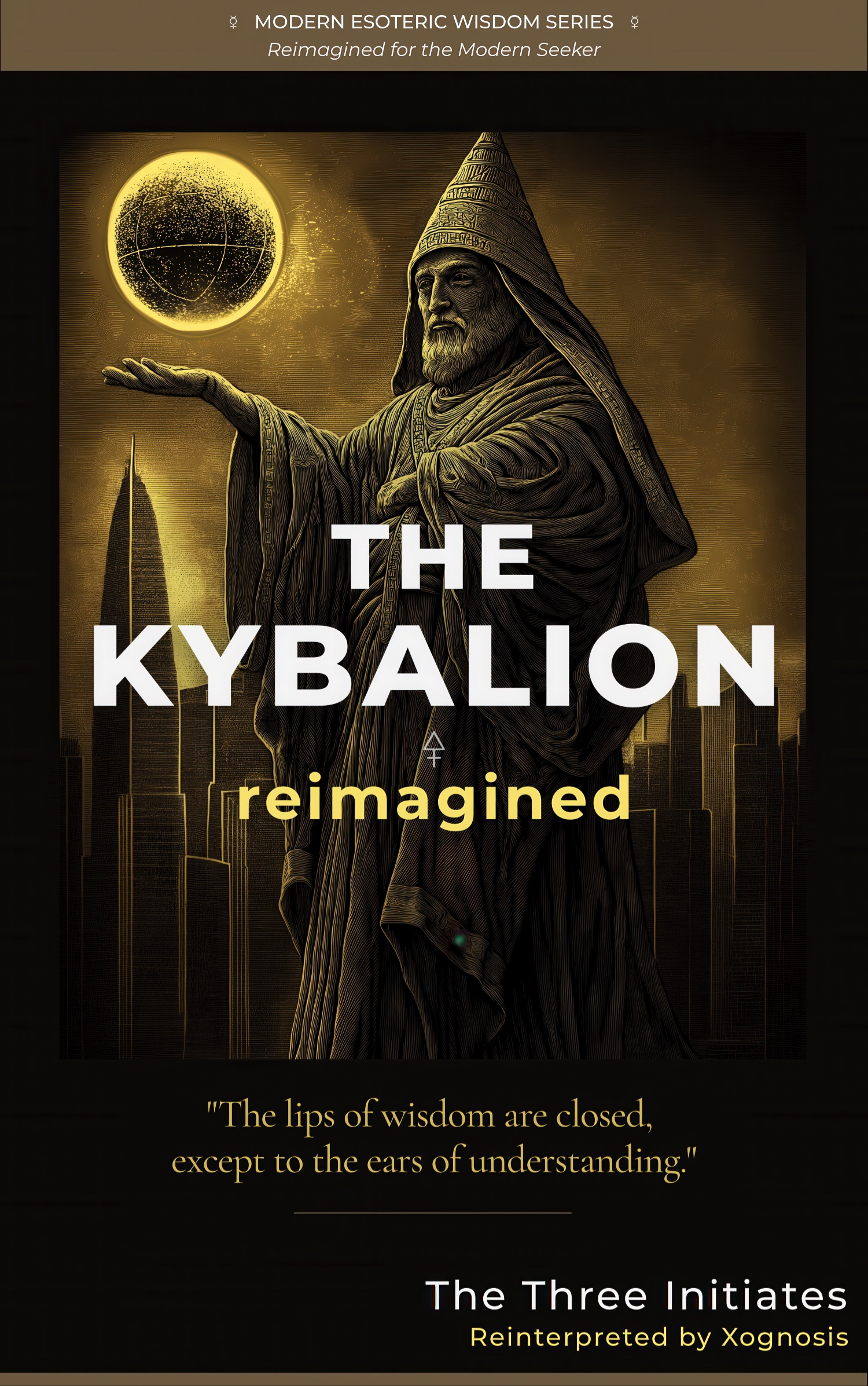
That comparison is exactly the exercise our edition, The Kybalion Reimagined, was built to support: the seven principles engaged critically rather than swallowed whole. The Kybalion remains a fascinating document of American esotericism, and Atkinson, if it was Atkinson, was a skilled synthesizer. But when a 1908 book tells you it holds the key to a temple of ancient Egyptian wisdom, check whether the temple existed, check who built the door, and check what the actual priests, the anonymous Greek authors of the Corpus, were praying for. They wanted what Poimandres promises: to be made one with God. The Kybalion wants you to master your mental universe. Both are serious projects. Only one of them is Hermetic in the historical sense.
Read the book
Related Articles
Continue through articles sharing this topic.
In 1908 a small book appeared in Chicago under the byline "Three Initiates." In 1912 a Russian journalist finished a treatise on the fourth dimension, a…
7 min read
Every few decades, someone translates the esoteric classics again. New Enoches appear. New Pistis Sophias.
6 min read
Two texts, separated by something like two millennia and with no documented line of transmission between them, open with the same move.
6 min read
In 1908 a small volume appeared in Chicago under the byline "Three Initiates." It claimed to transmit the secret doctrines of ancient Egypt, carried a…
6 min read