 Xognosis EsotericaArcane Publishing Studio
Every few decades, someone translates the esoteric classics again. New Enoches appear. New Pistis Sophias. Readers could be forgiven for asking why, since the old versions are still in print and often free online. The answer is that for these books, translation is not a one-time hurdle cleared on the way to the text.
Share
Every few decades, someone translates the esoteric classics again. New Enoches appear. New Pistis Sophias. Readers could be forgiven for asking why, since the old versions are still in print and often free online. The answer is that for these books, translation is not a one-time hurdle cleared on the way to the text. Translation is the transmission. A book like Enoch or the Pistis Sophia reaches us only through a chain of hands: scribes, collectors, editors, translators, each making decisions that shape what the next reader is able to see. When the decisions age, the book ages with them, and somebody has to start again.
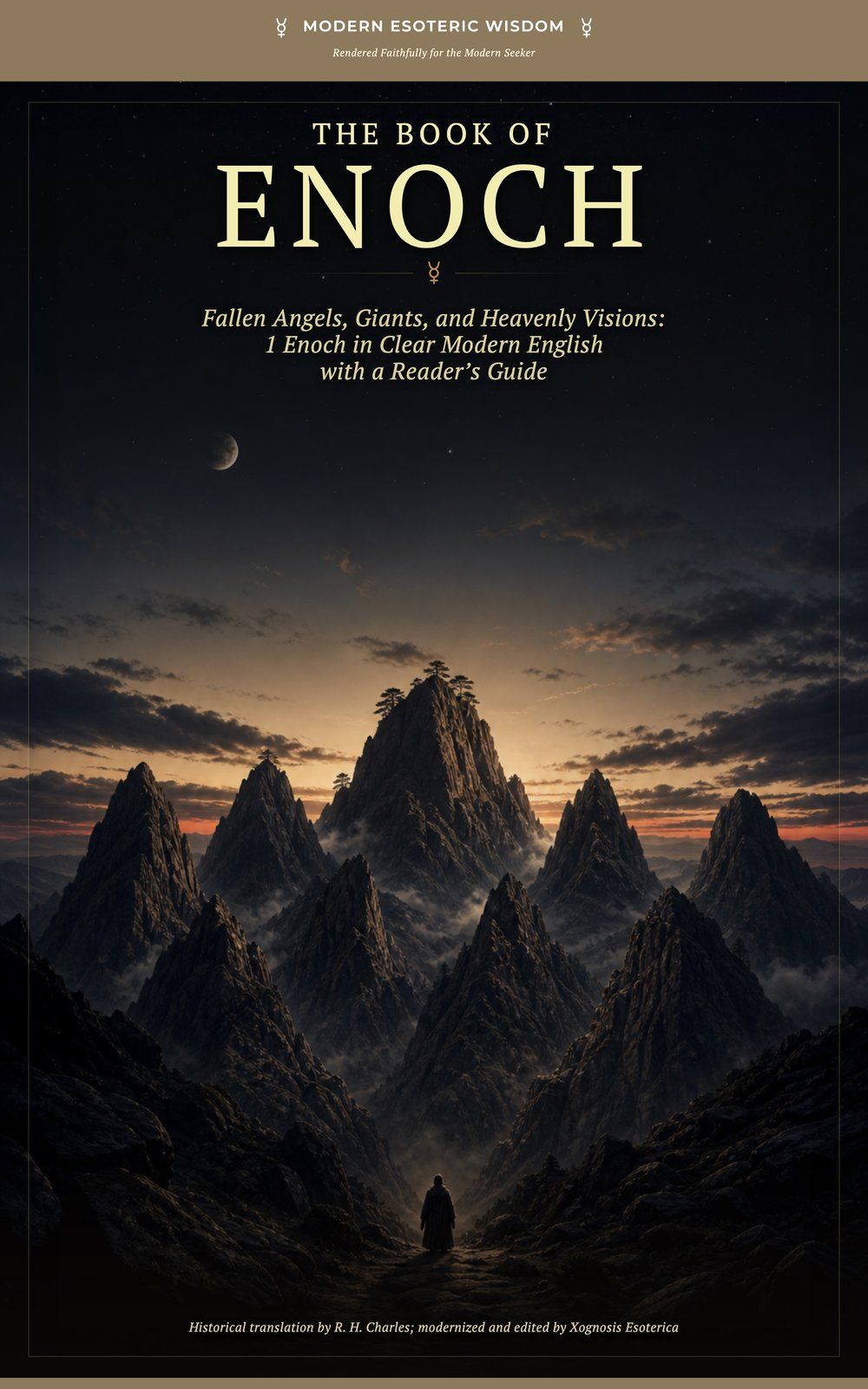
Consider what the Book of Enoch actually is, physically. The work presents itself as revelation to the antediluvian patriarch Enoch, but scholars treat it as a composite pseudepigraphon assembled over centuries, with the older sections generally dated to 300-200 BC. It survives complete only in Ge'ez, the classical language of Ethiopia. Aramaic fragments turned up among the Dead Sea Scrolls in Qumran cave 4, palaeographically dated to roughly 200-150 BC. The Greek witnesses are scattered too: a fourth-century papyrus, a sixth-century codex, a stray Oxyrhynchus fragment. There is no master copy. There is a wreckage with an Ethiopic keel still floating.
That wreckage reached the West in 1773, when the traveller James Bruce brought Ethiopic manuscripts back from Ethiopia. Richard Laurence made the first English translation in 1821. R. H. Charles produced critical editions in 1906 and 1912, dividing the Ethiopic manuscripts into an older family and a more recent, edited one, and his translation entered general circulation through Oxford's Apocrypha and Pseudepigrapha in 1913. Later in the twentieth century, Michael Knibb and George Nickelsburg translated it again. Each of these men had different manuscripts, different methods, and different English. None of them finished the job, because the job has no finish.
The Pistis Sophia makes the point more starkly. It survives in a single Coptic parchment manuscript, the Askew Codex, "originally comprising 178 leaves of parchment, but currently consisting of 174 leaves," purchased by the British Museum in 1785 from the collector Anthony Askew. One manuscript, four leaves gone. Everything anyone has ever said about the Pistis Sophia descends from those 174 leaves. Schwartze published the first edition in 1851, in Latin. Carl Schmidt produced German editions in 1905 and 1925, and it was Schmidt and Violet MacDermot who brought out the standard English translation in 1978. Even the book's name is an editorial layer: the Greek title "Pistis Sophia" was assigned by Carl Gottfried Woide from a title a later hand had added, and Schmidt himself proposed "Books of the Saviour" as an alternative. The familiar name on the cover is a translator's choice that stuck.
The clearest statement of why retranslation happens was written more than a century ago, in the editors' preface to a Society for Promoting Christian Knowledge series of fresh translations of early texts. W. O. E. Oesterley and G. H. Box opened their preface:
"Our principal aim, in a word, is to make some difficult texts, important for the study of Christian origins, more generally accessible in faithful and scholarly translations."
They added that even where a text was already available in the official Apocrypha, "reasons exist for putting forth these texts in a new translation." Laurence's English had been on the shelf for nearly a hundred years, and Charles's own version, the one in Oxford's Apocrypha and Pseudepigrapha, was only four years old. The SPCK still judged a fresh version necessary. That was 1917. The reasons have not expired.
Some are scholarly. Manuscripts surface, as the Qumran fragments did, and the textual ground shifts under a translation that predates them. Some are linguistic. Laurence's and Charles's English belong to their centuries; Coptic and Ge'ez sentence structures that once seemed well served by long periodic clauses now read as fog. And some reasons are interpretive. Every translation is an argument about what the text means, and arguments deserve to be re-opened.
For books like these, transmission never pauses: each translation is a fresh set of decisions made in a new decade's language, and letting the last translation stand forever means mistaking one era's choices for the text itself.
Then there is the book that needs a new translation for the opposite reason. The Kybalion was published in 1908 by the Yogi Publication Society of Chicago, under the byline "Three Initiates." Scholarship identifies the probable author as the New Thought writer William Walker Atkinson. The book announces an oral lineage: "From lip to ear the truth has been handed down among the few." Its title page promises that "THE LIPS OF WISDOM ARE CLOSED, EXCEPT TO THE EARS OF UNDERSTANDING."
This framing is legend, and it should be called that plainly. No external evidence supports an ancient source called the Kybalion. The scholar Nicholas E. Chapel, writing in the Journal of the Western Mystery Tradition, judges the book "too bound up with early 20th-century ideas emanating from the New Thought movement to be representative of the broader historical tradition of Hermetic philosophy." Yet generations of readers have met its ornate Edwardian prose and taken it for antiquity. The prose itself performs the disguise. "The Principles of Truth are Seven; he who knows these, understandingly, possesses the Magic Key before whose touch all the Doors of the Temple fly open." That is 1908 American occult publishing at full sail, read as if it were old wisdom.
Here the translator's task inverts. You are not carrying an ancient text into modern English; you are carrying a modern text out of its costume. Since the Kybalion is an English original, the work is modernization and clarification, honest about what the book is and is not, so the reader can meet Atkinson's ideas directly instead of through a century of accumulated false patina.
This is the reasoning behind how we publish at Xognosis. For the Book of Enoch, we work from the established translation tradition, with the manuscript history stated rather than smoothed over. For Pistis Sophia Reimagined, we treat the Askew Codex's fragility as part of the reading experience, not an embarrassment to hide. And for The Kybalion Reimagined, the aim is to make a 1908 book legible as itself. Where sources are contested we say so, where a story is legend we label it, and where interpretation is ours we own it. A reader deserves to know which voice is speaking: the ancient author, the medieval scribe, the nineteenth-century translator, or the press standing in the chain right now. Every link in that chain was once new.
Read the book
Related Articles
Continue through articles sharing this topic.
Esoteric literature has a way of swallowing beginners whole. You pick up one book about alchemy, and within a week you have six tabs open about Renaissance…
7 min read
In January 1896 the German scholar Carl Reinhardt bought a Coptic papyrus codex in Cairo.
7 min read
Pick a shelf of spiritual books at random and you will find, somewhere in the first twenty pages, the same accusation: you are not actually awake.
7 min read
For roughly seventeen centuries, if you wanted to know what the Gnostics taught, you had to ask the people who wanted them destroyed.
6 min read
Related Books
Catalog volumes sharing this article’s lead tag.