 Xognosis EsotericaArcane Publishing Studio
In 1908 a small volume appeared in Chicago under the byline "Three Initiates." It claimed to transmit the secret doctrines of ancient Egypt, carried a dedication to Hermes Trismegistus, and promised readers a "Master-Key" to every inner door of the Temple of Mystery.
Share
In 1908 a small volume appeared in Chicago under the byline "Three Initiates." It claimed to transmit the secret doctrines of ancient Egypt, carried a dedication to Hermes Trismegistus, and promised readers a "Master-Key" to every inner door of the Temple of Mystery. The Kybalion went on to reach a large occult readership throughout the next century. It also carried a secret of its own, one its authors never printed: the three initiates were, on the consensus of scholars, one man, a middle-aged Chicago lawyer named William Walker Atkinson, born in Baltimore. The anonymity was part of the sales strategy.
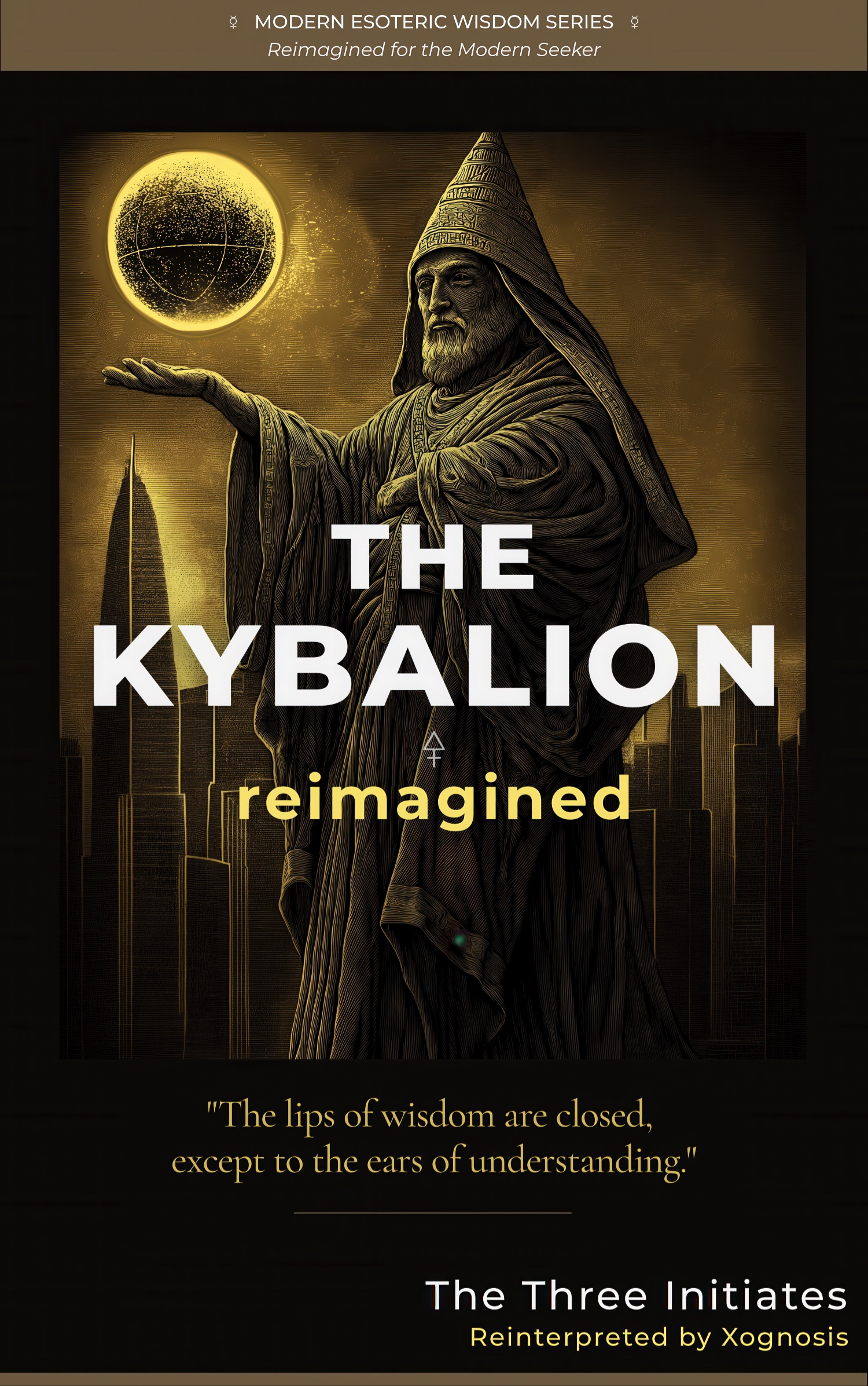
The title page announces itself with a motto: "The lips of wisdom are closed, except to the ears of understanding." The preface opens by presenting "this little work based upon the world-old Hermetic Teachings." Chapter I declares that "From old Egypt have come the fundamental esoteric and occult teachings which have so strongly influenced the philosophies of all races, nations and peoples, for several thousand years."
That is the legend, and it deserves to be named as legend. The book's frame story describes an oral transmission from teacher to prepared student, with maxims drawn from a lost source text also called "The Kybalion." The book itself concedes the point it hopes you will glide past, noting that the exact significance of the term had "been lost for several centuries." Nicholas Chapel, writing in the Journal of the Western Mystery Tradition, observes that the word "takes the form of a Greek noun, but has no meaning in that language or any other." There was no ancient Kybalion, and on Chapel's reading the name was coined to insinuate a link to antiquity.
The historical facts are these. William Walker Atkinson was born in Baltimore on December 5, 1862. He was admitted to the Pennsylvania bar in 1894 and the Illinois bar in 1903. In the mid-1890s he suffered a physical and mental breakdown attributed to overwork and recovered through the mind-cure movement, the healing philosophy then sweeping American metaphysical circles. The experience converted him. He turned to writing and publishing, producing more than fifty books under his own name and editing a string of New Thought periodicals in Chicago.
Around 1903 he began a second career as an oriental sage. Under the byline Yogi Ramacharaka, Atkinson issued at least thirteen books on yoga philosophy, breath control, and Hindu mysticism through his Yogi Publication Society. The Society promoted these with a biography of Ramacharaka as a real yogi born in India around 1799, who supposedly sent his student Baba Bharata to the 1893 World's Parliament of Religions in Chicago, where Bharata met Atkinson. The yoga historian Richard Rosen is blunt: "there's absolutely no record that a Baba Bharata addressed the Parliament." The biography was marketing, and Atkinson's reading public had no easy way to check it.
How do we know Atkinson wrote the Kybalion? The case rests on three legs, none of them secret-handshake material. First, a document: Atkinson's own self-submitted entry in the 1912 Who's Who in America listed The Kybalion among his works. The volume has not been independently inspected by every later researcher, but two independent scholars, Philip Deslippe and Mitch Horowitz, report the entry, and Horowitz states plainly that "Atkinson acknowledged sole authorship in an entry in Who's Who in America in 1912."
Second, infrastructure: the book was published by the Yogi Publication Society, which Atkinson ran from Chicago's Masonic Temple Building, the same operation that produced his Ramacharaka titles.
Third, style. Deslippe's introduction to the 2011 Definitive Edition, the first full-scale study of the book, argues from "similarities of content, format, and source material" that "do not exist with any other writer," noting that "the style of The Kybalion is consistent" with Atkinson's other works of the period, sharing "the same tone, voice, and quirks of syntax and word choice." Chapel's 2013 article summarizes the consensus: the book was likely written singlehandedly by Atkinson. Horowitz, who made the identification independently in his 2009 Occult America, adds that he was not the first.
The lore does survive in some quarters that Paul Foster Case, later a major figure in the American occult revival, was one of the three. Case reportedly told colleagues as much. But he was twenty-four in 1908 and had only just arrived in Chicago; Horowitz considers collaboration unlikely, and the claim now lives mainly in later biography. Horowitz has also offered a gentler reading of the byline as speculation: that the "three" echoes the three disciples of Hermes in the Hermetica, Tat, Ammon, and Asclepius. That is his interpretation, not a finding.
The Three Initiates were almost certainly one Chicago lawyer with a genius for publicity. The mystery was the marketing, and it worked for over a century.
Anonymity did commercial work. A byline named "William Walker Atkinson," a practicing attorney and former New Thought magazine editor, would have dated the book to 1908 and Chicago. "Three Initiates" suggested a hidden college, an unbroken lineage, custodians who could not speak except to worthy ears. The frame story made the reader's purchase feel like initiation.
The surrounding apparatus was equally modern. Atkinson's firms advertised in the mass press; at a 1919 federal mail-fraud hearing, testimony described the Advanced Thought Publishing Company, with offices at 904 Masonic Temple, placing frequent advertisements in The Nautilus and Physical Culture among other magazines. A postal inspector estimated the firm received roughly 200 letters a day. The surviving case file is a fragment, and its outcome is not in it, so the episode should be stated carefully: the proceeding reached Atkinson's two companies, and nothing in the available record resolves it. What the file does establish is scale. This was mail-order occultism, run like a catalog business, from an office tower in the Loop.
If not ancient Egypt, then what? The likely feedstock was two years old. G.R.S. Mead published his English translation of the Hermetic corpus, Thrice-Greatest Hermes, in London in 1906; Horowitz considers it probably the main source, with Anna Kingsford a secondary influence. Even the book's signature principles have traceable modern roots: Chapel traces the principle of vibration to the eighteenth-century associationist thinker David Hartley. The axioms are punchy and memorable. "The All is Mind; the Universe is Mental." "Nothing rests; everything moves; everything vibrates." Their lineage, however, runs through nineteenth-century metaphysical religion far more than through Alexandria.
Scholars disagree about how much this matters. Horowitz reads the book as a genuine, if dramatized, carrier of classical Hermetic themes. Chapel reads it as a New Thought text with only superficial Hermetic overlap, and Richard Smoley calls the aphorisms "very likely a pious fraud." The disagreement is live; readers deserve both readings rather than a verdict.
That the book still earns readers is not in dispute. A century of seekers have found its seven principles a serviceable ladder, which is presumably why new editions keep appearing, including retellings like The Kybalion Reimagined. One can read it with clear eyes and still enjoy the machinery. The honest posture is to know who built the machine, when, and for how much postage.
Read the book
Related Articles
Continue through articles sharing this topic.
In 1908 a small book appeared in Chicago under the byline "Three Initiates." In 1912 a Russian journalist finished a treatise on the fourth dimension, a…
7 min read
Every few decades, someone translates the esoteric classics again. New Enoches appear. New Pistis Sophias.
6 min read
Two texts, separated by something like two millennia and with no documented line of transmission between them, open with the same move.
6 min read
Every few years someone rediscovers the Kybalion and announces, with the confidence of a person quoting scripture, that it preserves the ancient wisdom of…
6 min read