 Xognosis EsotericaArcane Publishing Studio
Open a page of John Dee's Monas Hieroglyphica at random and you see a strange object: a single compound sign, part astronomical, part alchemical, drawn once and then taken apart piece by piece across twenty-four terse theorems. What you do not expect to find inside a magical symbol is arithmetic. Yet Dee put it there deliberately.
Share
Open a page of John Dee's Monas Hieroglyphica at random and you see a strange object: a single compound sign, part astronomical, part alchemical, drawn once and then taken apart piece by piece across twenty-four terse theorems. What you do not expect to find inside a magical symbol is arithmetic. Yet Dee put it there deliberately. Between the point, the line, and the circles on one side and the Christian Cabala on the other, his sequence of arguments runs through what the tradition called formal numbers, a way of treating number as the skeleton of reality rather than as a tool for counting merchandise. The Monas, published in Antwerp in 1564, is one of the few places where that arithmetic program is displayed inside an explicitly symbolic frame.
The publishing facts are solid. The Monas Hieroglyphica appeared in Antwerp in 1564, printed by Willem Silvius, in a Latin text of 107 pages. Wikipedia summarizes the work plainly as "an exposition of the meaning of an esoteric symbol that he invented". Dee dedicated it to Maximilian II and tried to present it to him around the time of the emperor's accession to the Hungarian throne, an attempt at patronage that went nowhere but tells us how Dee wanted the book read: as a gift fit for a ruler, a compressed body of knowledge rather than a curiosity.
The structure is the first clue that number matters here. The book does not lecture; it demonstrates. Each theorem takes some component of the glyph, the solar circle, the lunar crescent, the cross, and derives something from it, in an order that moves from the simplest geometric elements toward Cabala and a final synthesis. Our own edition's synopsis describes how, in twenty-four compact theorems, Dee "joins point, line, circle, the Sun and Moon, planetary characters, formal numbers, alchemical operations, Christian Cabala, and a single compound sign". That list is a program. Arithmetic sits in the middle of it, between the signs of the planets and the Hebrew-learning of Renaissance Cabala, and it is doing structural work in both directions.
Here the honest scholar has to slow down. The phrase "formal numbers" is how the arithmetic content of the theorems is described in the textual tradition our edition follows, and the deeper Renaissance background of the term, the scholastic and Neoplatonic idea of numeri formales, numbers existing as forms in things themselves, has not been pinned down in the sources for this essay. What can be said safely is this: in the number-philosophy inherited from Pythagoras and filtered through medieval and Renaissance Platonism, number was widely treated as prior to the things numbered. To know a thing's number was to know something about its structure rather than only its quantity.
Dee's theorems work in that spirit. The glyph is built up from units, and the argument about it proceeds by counting, combining, and resolving those units, the way a geometer proceeds from axioms. Stephen Clucas's 2010 study, titled "Pythagorean Number Symbolism, Alchemy, and the Disciplina Noua", points modern readers toward exactly this seam in the Monas, though its detailed claims lie outside what this essay has verified and should be consulted directly. The important point is that the arithmetic is not decoration pasted onto a mystical emblem. It is one of the load-bearing members.
The boldest move in the Monas is the junction of that arithmetic with Christian Cabala. Renaissance Cabalists worked with Hebrew letters as numerical values, so that words could be computed and numbers could be read as words. Dee, a Christian reader of that tradition, folded the logic into his symbol. Wikipedia characterizes the whole book as "an exhaustive Christian Kabbalistic interpretation of a glyph of his own design, meant to express the mystical unity of creation", and the reception confirms the register: as early as 1592 the Italian writer Giulio Cesare Capaccio could refer to the "recondite Kabbalistic philosophy" of the Londoner Dee. Interpretation, in other words, is not an accident someone later read into the Monas. It is the book's own method.
This needs to be said carefully, because two things easily get confused. The historical facts are the publication, the structure, the dedication, and Dee's documented engagement with Cabalist and mathematical learning. The meaning of the glyph is a separate matter, and a live one. Our edition is explicit on this point, avoiding any claim that "the whole Monad has one settled decoding", and holding one Hebrew formula from publication pending qualified review. That candor is rare in this genre and worth matching: any specific reading of the formal-number theorems is an interpretation, attributed and argued, not a decoded secret being announced.
One boundary should also be kept. Dee's later angelic conferences with Edward Kelley, the material commonly called Enochian, belong to the 1580s and are a different enterprise entirely. The 1564 theorems argue in daylight: geometry, number, planetary signs, and Cabala, joined in a single invented character. Readers who arrive from the later legend sometimes expect the Monas to whisper spirit-names. It does something more interesting. It calculates.
In 1570 Dee wrote the Mathematicall Praeface for Henry Billingsley's English translation of Euclid's Elements, and there the number doctrine steps out of the emblem and into the open. The Preface, as Wikipedia puts it, "argued for the importance of mathematics as an influence on the other arts and sciences", was "intended for an audience outside the universities", and became Dee's "most widely influential and frequently reprinted work". The argument opens with the status of mathematical objects and moves through number and magnitude before branching into a classification of the arts, laid out in the Groundplat, which our edition presents as "a complete searchable 72-node hierarchy that preserves every branch".
Read side by side, the two books illuminate each other. The Monas compresses a philosophy of number into a sign; the Preface expands a philosophy of number into a public map of knowledge. The arithmetic inside the symbol and the taxonomy inside the Euclid volume come from the same mind, six years apart, one written for the emperor's court and one for practical English readers. If the Monas is the cipher, the Preface is the plain text.
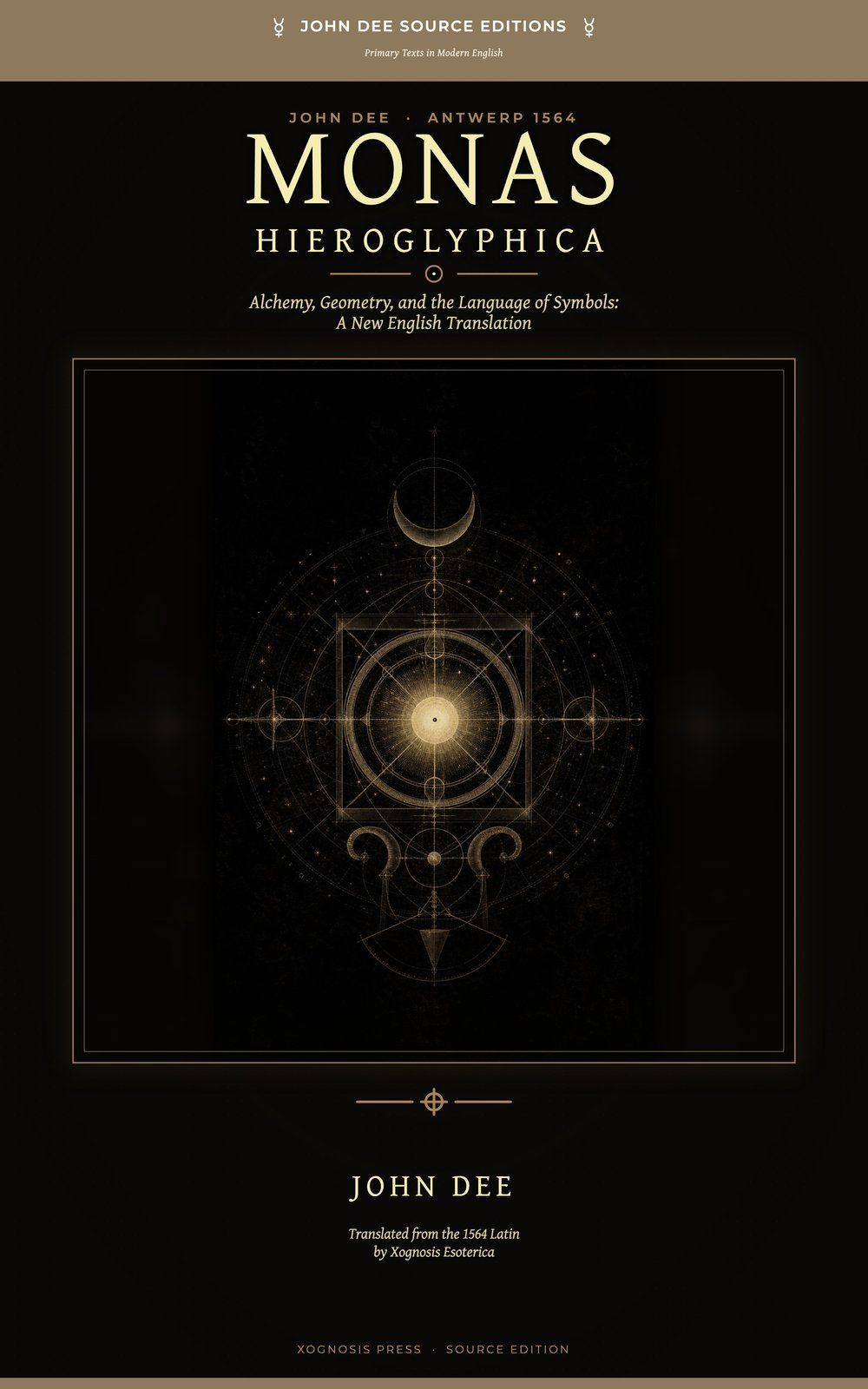
Our Monas Hieroglyphica edition is a new English translation controlled against the Wellcome witness, preserving the twenty-four-theorem order, the typography, and what the synopsis calls "mathematical and alchemical language", with an orientation that treats "geometry, number, planetary signs, alchemical language, and Cabala without treating them as interchangeable". For the 1570 side, The Mathematical Preface to Euclid gives the full argument in modern English with the Groundplat intact. Together they let you watch the same arithmetic wear two costumes.
Dee hid arithmetic inside a magical symbol because, for him, number was how creation was built; the Monas is a proof wearing the costume of a talisman, and its mathematics is the part meant to be checked.
After 1564 the glyph traveled without its author's supervision. Heinrich Khunrath reproduced it in his Amphitheatrum sapientiae aeternae, printed in 1595 with an expanded edition in 1609, and it appears in the 1616 Rosicrucian manifesto the Chymical Wedding of Christian Rosenkreutz. Reception is its own story. The theorem sequence, with formal numbers at its hinge, is the part that rewards close reading now, and it is best read in a text that tells you honestly which decoding is settled and which is still open.
Read the book
Related Articles
Continue through articles sharing this topic.
Two books sit at the far ends of the esoteric shelf, and they answer the same question in opposite ways.
6 min read
In the summer of 1552, two of the most restless minds in Europe were, as far as anyone can tell, in the same city at the same time.
6 min read
Open a modern edition of A True and Faithful Relation and you meet a problem before you meet a single angel.
7 min read
There is a shelfmark in Glasgow that every serious student of John Dee eventually learns: Sp. Coll. Hunterian R.6. It holds what the scholar A.
6 min read