 Xognosis EsotericaArcane Publishing Studio
In the summer of 1552, two of the most restless minds in Europe were, as far as anyone can tell, in the same city at the same time. Gerolamo Cardano, the Milanese physician and mathematician, had come to Britain to cure an archbishop thought to be beyond help. John Dee was twenty-five that summer and living in London.
Share
In the summer of 1552, two of the most restless minds in Europe were, as far as anyone can tell, in the same city at the same time. Gerolamo Cardano, the Milanese physician and mathematician, had come to Britain to cure an archbishop thought to be beyond help. John Dee was twenty-five that summer and living in London. What happened between them during that passage has been told, retold, and embellished for over a century, and the honest version is stranger than the legend, because the honest version requires us to say what we know and admit what we do not.
Cardano's presence in Britain is solid ground. As the standard references put it, "In 1552, Cardano travelled to Scotland with the Spanish physician William Casanatus, via London, to treat the Archbishop of St Andrews" (Wikipedia, "Gerolamo Cardano"). The patient was John Hamilton, archbishop of St Andrews, who according to Cardano's own later account had been speechless and thought incurable. The treatment succeeded. In his autobiography Cardano reported the details with characteristic self-regard: "Cardano wrote that the Archbishop had been short of breath for ten years, and after the cure was effected by his assistant, he was paid 1,400 gold crowns" (Wikipedia, summarizing Cardano's account). A fee of 1,400 gold crowns tells you what Cardano's reputation was worth at the height of his career.
The London leg of the journey is where Dee enters the story. The biographical tradition holds that the two men met there. The claim as modern reference works state it is that in 1552 Dee "met Gerolamo Cardano in London, with whom he investigated a purported perpetual motion machine and a gem supposed to have magical properties" (Wikipedia, "John Dee"). Two mathematicians bending over a machine that promised to move forever, and a stone said to hold power. It is a wonderful image, and it deserves scrutiny before it is believed.
Here the record thins out, and a reader deserves to know exactly how much. The meeting claim descends through the standard biographies of Dee, and the underlying primary evidence usually cited is a passage in Cardano's De Rerum Varietate describing a young English mathematician, which some scholars have read as Dee. That passage was not located in preparing this article, and the modern biographies that repeat the story do not always flag how indirect the trail is.
The divergence among reference works is itself telling. Wikipedia's Dee article states the 1552 meeting as flat fact. The MacTutor History of Mathematics biography of Cardano, maintained at the University of St Andrews, records the 1552 trip to Scotland and says nothing at all about England or Dee. When adjacent standard references disagree on whether a meeting happened, that disagreement is information. The most defensible statement is this: Cardano was certainly in Britain in 1552, both men were in London that year, a meeting was entirely possible, and the specific scene with the perpetual motion machine and the gem belongs to the biographical tradition rather than to documented record.
There is one further piece of negative evidence, and it cuts both ways. Dee kept a private diary, whose surviving entries begin in 1554, and it never mentions Cardano. That silence proves nothing, since the diary starts two years after the putative meeting. It is a fact about the sources, not evidence against the story.
The article's title promises spirits, so let us be precise about what each man actually did, because they did very different things.
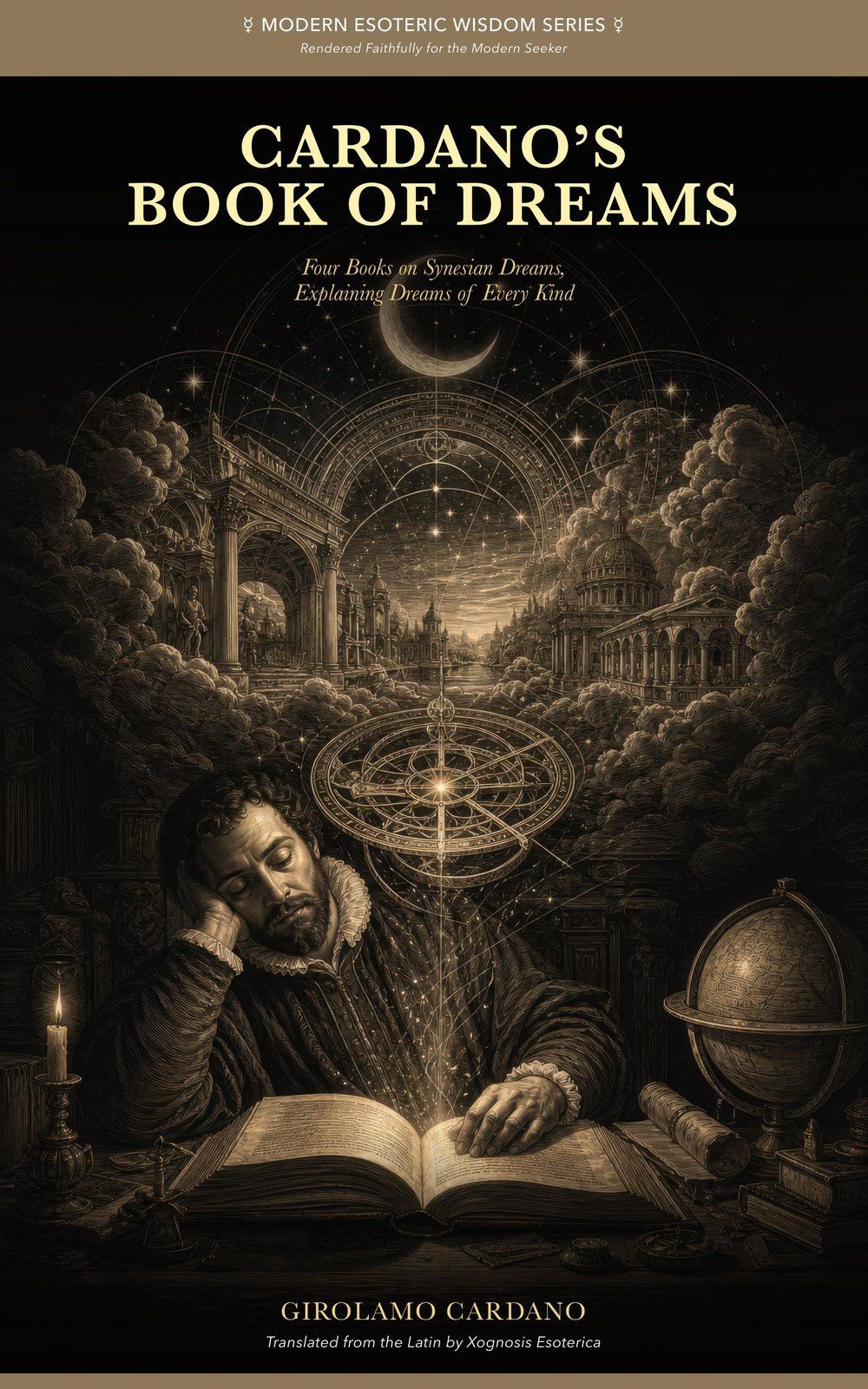
Cardano interpreted dreams. His major work on the subject, Somniorum Synesiorum, was published in Basel in 1562, its full title announcing books that explain "omnis generis insomnia", dreams of every kind. The title looks back to Synesius of Cyrene, the late-antique bishop and philosopher who wrote on dreams, and Cardano framed dreaming as a natural phenomenon that could be studied and interpreted by rules. His own dreams, recorded and analyzed with the same unsparing attention he gave everything else, formed part of the material. This is the side of Cardano we publish in our edition of Cardano's Book of Dreams: a rationalist of the sixteenth century building a systematic account of the dream world, decades before anyone had a vocabulary for psychology.
Dee, decades later, went much further. From 1582 he worked with Edward Kelley, who first appeared in Dee's circle that year calling himself Edward Talbot, holding the sessions Dee called "actions": attempts to make contact with angelic intelligences through a scryer who reported what the spirits showed him. The sessions were conducted, the accounts insist, with intense Christian piety. Dee did not consider himself a necromancer. He considered himself a devout man seeking knowledge from legitimate spiritual sources, and he recorded the conversations in diaries with the same meticulousness he brought to astronomical observation.
The diaries outlived him. Decades after Dee's death, Meric Casaubon published them in 1659 as A True and Faithful Relation of What Passed for Many Yeers between Dr. John Dee and Some Spirits, and that publication fixed Dee's public image permanently as the man who talked with angels. His private diary, a plainer and more human document covering everything from library loans to family illness from 1554 into the 1590s, survived separately; Halliwell's 1842 edition for the Camden Society made it widely available, and we publish it as The Private Diary of Dr John Dee.
Cardano's unorthodox writings caught a different kind of attention. In 1570 the Inquisition arrested him for heresy and his non-medical works were placed on the Index. He died in 1576, well before Dee's angel conferences began. Any scene of the two men comparing notes on spirits is a later construction, and no contemporary account has them holding a joint session or corresponding about angels.
Between them, the two men cover the whole spectrum of Renaissance approaches to the unseen. Cardano, who gambled his way through an uncertain youth and became Europe's most famous physician, treated dreams as data. Dee, the mathematician who trained England's navigators and advised its voyages of exploration, treated angels as interlocutors. Both paid for it: Cardano in a heresy cell, Dee in a reputation that collapsed around him late in life, when he returned from the continent to find his library ransacked and his neighbors convinced he was a conjurer.
Dee's Monas Hieroglyphica of 1564, an enigmatic treatise on a single symbolic glyph meant to encode the unity of creation, sits at the junction of his mathematics and his mysticism; our edition of the Monas Hieroglyphica lets the reader judge how far the two really separated in his mind.
The documented fact is that Cardano and Dee shared London in 1552. The meeting, the machine, and the gem belong to biographical tradition. And the "talking to spirits" each man did, Cardano with dream interpretation in the 1560s, Dee with scryers and angels in the 1580s, happened separately, decades apart, in forms the legend conflates.
The legend persists because it is a good story, and because it compresses a truth the sources state more slowly: the sixteenth century made no clean division between mathematics and the invisible world, and its two most ambitious students of that divide moved in overlapping circles, once, possibly, in the same room.
Read the book
Related Articles
Continue through articles sharing this topic.
Two books sit at the far ends of the esoteric shelf, and they answer the same question in opposite ways.
6 min read
Open a modern edition of A True and Faithful Relation and you meet a problem before you meet a single angel.
7 min read
Open a page of John Dee's Monas Hieroglyphica at random and you see a strange object: a single compound sign, part astronomical, part alchemical, drawn once…
6 min read
There is a shelfmark in Glasgow that every serious student of John Dee eventually learns: Sp. Coll. Hunterian R.6. It holds what the scholar A.
6 min read