 Xognosis EsotericaArcane Publishing Studio
Open a modern edition of A True and Faithful Relation and you meet a problem before you meet a single angel. Meric Casaubon, printing the book in 1659, knew exactly what his readers would say about John Dee, and he put the objection on the table himself: this was a man whom England had long called a conjurer.
Share
Open a modern edition of A True and Faithful Relation and you meet a problem before you meet a single angel. Meric Casaubon, printing the book in 1659, knew exactly what his readers would say about John Dee, and he put the objection on the table himself: this was a man whom England had long called a conjurer. So the volume does not begin with the diaries. It begins with a defence. And the defence is Dee's own, written while he still lived, reprinted by Casaubon as the record's front door. Few readers who quote the angel conversations have ever walked through it.
The label was not a late invention of hostile posterity. Casaubon notes that Dee "began to have the reputation of a Conjurer betimes," meaning early, and he points to the evidence in Dee's own Mathematical Preface to Billingsley's English Euclid of 1570. At the close of that Preface, thirteen years before the first recorded angel action of 28 May 1583, Dee was already complaining grievously of the imputation, and calling himself, in Casaubon's paraphrase, "An old forworn Mathematician." A man does not call himself forworn in his early forties unless the fight has already cost him something.
The maths is the point. To the ordinary Elizabethan reader, the calculations and instruments of a mathematician were barely distinguishable from the circle-drawing of a stage magician, and, in the popular imagination at least, the stage did its part to fix the type. Dee's learning made him suspect, and the suspicion made him a stock figure. His own defence, and Casaubon's testimony after him, stand against that legend: the popular image of Dee as a worker of black magic is contradicted by the record both men left.
On 12 December 1595, Dee wrote to the then Archbishop of Canterbury, Whitgift, a letter Casaubon calls a "discourse Apologetical"; it was printed in 1599 by Peter Short. Casaubon's summary of it survives, and it is a catalogue of wreckage offered as a defence. In it Dee lists his own written works, printed and unprinted, to the number of 48 in all. He describes his library of about 4000 volumes, of which 700 were ancient manuscripts in Latin, Greek, and Hebrew. And he produces a testimony from the University of Cambridge dated 1548, evidence of standing that reached back half a century.
Read as an argument, the apology runs: look at what I have written, look at what I have collected, look at who has vouched for me. This is the case of a scholar who believes the record will clear him. Casaubon thought it short enough to be worth reprinting entire, and placed it "the next after this Preface," so that anyone opening the 1659 volume would meet Dee's defence before a single spirit spoke.
The letter survives independently of Casaubon, and its 1599 printing is transcribed online. Its own title makes the posture plain: "A plaine Demonstration, and feruent Protestation, for the lawfull, sincere, very faithfull and Christian course" of his "Philosophicall studies and exercises." The quotations in this article follow Casaubon's Preface summary, which tracks the letter closely; anyone quoting the letter at length should work from the transcription or a facsimile.
Casaubon did not believe Dee was a conjurer, and he said so with care. His words are worth having exactly:
"For my part whether he could ever truly be so called, I yet make some question: But I am very confident, that himself did not know or think himself so, but a zealous worshipper of God, and a very free and sincere Christian."
That is a distinction, and a subtle one. Casaubon leaves open whether Dee could in fact be called a conjurer, while insisting that Dee did not think of himself that way. Elsewhere he puts it flatly: Dee never sought unto devils directly, and "abhorred the thought of it in his heart." Sincerity is granted. The question of what the spirits actually were is answered in Casaubon's own editorial frame: Dee's "only (but great and dreadful) error being, that he mistook false lying Spirits for Angels of Light." That judgement is Casaubon's interpretation, written fifty years after Dee's death, and it should be read as the editor's theology doing its work, not as a settled fact about the events.
Casaubon also noticed the awkward chronology and said so plainly. Pointing readers to the Euclid Preface, where Dee "doth plead his own cause, to acquit himself of that grievous crime and imputation of a Conjurer," he adds: "But that was written, I must confess, long before his Communication with Spirits." The defence predates the thing defended against suspicion of it. Dee was answering the charge of conjury years before he ever sat at a table with a shew-stone, and the popular legend has never quite absorbed that sequence.
There is a material reason the 1659 volume opens this way, and it is a story of buried paper. The diaries survived in Dee's own hand in the Cotton library, where Sir Robert Cotton had bought the remains of Dee's library along with the manuscript. Casaubon attests that "The Original Copy it self, all written with Dr. Dees own hand, there kept and preserved." But the book had a hard history. In his Preface Casaubon reports that it "had been buried in the Earth," and that though it was carefully kept afterward, "it retained so much of the Earth, that it began to moulder and perish some years ago." Sir Thomas Cotton, seeing this, paid out of his own pocket to have a fair copy made "before it should be too late."
So the physical book nearly died in the ground, and the record we have was saved by a transcribing commission. Given a manuscript rescued from decay, and a subject everyone thought they already understood, Casaubon made an editor's choice: let the accused speak first. The diaries begin abruptly on 28 May 1583, with Laski's visit to England already in the air, and they run to the actions of 1607, which Casaubon suspected came near the end of Dee's life. Before all of that, he placed the apology. It is as if the volume itself declines to let the sessions start until the reader has heard the defence.
The record's own front door is a plea, not a séance: before a single angel speaks in A True and Faithful Relation, the man accused of summoning them is allowed to answer the charge in his own words.
That framing has consequences for how the book should be read. The angel conversations, dramatic as they are, sit downstream of a reputation crisis that began in the 1560s. The Dee of 1583, leaning over a table while Edward Kelley reports what the spirits show, is the same Dee who had spent decades insisting he was a mathematician and a Christian scholar, and who would go on insisting it to the Archbishop in 1595.
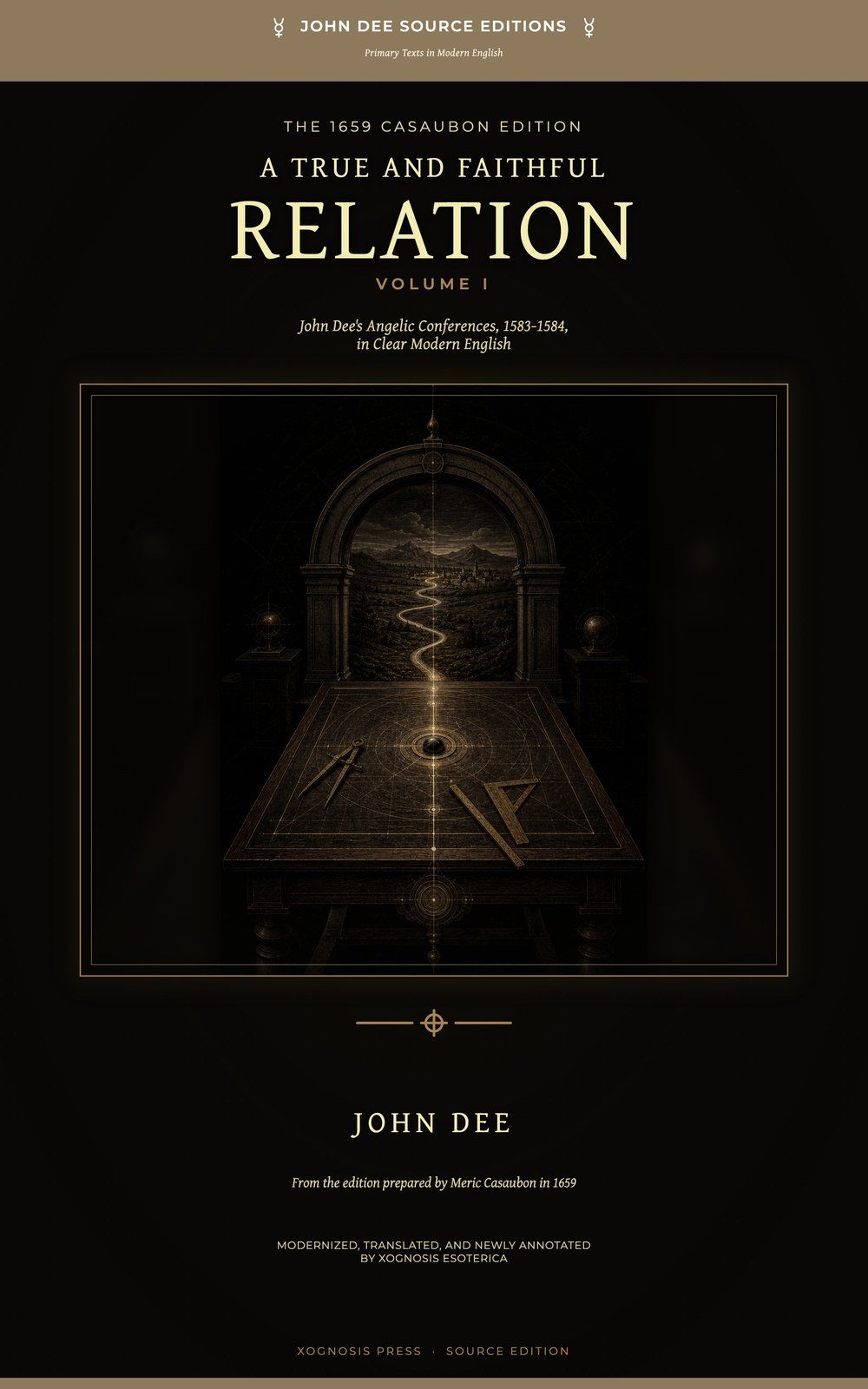
For the reader who wants the full arc, from Casaubon's Preface through Dee's reprinted apology and into the diaries themselves, our edition of *A True and Faithful Relation*, Volume I puts the defence back where the 1659 printer put it, at the front. The manuscript trail is real and checkable: the original in the British Library's Cotton Appendix MS XLVI, in Dee's own hand, with Casaubon's annotated copy in the Bodleian. Elias Ashmole had already printed diary material in his Theatrum Chemicum Britannicum of 1652, so printed awareness of Dee's manuscripts preceded Casaubon by seven years.
Vindication is not ours to give, and neither is conviction. What the apology gives is position. Dee under oath, as it were, cataloguing his books and his witnesses, telling the Archbishop and the century that he knows what is being said about him. The diaries have kept their strangeness for four centuries. The apology has kept something rarer: the sound of the accused man refusing the sentence.
Read the book
Related Articles
Continue through articles sharing this topic.
Two books sit at the far ends of the esoteric shelf, and they answer the same question in opposite ways.
6 min read
In the summer of 1552, two of the most restless minds in Europe were, as far as anyone can tell, in the same city at the same time.
6 min read
Open a page of John Dee's Monas Hieroglyphica at random and you see a strange object: a single compound sign, part astronomical, part alchemical, drawn once…
6 min read
There is a shelfmark in Glasgow that every serious student of John Dee eventually learns: Sp. Coll. Hunterian R.6. It holds what the scholar A.
6 min read