 Xognosis EsotericaArcane Publishing Studio
Open an old alchemical text expecting dragons, celestial spheres, and hermetic thunder, and you will often find yourself instead in a house. Someone is bathing. Someone is in bed.
Share
Open an old alchemical text expecting dragons, celestial spheres, and hermetic thunder, and you will often find yourself instead in a house. Someone is bathing. Someone is in bed. In the Cantilena attributed to George Ripley, the fifteenth-century canon of Bridlington, the central action reads like family life: the mother "Bath'd her with the Teares which she had shed," the child-to-be feeds on strange food ("Peacocks Flesh she kindly Eate, / And Dranke Greene-Lyons Blood"), and at the work's turning point the subject is simply "great with Child." Whatever the Great Work was supposed to be, its authors reached for the vocabulary of the household to describe it.
This is the puzzle this article sits with. Why would a tradition that claimed to hold the secret of matter describe its operations through laundry, marriage, pregnancy, and nursing?
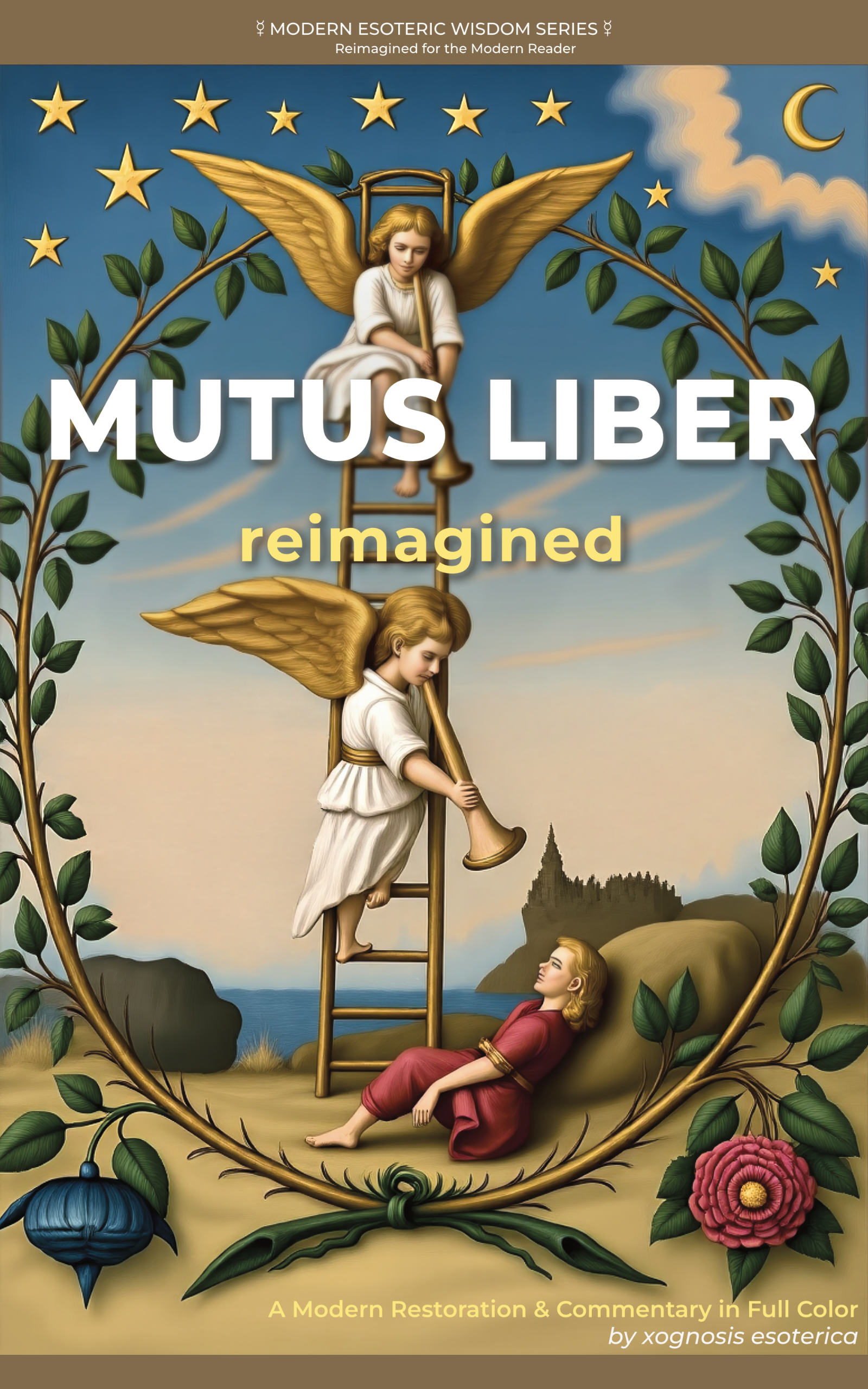
The strangest artifact of this domestic tendency is the Mutus Liber, printed at La Rochelle in 1677 by Pierre Savouret. The title means "silent book," and the book earns it: the work consists mainly of fifteen illustrated plates, almost without text. Where other alchemical authors buried their secrets under layers of cover language, this one dispensed with language entirely and let pictures carry the whole argument.
The silencing goes further than the format. The stated author, "Altus," and the attribution to one Jacob Saulat, Sire of Marez, do not survive scrutiny. The standard reference article says both assertions were soon shown to be fictitious, and the Library of Congress catalog still repeats the phrase "possibly fictitious Jacob Saulat" in its own notes. Modern scholarship instead names the La Rochelle printer Isaac Baulot as the likely author, with the engraver Abraham Thevenin probably working on the plates and two local doctors, Elie Bouhereau and Elie Richard, contributing to the conception. That remains an attribution, not a settled conclusion.
A legend attaches to the book's origin. Manuscript notes in one university library copy record that the plates were "first found in 1677 in the library of Denis Tolle, a doctor in La Rochelle." That is tradition, not documented provenance, and should be held as such. What survives as hard bibliography is this: the 1677 La Rochelle printing, the fifteen-plate format, and a 1702 Geneva reprint with newly engraved plates for Manget's Bibliotheca Chemica Curiosa. Adam McLean, who painted hand-coloured versions of the series in June 1999, notes that he worked from the 1677 plates "rather than the more commonly" reproduced Manget set, since the two versions differ in engraving. Marsh's Library in Dublin, which holds a copy, describes the 1677 printing as almost entirely pictorial.
According to the standard reference article, the plates "arouse contradictory interpretations." That sentence deserves to be taken slowly. A wordless book of fifteen pictures has produced centuries of disagreement precisely because pictures of ordinary things are the most load-bearing kind. A dragon announces itself as symbol. A person doing chores at a table does not. The ordinariness is the concealment.
I will not walk you plate by plate. The plates repay an unannounced reading, and a confident description has a way of hardening into doctrine, which is the fate the book's author tried to escape by leaving out the words. The general claim is yours to test: that the pictures draw their raw material from farm and household labor rather than from laboratory glassware. The plates are digitized, and our own reimagined editions, Mutus Liber Reimagined in full colour and the monochrome edition, reproduce the series for exactly this kind of looking.
What can be said with confidence is structural. A wordless alchemical book published in 1677 staked its whole doctrine on pictures, and on pictures of recognizable daily work at that: hands, heat, time, and materials that spoil. That choice tells you the intended register. Whatever transformation the plates diagram, it is dressed as labor the viewer already understood, the kind performed in kitchens, fields, and workshops rather than by any apparatus a specialist would recognize.
The Cantilena makes the same choice in words. Its images are bath, bed, sheets, marriage, pregnancy, and milk. It contains, I should note plainly, no baking, bread, oven, kneading, grain, or harvest imagery at all; the poem keeps to the washbowl and the marriage bed. That matters for honesty, because the Cantilena is often loosely cited for "kitchen alchemy," and the text itself does not support the kitchen half of the phrase. What it supports is domesticity.
But domesticity is the point. The operations are figured as conception, gestation, and nursing because those are the transformations people watched succeed. Bread dough rising, grain swelling in the field, a pregnancy coming to term, a sick body bathed and sweating: these were the reliable transformations in an early modern world where laboratory chemistry barely existed as a discipline. A tradition trying to describe an invisible process in publicly checkable terms had nowhere better to reach than the processes everyone had already watched in a kitchen, a byre, or a bedroom.
So the household imagery is doing precise technical work, or at least claiming to. Bathing corresponds to washing and purifying the matter. Marriage figures the union of opposites. Pregnancy and nursing figure the slow maturation of the Stone, the idea that the product cannot be hurried but must be carried to term. These interpretations are old, but they remain interpretations. Carl Jung, who owned a 1677 copy of the Mutus Liber and used its plates to illustrate Psychology and Alchemy, built a whole psychological reading on such material, mapping the domestic scenes onto processes internal to the psyche. His reading is coherent and influential, and it is a reading, which is how it should be labeled.
It helps to keep three registers separate. The bibliographic facts are firm: La Rochelle, 1677, Savouret, fifteen plates, a 1702 Geneva reprint with new engravings, and an authorship so obscure that even the named author may be an invention. The legend of Denis Tolle's library is a tradition recorded in later manuscript notes, appealing and unproven. And every statement about what the pictures mean, including everything in the previous section, is interpretation layered onto images that their own publisher refused to caption.
That refusal is the most eloquent thing in the book. An author who believed words were the problem, who watched other alchemical writers contradict themselves into obscurity, handed the whole doctrine to pictures of ordinary work and let the reader supply the theory. The reader has been supplying it ever since, which is why the interpretations contradict each other and why the book still gets reprinted.
The old alchemical authors described invisible processes through the transformations their readers had watched succeed: dough rising, fields ripening, pregnancies coming to term. The household imagery was the evidence base.
Read the book
Related Articles
Continue through articles sharing this topic.
Some books resist being read aloud. You can summarize a novel over dinner, and a history book lends itself to bullet points, but a certain strain of…
7 min read
Two books sit at the far ends of the esoteric shelf, and they answer the same question in opposite ways.
6 min read
A book with no sentences is a bold wager. In 1677, at La Rochelle on the French Atlantic coast, the publisher Pierre Savouret printed a slim volume of…
6 min read
The Mutus Liber arrived in 1677 as a book with almost no words in it. Fifteen engraved plates, published in La Rochelle by Pierre Savouret, credited to an…
5 min read
Related Books
Catalog volumes sharing this article’s lead tag.