 Xognosis EsotericaArcane Publishing Studio
Some books resist being read aloud. You can summarize a novel over dinner, and a history book lends itself to bullet points, but a certain strain of esoteric literature was built on a different assumption: that the picture carries meaning the sentence cannot.
Share
Some books resist being read aloud. You can summarize a novel over dinner, and a history book lends itself to bullet points, but a certain strain of esoteric literature was built on a different assumption: that the picture carries meaning the sentence cannot. Three centuries of this tradition, from Elizabethan London to La Rochelle to twentieth-century Russian émigré circles, produced books you do not merely read. You look at them, sometimes for years, and the looking is the argument.
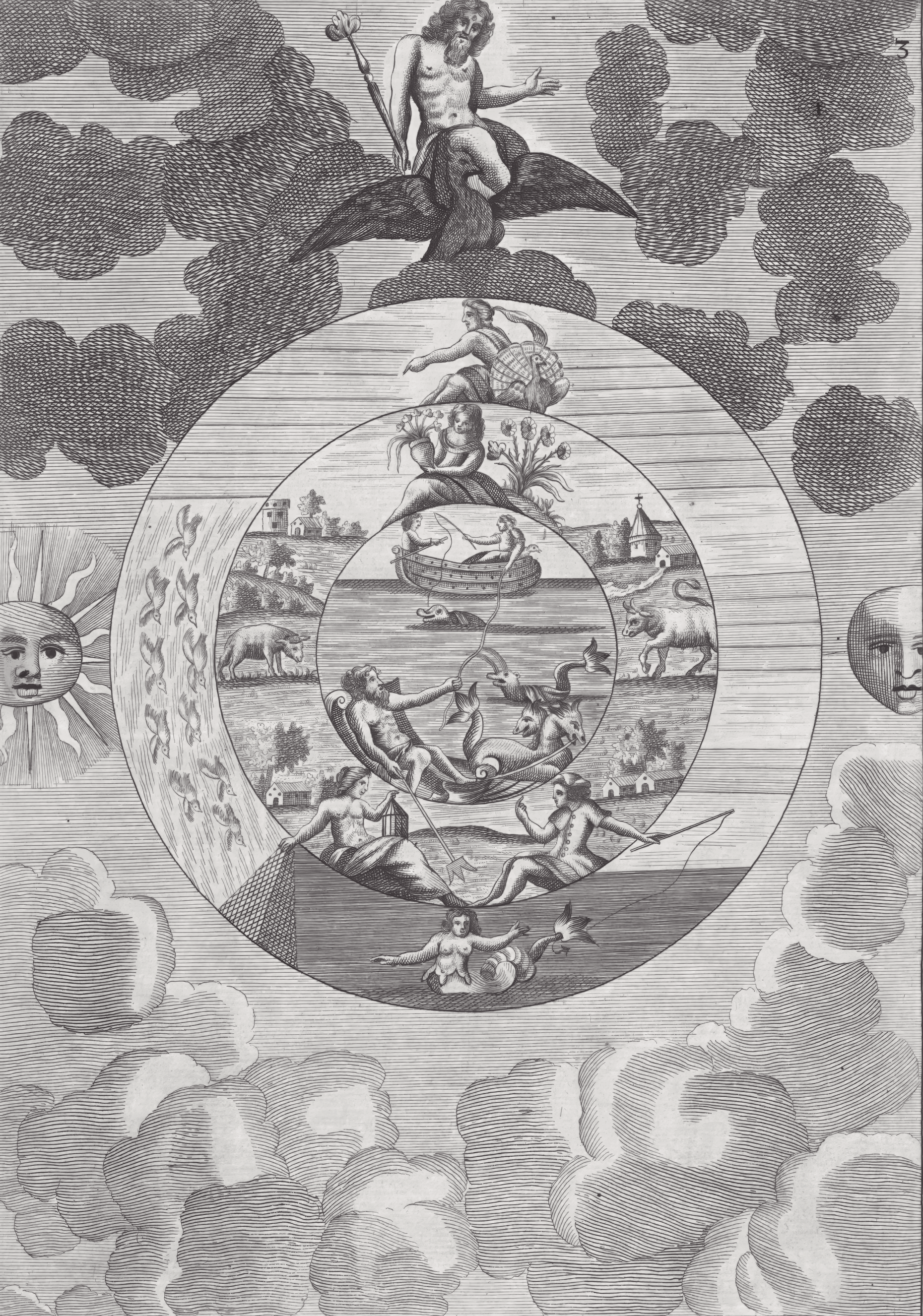
The purest example is the Mutus Liber, the "silent book," first printed in 1677 at the port town of La Rochelle. As the standard account has it, "The first edition of Mutus Liber dates from 1677, published by Pierre Savouret in La Rochelle." The press run was tiny, a few dozen copies, and the book itself is almost entirely pictures: fifteen engraved plates in the 1677 edition, showing figures climbing ladders, drawing dew from sheets stretched over fields, tending furnaces, and consulting the stars. A handful of mottoes aside, there is no text to speak of. The reader is given images and left alone with them.
The book wants you to believe it was written by someone. Its title matter names an author, "Altus, a scholar in high chemistry of Hermès," and an inventor, Jacob Saulat, Sire of Marez. These attributions deserve skepticism. As the research literature puts it, "these assertions were soon proven to be fictitious." The names are part of the book's design, a costume of antiquity put on a seventeenth-century publication. Treat them as tradition, not biography.
Later editions complicated the picture. A 1702 Geneva reprint by Chouet and Manget introduced newly engraved plates, and these later re-engravings became more common than the originals. A claimed 1725 Paris printing rests almost entirely on the word of Eugène Canseliet, the figure entangled with the Fulcanelli legend, and its existence has not been established. That is legend layered on top of a printed book, and it should be kept clearly separate from what the bibliographic record supports: La Rochelle 1677, Geneva 1702, an extremely rare Paris printing around 1760, and a revival of editorial interest in the late nineteenth century.
Our own Mutus Liber Reimagined (Full Color) edition reproduces the fifteen plates in full color, with a companion set of reimagined plates. The point of the original was that the images do the work. The point of a modern color edition is that you can finally see how they might have done it.
A century before the Mutus Liber, John Dee tried the opposite experiment. Where the La Rochelle book says nothing, Dee's Monas Hieroglyphica (Antwerp, 1564) says a great deal, but about a single invented sign. The book, published by Willem Silvius, runs 107 pages and expounds one composite symbol assembled from the conventional astrological glyphs for the planets and elements. Its structure is that of a geometrical treatise. As the Cardiff University special collections account summarizes it, "Dee published Monas Hieroglyphica, a series of twenty-four theorems interpreting the Hieroglyphic Monad." Theorem by theorem, Dee unfolds what he takes the sign to contain.
Reading him is hard going even in translation. "Understanding the text is difficult because of Dee's Latin wordplay, unexplained capitalization, odd spacing and diacritics," as one account understates it. The prose performs the same operation as the symbol: it compresses, it folds meanings into one another, and it refuses to hand you a plain paraphrase.
Here the honest distinctions matter. The facts are these: Antwerp, 1564, Silvius as printer, one symbol, twenty-four theorems, notoriously difficult Latin. Any specific claim about what the Monad means, cabalistic, astronomical, devotional, is interpretation, and the interpretations diverge sharply. Dee's own statements about the symbol's extraordinary powers are Dee's claims, reported as such, not established properties of an inked figure on paper. The standard scholarly treatment remains C. H. Josten's 1964 translation and study in Ambix, the reference on which later scholarship leans. Our Monas Hieroglyphica edition makes the text and the symbol available together, which is the only way the book makes sense.
Jump forward again, to the talks P. D. Ouspensky gave at his meetings in London and New York, published posthumously as The Fourth Way (1957). Here the visual register shifts from emblems to schematics. The teaching Ouspensky relayed, drawing on G. I. Gurdjieff, describes human beings as machines run by many competing "I"s, and it renders that claim in dozens of diagrams: branching trees of selves, the enneagram, cosmological ladders of rays and worlds. Our The Fourth Way Explained edition contains thirty-eight of these diagrams, and we say "thirty-eight" because we counted them in our own pages, not because the number belongs to the public-domain work as a fixed bibliographic fact.
A caution the honest reader should keep: In Search of the Miraculous and The Fourth Way present Gurdjieff's cosmology as reported speech. What is fact is that Ouspensky wrote these books and drew these diagrams. What Gurdjieff claimed about the structure of the universe is a claim inside a teaching narrative. The diagrams are not photographs of a metaphysical landscape; they are arguments drawn in ink, designed to make a psychological point visual. A ladder of selves on paper can change how you notice yourself, and that effect needs no cosmology to be true.
Underneath all three of these books lies a fourth and far older one: Euclid, whose Elements came into English in 1570 through Henry Billingsley, translated from the Greek rather than from a Latin intermediary, with technical advice from John Dee. Dee attached to it his Mathematicall Praeface, a sweeping defense of the mathematical arts, and the whole volume is a monument to the diagram as an instrument of certain knowledge. Proposition by proposition, line by drawn line, the page shows you what the words assert.
Dee's praise of the mathematical sciences is extravagant in the original spelling: arithmetic, he writes, is "of all Sciences, next to Theologie, it is most diuine, most pure, most ample and generall, most profounde, most subtile, most commodious and most necessary." And he quotes Plato's warning that geometry is a science of another condition entirely than the account its own practitioners give of it. The preface is available in our Mathematical Preface to Euclid edition, with the full text of the 1570 original.
Put the four books side by side and a family resemblance emerges across three centuries and three very different temperaments. The alchemists withheld words because they thought the pictures could carry an operational meaning that plain language would corrupt. Dee built one symbol and then spun a geometrical argument around it. Ouspensky drew the structure of attention itself. Euclid's tradition, the eldest of them, established the rule they all borrow: in the exact sciences, the diagram is allowed to bear the burden of proof.
The esoteric picture book does not illustrate an argument that could be made in words. In the strongest of these works, the picture is the argument, and the text, where it exists at all, is the commentary you are permitted after you have looked.
That is the honest defense of the tradition, and its honest limit. A picture that cannot be paraphrased can also never be checked. Dee's Monad has accumulated readings for four and a half centuries precisely because no reading can be final. The Mutus Liber has kept its silence since 1677, and every generation of readers, Geneva in 1702, Paris in the 1760s, the nineteenth-century revival, and now us, has projected a different operation onto its ladders and its dew. The books that make you look are the books that make you confront how much of understanding is seeing, and how much is merely recognizing what you already believed.
Read the book
Related Articles
Continue through articles sharing this topic.
The Mutus Liber arrived in 1677 as a book with almost no words in it. Fifteen engraved plates, published in La Rochelle by Pierre Savouret, credited to an…
5 min read
The Mutus Liber, the "silent book" of alchemy, has no text to argue with. A sequence of engraved plates, a title page, and little else: no preface, no…
5 min read
Of the fifteen plates in the Mutus Liber, the eleventh is the one where the whole doctrine squeezes itself into a single drop of water.
5 min read
Somewhere near the start of the Mutus Liber, a ladder leans against the sky. Figures climb it, and above them angels wring out clouds like wet linen,…
5 min read