 Xognosis EsotericaArcane Publishing Studio
A book with no sentences is a bold wager. In 1677, at La Rochelle on the French Atlantic coast, the publisher Pierre Savouret printed a slim volume of engraved plates, almost entirely without words: vessels, furnaces, a couple kneading dew from hung sheets, a woman at a well, an angel lowering a ladder.
Share
A book with no sentences is a bold wager. In 1677, at La Rochelle on the French Atlantic coast, the publisher Pierre Savouret printed a slim volume of engraved plates, almost entirely without words: vessels, furnaces, a couple kneading dew from hung sheets, a woman at a well, an angel lowering a ladder. Its only continuous text is a handful of Latin phrases, including one famous instruction at the foot of an emblem: "Ora, Lege, Lege, Lege, Relege labora, et Invenies." Commonly translated: pray, read, read, read, reread, work, and you will find. The book has kept that promise unevenly. Readers have worked for three centuries, and what they found, mostly, was more questions.
The Mutus Liber, or "silent book," does name an author, and that is where the trouble starts. The book itself credits one Altus, described as a "scholar in high chemistry of Hermès," and names as the work's inventor Jacob Saulat, sieur des Marez. These sound like real men of the seventeenth century. They are not. As the English Wikipedia account puts it, "these assertions were soon proven to be fictitious." The volume announces a small deception before its images even begin.
Later guesses fared little better. The Reverend Arcère, a historian of La Rochelle, proposed one Jacob Tollé as the true author, and even Tollé's existence has since been doubted. The silent book attracted loud, confident attributions for two hundred years, and nearly all of them dissolved under inspection.
It is worth pausing on what that means. A wordless text removes the usual anchors: no prose style to compare, no dedications to trace, no printer's errors that fingerprint a compositor. What remains is engraving, and engravings can be copied, reworked, and reattributed with ease. The anonymity reads as a design feature rather than an accident, and it made the book a screen onto which every generation projected its favorite candidate.
What can be stated as firm fact is the imprint. The first edition appeared at La Rochelle in 1677, printed by Savouret. The choice of city carries a resonance that the surviving records do not explain. La Rochelle had been the great Protestant stronghold of France until the siege of 1628 broke its independence, and alchemical and hermetic printing had long overlapped with heterodox and Reform circles elsewhere in Europe. But the specific link between this book's production and Huguenot networks is not established in the sources gathered here; the documents confirm only where it was printed. Anything more about the publishers' confessional motives would be speculation, and the honest historian leaves it there.
The book then led a busy afterlife in print. A Geneva reprint followed in 1702, with new plates, under the editors Jean-Antoine Chouet and Jean-Jacques Manget. Around 1760 a Paris edition appeared, entirely re-engraved again, and is now described as extremely rare. Modern reprints began in 1867, from Thibaud in Clermont-Ferrand, and have multiplied since. For a book that refuses to speak, it has been remarkably willing to be reprinted.
Here is the figure that gives this article its title: "Twelve original copies are conserved in main Western libraries." Twelve copies of the 1677 La Rochelle printing, scattered across the major collections of the West, out of a print run that was never large; the same account allows that no more than a few dozen copies were ever printed.
That number deserves its own caution, and the French Wikipedia article supplies it: "Douze exemplaires originaux sont conservés dans les principales bibliothèques occidentales. Il est possible que davantage d'exemplaires existent." Twelve are known; more may surface. Twelve is a census, not a law. Rare books have a way of hiding in uncatalogued estate trunks and provincial shelves, and every "exactly N copies" claim about any early modern book eventually embarrasses someone. Still, twelve is few. For comparison, it is the kind of survival rate that makes each copy an object of study in its own right, with its own provenance worth tracing.
Modern scholarship did eventually converge on a name. Jean Flouret established that the likely author was Isaac Baulot, and Patrick Sembel later refined the picture into a collaboration: Baulot as the mind behind the scheme, Abraham Thévenin as the engraver of the plates, with contributions suggested from Elie Bouhéreau and Elie Richard. Two cautions attach to this paragraph. First, these are attributions, well supported in the reference literature summarized in the sources below, yet attributions all the same; no signed confession exists. Second, a point of frequent confusion: the inscription naming Altus and Saulat is the book's own fiction, printed in 1677. Baulot signed nothing. His connection to the Mutus Liber is a twentieth-century scholarly reconstruction, and the article you are reading marks it as interpretation rather than fact, which is the category it belongs to.
Sembel's three-collaborator hypothesis is explicitly a suggestion, not a consensus. It fits what the plates show, a draftsman's hand distinct from a theorist's program, but fitting the evidence is not the same as proving the arrangement.
The Mutus Liber stripped away words to guarantee that only the prepared reader could follow it, and the same silence erased its author so thoroughly that three centuries of scholarship have only partly restored him. The book's difficulty and its anonymity come from the same source.
Among the twelve known copies, one has a famous owner. Carl Gustav Jung studied the Mutus Liber, used its imagery in his 1944 work Psychology and Alchemy, and possessed a 1677 copy of his own. That copy has been digitized on e-rara.ch, the Swiss platform, which means the volume Jung handled page by page can now be paged through by anyone with a browser. There is a neat symmetry in this. A book designed to bypass language and speak in images to the initiated now circulates as image files, wordless still, open to all. Jung read the plates as projections of psychic process rather than as laboratory instructions, and that psychological reading remains the most influential modern interpretation, standing alongside the traditional alchemical readings it broke from.
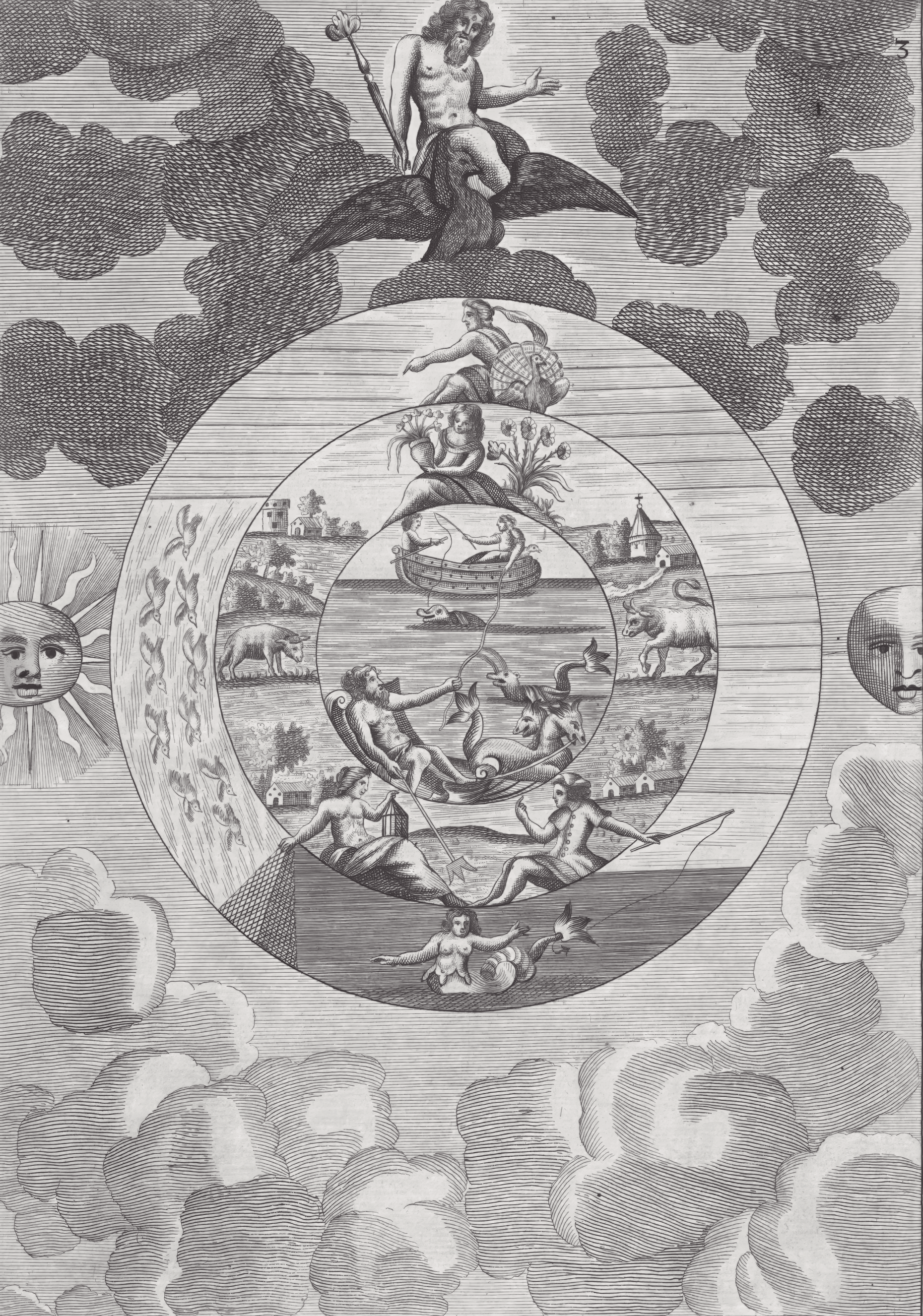
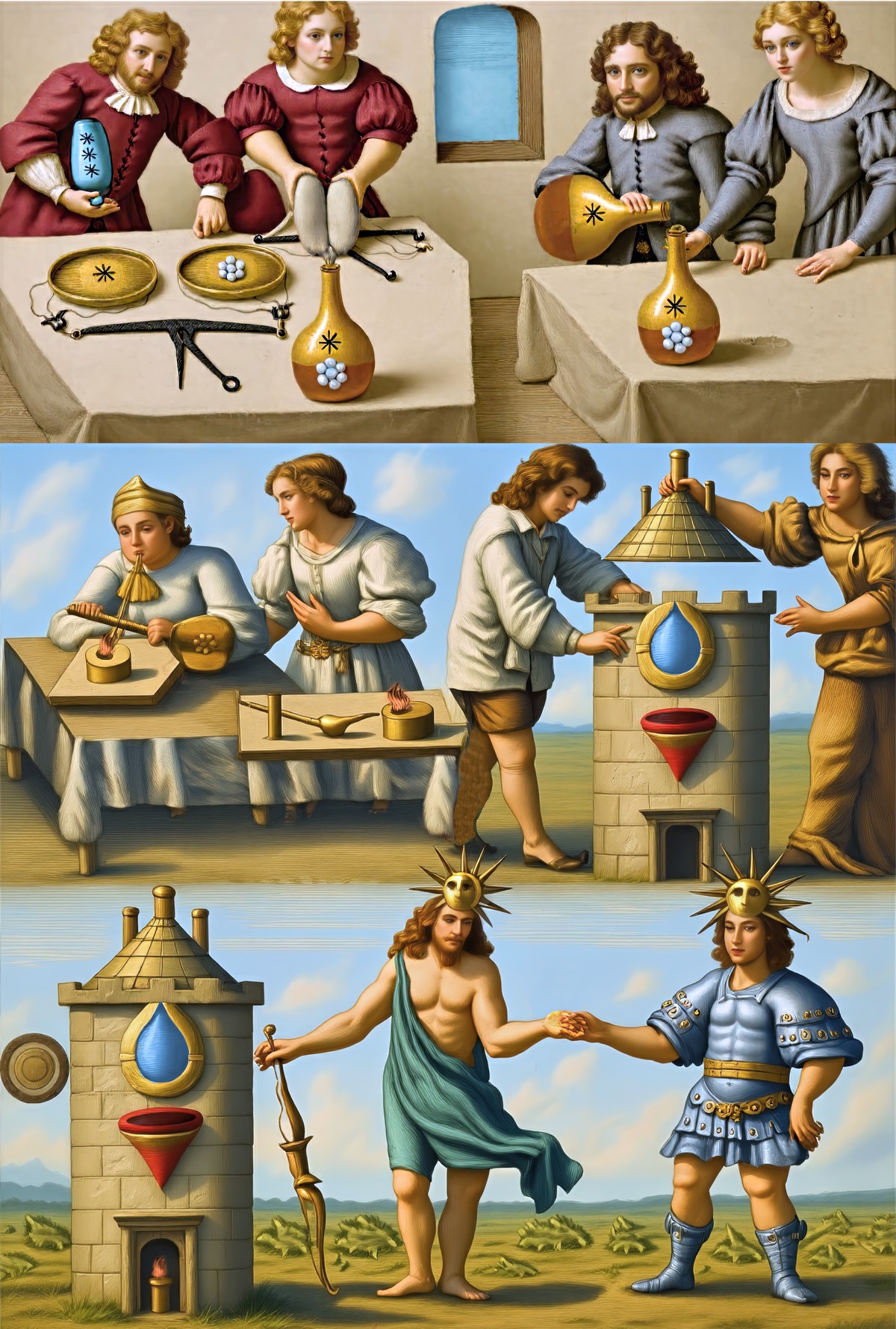
What does one actually do with the Mutus Liber? The traditional answer follows the inscription: pray, read, reread, work. The plates trace a sequence, from the gathering of dew through successive digestions and distillations toward a final emblem of attainment, and generations of commentators have offered keys to that sequence, alchemical ones in the lineage of Eugène Canseliet and Serge Hutin, psychological ones in Jung's. The book supports both readings precisely because it commits to neither in words. That refusal is its whole method.
For the modern reader who wants to work with the images directly, good reproductions matter; the 1677 engravings reward close looking, and our own editions were built for exactly that purpose, in a full color restoration of the plates and a monochrome printing for those who prefer the graphic force of the original line work.
The honest summary of the Mutus Liber is a study in absences. No author's name that survives checking. Roughly twelve copies, possibly more. An inscription that commands reading on a page that offers no sentences. And yet the book has never gone out of circulation for long, because the absence it is built on is the kind that makes readers lean in.
Read the book
Related Articles
Continue through articles sharing this topic.
Some books resist being read aloud. You can summarize a novel over dinner, and a history book lends itself to bullet points, but a certain strain of…
7 min read
Two books sit at the far ends of the esoteric shelf, and they answer the same question in opposite ways.
6 min read
The Mutus Liber arrived in 1677 as a book with almost no words in it. Fifteen engraved plates, published in La Rochelle by Pierre Savouret, credited to an…
5 min read
The Mutus Liber, the "silent book" of alchemy, has no text to argue with. A sequence of engraved plates, a title page, and little else: no preface, no…
5 min read
Related Books
Catalog volumes sharing this article’s lead tag.