 Xognosis EsotericaArcane Publishing Studio
In February 2018 the heritage blog of the Royal College of Physicians and Surgeons of Glasgow published a post about a sixteenth-century Latin book from the College's collection. The book was Gerolamo Cardano's Somniorum synesiorum, the Renaissance's most ambitious manual of dream interpretation, printed in Basel in 1562.

Share
In February 2018 the heritage blog of the Royal College of Physicians and Surgeons of Glasgow published a post about a sixteenth-century Latin book from the College's collection. The book was Gerolamo Cardano's Somniorum synesiorum, the Renaissance's most ambitious manual of dream interpretation, printed in Basel in 1562. The post included a sentence that should startle anyone who assumes the important books of Europe crossed into English long ago: "The book has unfortunately never been translated into English."
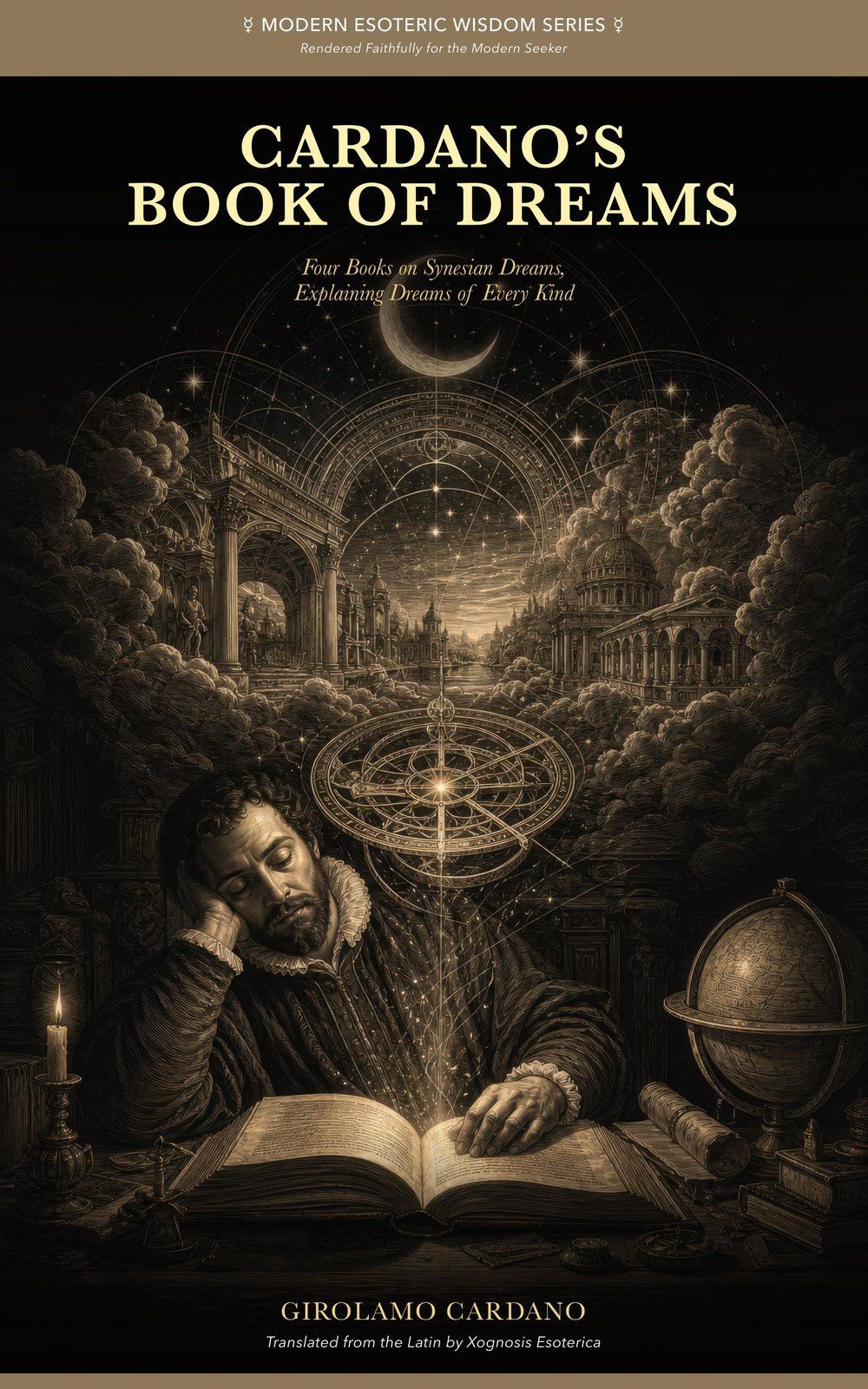
Not a new translation. Not a better one. None at all. A work by one of the sixteenth century's most famous scholars, a four-book treatise on dreams, had gone more than four and a half centuries without a complete English version. That gap has now closed, and the story of how it stayed open for so long is itself a lesson in how books survive.
Girolamo Cardano was born in Pavia on 24 September 1501, and he died in Rome on 21 September 1576. Between those dates he became a physician of European reputation, a mathematician of the first rank, an inventor, a gambler, and a prodigious writer. He also led a life streaked with catastrophe. His eldest son, Giovanni Battista, was arrested in 1560 for having poisoned his wife, and was sentenced to death and beheaded. In 1570 Cardano was arrested by the Inquisition after an accusation of heresy brought by the Inquisitor of Como, who targeted Cardano's De rerum varietate (1557). He spent several months imprisoned and lost his professorship at Bologna.
The dream book belongs to this biography in an intimate way. The scholar Guido Giglioni has shown that Cardano first conceived and outlined the project between 1535 and 1537, following the philosophy of the late-antique bishop Synesius of Cyrene, and that it was originally divided into ten books before being recast as the four that appeared in print. But the edition of 1562, published by Henricus Petri in Basel, came in the aftermath of the son's execution. Giglioni describes that period as a watershed: Cardano recorded intense dream activity in the years after 1560. The book that finally reached print carries the marks of a father reading his own night life for meaning while the Inquisition gathered interest in his daylight writing.
The Somniorum synesiorum is a taxonomist's dream book. Cardano sorts dreams into four categories, a scheme the Glasgow post summarizes neatly: digestive dreams, caused by food and drink; humoural dreams, arising from an imbalance of the four humours; anamnestic dreams, produced by the passions or emotional change; and prophetic dreams, of supernatural or divine origin. The first three categories fold dreaming into the physiology Cardano knew as a physician. Only the fourth steps outside it.
That structure is the book's engine. Cardano was not content to list omens. He wanted to know how a dream could carry information, and where the boundary lies between a body processing supper and a mind receiving something it could not otherwise know. The result is a strange hybrid: half medical treatise, half manual of divination, threaded through with his own recorded dreams and his reading of Synesius.
Modern scholarship keeps returning to it. A 1979 study by A. Browne describes a work that comprises an exhortation to interpret dreams, an account of how dreams are caused, and classifications of them. A 2018 essay by A. Corrias examines the distinction Cardano draws between idola and visiones. Neither of these scholars had a complete English text to work from, and neither did their readers.
Why did nobody translate it? The Glasgow post offers no theory, and honesty requires admitting that no single answer survives in the record. What follows is inference, not documentation. But the pressures on the book are easy to see. It is long, it is technical, and it sits awkwardly between disciplines: too astrological for the historians of medicine, too medical for the historians of magic. Latin literacy among exactly the readers who might have cared declined across the eighteenth and nineteenth centuries, while the Anglophone appetite for dream books was satisfied by cheaper and simpler fare. And Cardano himself was a compromised figure, an Inquisition-accused heretic in one century and a footnote in the next.
The copy in Glasgow shows what such books endured physically. Its earlier history is documented by an inscription: it belonged to Kloster Oberalteich, a Benedictine abbey at Bogen in Bavaria, whose library was scattered when the monastery was dissolved in 1803. The next firm landmark is the copy's arrival at the College around the 1890s. Between those two dates lie roughly ninety years in which the book's whereabouts go untraced. Any account of those decades would be invention, and the post's author, to their credit, does not attempt one.
The wait ended on 16 July 2026, when a complete modern English translation was published as Cardano's Book of Dreams. The edition runs to 616 pages across all four books, carries bracketed page locators keyed to the 1562 Basel printing, and works through the forty-five corrections listed on the original errata sheet. The publisher describes it as the first complete English translation, which is a claim about its own product; the independent documentation for the underlying negative, that no complete English translation existed before, remains that 2018 statement by the Royal College of Physicians and Surgeons of Glasgow, together with the absence of any prior complete edition in the scholarly record assembled here.
Anyone who wants to check the publisher's work against the original can. The Bavarian State Library in Munich holds a digitized copy of the 1562 Latin text, freely readable online. That is a pleasing symmetry: the book that took over 460 years to cross into English can now be read in both languages by anyone with a browser.
Cardano's Somniorum synesiorum survived the dissolution of a monastery, an untraceable century, and more than 460 years of neglect in English, a reminder that translation is not an automatic honor history pays to important books. Somebody has to decide a work is worth the labor, and for this one, English readers waited until the twenty-first century.
Read the book
Related Articles
Continue through articles sharing this topic.
In the summer of 1552, two of the most restless minds in Europe were, as far as anyone can tell, in the same city at the same time.
6 min read
In 1936, C. G. Jung began a seminar in Zurich on children's dreams. Over the following years it grew into something larger: a survey, delivered to a circle…
6 min read
You wake with an image in your head: a staircase, a stranger's face, an eclipse. Days later something happens and the image seems to have known it first.
7 min read
Sometime in 1547, in the Lombard city of Pavia, a quarrelsome professor of medicine went to sleep and did what almost no one in Europe did in 1547: he wrote…
6 min read