 Xognosis EsotericaArcane Publishing Studio
Sometime in 1547, in the Lombard city of Pavia, a quarrelsome professor of medicine went to sleep and did what almost no one in Europe did in 1547: he wrote his dream down, dated it, and kept it.

Share
Sometime in 1547, in the Lombard city of Pavia, a quarrelsome professor of medicine went to sleep and did what almost no one in Europe did in 1547: he wrote his dream down, dated it, and kept it. Gerolamo Cardano was in the middle of his years teaching at the university there, and somewhere in the surviving record of those years sits a single night's entry, one line in what would become one of history's strangest dream diaries. This article is an annotation of that night. Or rather, of everything we can honestly say around it, because the entry itself has to be read where it lives, in the Latin of the 1562 first edition or in a faithful translation. What follows is the frame, the margins, and the gloss.
Cardano was born in Pavia on 24 September 1501, and his life ran like a baroque plot. He taught medicine at the University of Pavia discontinuously from 1543 to 1551, which is what fixes him in the city in 1547: this is documented biography, not guesswork. Later came the catastrophic years. His son Giovanni Battista was executed in 1560 for murdering his wife. In 1570 the Inquisition arrested him; he was held from 6 October to 22 December, then abjured in February 1571 as "vehemently suspect of heresy". From prison he wrote letters of pure physical misery, one of them saying, "Today is the forty-third day in prison... I eat almost nothing."
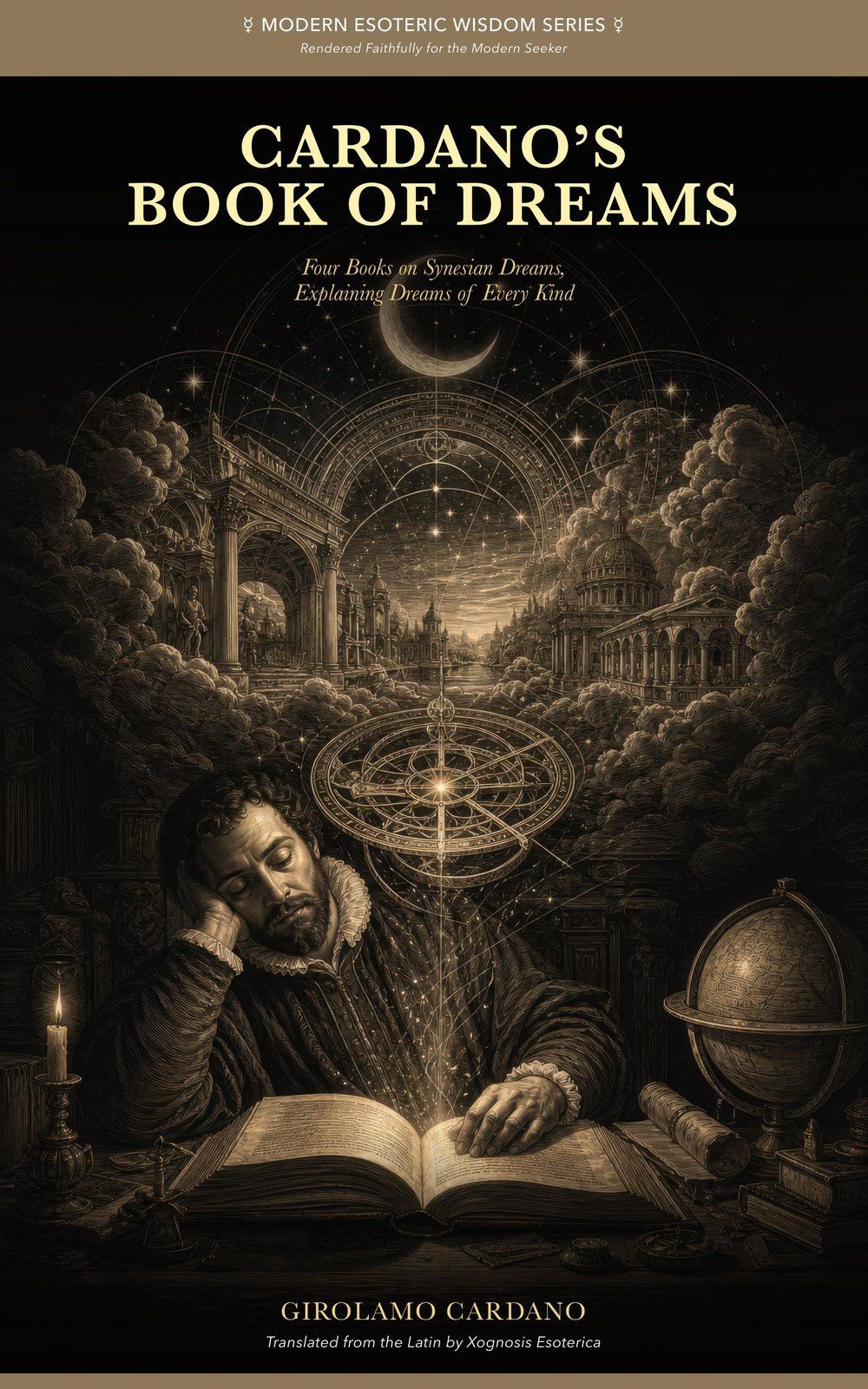
Somewhere between the professorship and the prison, in 1562, he published the dream book. Its full title is a mouthful: Somniorum synesiorum omnis generis insomnia explicantes, Libri IIII, printed by Henricus Petri in Basle, in four books. It is a treatise on interpretation and a diary at once, because Cardano stocked it with his own recorded dreams, going back decades. That is the document the 1547 night belongs to.
To read one of his entries without his theory is to read a menu without prices. Cardano thought dreaming was a channel, and he said so in terms that still startle. In sleep, he argued, we "enter into a communion with God's mind, such that the future is entirely presented to our souls". That sentence, in the Stanford Encyclopedia of Philosophy's translation of his theory, is his claim about the mechanism. It is a theological position, and modern readers should hold it as such: a sixteenth-century physician's model of mind, presented with complete confidence and no experimental warrant.
The subtler half of the theory is more interesting than the prophecy. The mind in sleep, Cardano proposed, works with the material it has, rearranging memories "as if they were stones in a mosaic". The dream image is real but composite: fragments of the dreamer's own past, re-laid into a pattern that can carry meaning. He even had a name for the rare dreams of perfect clarity, the ones that seemed to arrive whole rather than assembled. He called them idola.
So the diary had a double logic. Each entry was evidence for a man building a natural philosophy of the imagination, and each was a personal record, a physician taking his own pulse in the middle of the night.
Here the honest annotation has to slow down. The claim that Cardano recorded a dream at Pavia in 1547 is consistent with everything documented about those years, and consistent with the dream-diary character of the 1562 book. But the specific entry, its wording, its book-and-chapter location in Somniorum Synesiorum, was not verifiable from the reference sources available when this article was researched. The popular retellings of Cardano's dreams circulate freely online, and they blur documented entries with embellished versions. Quoting any of them from memory would be exactly the kind of thing Cardano the critic of bad astrologers spent his career attacking.
This is more than an academic scruple, and it is where the annotation earns its keep. A dated entry in a 1562 printed book is a checkable fact. A paraphrase of a paraphrase on a website is a legend with a citation costume. The difference matters especially with Cardano, because legends already cling to him. One example: the seventeenth-century writer Thomas Browne reported that Cardano wrote two of his major works, De subtilitate and De rerum varietate, "by admonition in a dream". That is reception, a later author's report, not a dated entry from Cardano's own hand. It gets repeated as biography. It should not be.
The entry from that night in Pavia is not a story to be retold from memory. It is a text in a 1562 Basle imprint, and it deserves to be met on the page, in order, with the theory that explains why its author thought the night mattered.
The first edition survives in digitized form, scanned from a European library holding and readable on the Internet Archive (identifier b33350231_0001). It runs to nearly eight hundred pages of Latin from Henricus Petri's Basle shop, the four books carrying interpretation and dream records together. Where the Pavia material surfaces in them is something to check on the page, not on trust. Reading the Latin is its own pleasure; the sentence rhythms of a Renaissance polymath dictating his own sleeping mind have no modern equivalent.
For readers who want the English, there is our own edition, Cardano's Book of Dreams, which translates the work and sets the diary entries in context. If you have come this far on the strength of one night in 1547, that is where the night itself is.
Any statement about what the 1547 dream meant to Cardano is interpretation, and should wear the label. What can be said is structural. He was mid-career, in the city of his birth, keeping records of himself with an obsessiveness that would culminate in the autobiography he wrote from September 1575 to May 1576, De vita propria, one of the first modern self-portraits. The dream diary and the autobiography are the same instinct at two scales: the day and the life, both held up for inspection.
Cardano died in Rome on 21 September 1576, days short of his seventy-fifth birthday. The dreams outlived him into an afterlife of misquotation. The diary's real subject, read carefully, was never second sight. It was a man insisting that his own inner life was data, worth recording with a date and a place, worth a theory, worth printing. One night in Pavia, 1547, is a small stone in that mosaic, and he is the one who set it.
Read the book
Related Articles
Continue through articles sharing this topic.
In the summer of 1552, two of the most restless minds in Europe were, as far as anyone can tell, in the same city at the same time.
6 min read
In 1936, C. G. Jung began a seminar in Zurich on children's dreams. Over the following years it grew into something larger: a survey, delivered to a circle…
6 min read
You wake with an image in your head: a staircase, a stranger's face, an eclipse. Days later something happens and the image seems to have known it first.
7 min read
In February 2018 the heritage blog of the Royal College of Physicians and Surgeons of Glasgow published a post about a sixteenth-century Latin book from the…
5 min read