 Xognosis EsotericaArcane Publishing Studio
In 1936, C. G. Jung began a seminar in Zurich on children's dreams. Over the following years it grew into something larger: a survey, delivered to a circle of analysands and colleagues, of the whole historical literature of dream interpretation.
Share
In 1936, C. G. Jung began a seminar in Zurich on children's dreams. Over the following years it grew into something larger: a survey, delivered to a circle of analysands and colleagues, of the whole historical literature of dream interpretation. Artemidorus came up, and Synesius of Cyrene, and then, deep in the later sessions devoted to the historical material, a Milanese physician who had died three and a half centuries before. Jung spent real time on Girolamo Cardano. According to Jacomien Prins, whose 2017 study in I Tatti Studies in the Italian Renaissance reconstructed the encounter, "As part of the seminar Jung analysed twelve dreams of Girolamo Cardano." Twelve dreams, taken from the autobiographical section of a Renaissance treatise, read aloud and worked through with the full machinery of analytical psychology.
Cardano published his dream book, the Somniorum synesiorum libri IIII, in Basel in 1562, printed by the Henricus Petri press. The place matters, up to a point. Basel in the 1560s was one of the printing capitals of Europe, and the Petri workshop issued a stream of scholarly and scientific works, Cardano's among them. But the title of this essay should not mislead: Cardano himself was a Milanese physician and academic, associated over his career with Padua and Bologna among other cities, and the meeting between him and Jung is a meeting of texts across four centuries, not of two men in the same city. Jung never left Zurich for this encounter. He found it on the page.
What he found there was unusual. The Somniorum synesiorum is a systematic treatise on dreams of every kind, and its final section turns autobiographical: Cardano's own dreams, recorded and offered up as evidence. Prins summarizes the philosophy underneath: "Central to his dream theory is the idea that the cosmos is a unified, harmonic and animate entity. The universal harmonic interrelations between all cosmic phenomena provide the basis for Cardano's theory of dream interpretation." A dream, on this view, is a node in a web that binds everything to everything. Because the whole cosmos resonates, a dream can carry information from the wider world into the sleeper.
That premise gives the Zurich seminar's encounter with Cardano its bite. Jung's mature psychology had arrived, by its own winding routes, at ideas with a family resemblance to Cardano's: archetypes, a collective unconscious shared beneath individual minds, the unus mundus or unitary world, synchronicity, the harmonization of opposites, even a perennial philosophy underneath them all. Prins argues that Jung used the twelve Cardano dreams specifically to corroborate these concepts. That last claim is her scholarly interpretation, published in a peer-reviewed Renaissance-studies journal, and it should be held as interpretation rather than plain fact. But the abstract of her article is unambiguous about the structure of the encounter, and about its central irony.
Here is the irony. Jung had no patience for how Cardano interpreted his own dreams. He treated Cardano's method, in Prins's phrasing, as "vulgar dream interpretation totally inadequate," those words being Prins's quotation of Jung's own judgment. And yet he reached across that dismissal and took the dreams anyway. Prins describes this move with a phrase of Jung's that deserves to be quoted exactly: a "salto mortale," the circus performer's death-leap. Jung leapt over Cardano's theory to land on Cardano's material. The dream reports were valuable evidence; the framework that produced them was discarded.
Jung dismissed Cardano's method as totally inadequate, and then performed what he himself called a salto mortale: he leapt past the Renaissance theory to appropriate the Renaissance dreams as evidence for his own.
The shape of that leap tells you something about both thinkers. Cardano recorded his dreams because he believed the cosmos itself was speaking through them, harmonically, and that a properly disciplined interpretation could extract that speech. The dreams mattered as messages within his system. Jung wanted something different from the same documents. He wanted dated, written, first-person dream reports from a pre-modern mind, material he could read for archetypal imagery and compare against the dreams of his twentieth-century patients. A dream series nearly four centuries old was data. It let him ask whether the collective unconscious really did show the same figures to a Renaissance physician and to a Zurich bank clerk.
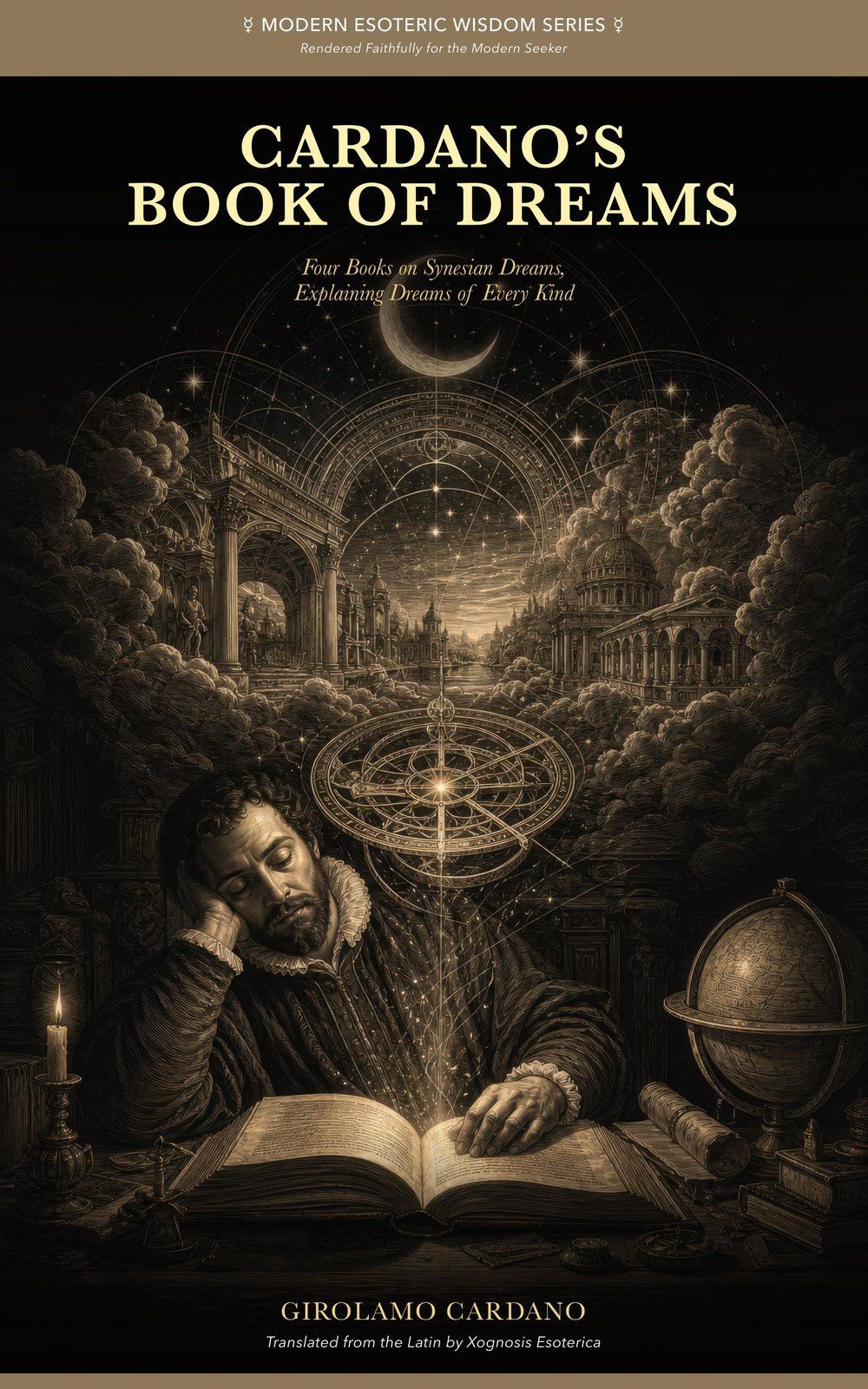
This is why the Somniorum synesiorum rewards a modern reading, and why we publish a reader's edition of it as Cardano's Book of Dreams. The treatise Jung mined is the same work, and the dreams he pulled from its final section are still there, beside the interpretive method that so failed to impress him.
There is a second asymmetry worth naming honestly. Jung's engagement with Cardano was interpretation, not endorsement, and an account that casts Jung as a friendly modern champion of Cardano's dream theory misreads the record. He was a diagnostician reading an interesting case. That the case happened to be the author of the treatise enclosing it was, for Jung's purposes, almost incidental.
The dates deserve a moment of care, because the published record itself wavers on them. The companion volume Children's Dreams, which preserves the first half of the seminar, carries the subtitle 1936-1940. The volume that contains the historical material, Dream Interpretation Ancient and Modern, says 1936-1941, and Prins likewise writes that Jung presented the seminar "between 1936 and 1941." Whichever endpoint you take, the seminar ran through the years in which Europe dismantled itself, with neutral, intact Zurich at the center of a continent at war. Jung was reading Renaissance theories of cosmic harmony while the newspaper outside described the opposite of harmony. No document in the research record connects those two facts, so the connection is offered here as atmosphere, not argument.
The seminar notes had a long afterlife of their own. Children's Dreams reached print from Princeton University Press in 2008, and Dream Interpretation Ancient and Modern, edited by Maria Meyer-Grass, Lorenz Jung, and John Peck and translated by Ernst Falzeder with Tony Woolfson, followed in 2014 as part of the Philemon Foundation's project of bringing the seminars to the public. The Philemon Foundation's page for the volume notes that Jung examined "in depth a long dream series from the Renaissance physician Girolamo Cardano." The twelve dreams Prins counts are that series, or the heart of it.
Was Jung's leap a rescue or a theft? The question is probably badly formed. He took Cardano's dreams out of the harmonic cosmos that gave them meaning and installed them in a different cosmology, one of archetypes and a collective substrate of the psyche. What Prins's analysis suggests is that the two cosmologies rhyme: a Renaissance world in which all phenomena interrelate harmonically, and a Jungian world in which all minds share a common deep structure and events can coincide meaningfully across it. Jung could not accept Cardano's reasoning and could not leave Cardano's evidence alone.
Cardano, who believed the universe was animate, unified, and resonant down to its smallest parts, might have recognized the shape of the argument being built on his dreams, if not its vocabulary. His book was printed in Basel in 1562. Jung read it, or read in it, in Zurich between 1936 and 1941. Between those two acts of reading lies the whole history of modern psychology, and a leap across it that Jung himself named.
Read the book
Related Articles
Continue through articles sharing this topic.
In the summer of 1552, two of the most restless minds in Europe were, as far as anyone can tell, in the same city at the same time.
6 min read
You wake with an image in your head: a staircase, a stranger's face, an eclipse. Days later something happens and the image seems to have known it first.
7 min read
Sometime in 1547, in the Lombard city of Pavia, a quarrelsome professor of medicine went to sleep and did what almost no one in Europe did in 1547: he wrote…
6 min read
In February 2018 the heritage blog of the Royal College of Physicians and Surgeons of Glasgow published a post about a sixteenth-century Latin book from the…
5 min read