 Xognosis EsotericaArcane Publishing Studio
You wake with an image in your head: a staircase, a stranger's face, an eclipse. Days later something happens and the image seems to have known it first. Most of us file this under coincidence and get coffee. Girolamo Cardano, the Italian physician and mathematician who published his dream book in Basel in 1562, refused to file it away.
Share
You wake with an image in your head: a staircase, a stranger's face, an eclipse. Days later something happens and the image seems to have known it first. Most of us file this under coincidence and get coffee. Girolamo Cardano, the Italian physician and mathematician who published his dream book in Basel in 1562, refused to file it away. His treatise, Somniorum synesiorum libri IIII, asks the question directly: if a dream contains information the dreamer did not have, where did the information come from? More than four and a half centuries later the question still works on people, because it is not really about dreams. It is about what a mind can know.
Cardano was a hard-headed skeptic about plenty of things. This is the man who published Ars Magna in 1545, advancing algebra past problems that had stalled for centuries. He kept case notes, recorded his own failures, and found himself refused admission to the College of Physicians in Milan. He was, by the standards of his century, an unusually empirical writer. Nancy Siraisi has described his habit of embedding case narrative and self-observation in his medical writing, which is exactly the temperament you would not expect to produce a book of dream interpretation. And yet he spent decades on one.
The dream book had a long gestation. Guido Giglioni's scholarship establishes that Cardano "conceived and outlined his four books on dreams according to Synesius' philosophy between 1535 and 1537," and that the work began as ten books before its 1562 publication. Synesius of Cyrene, the fourth-century philosopher whose De insomniis inspired the project, treated dreams as an accessible kind of prophecy, and Cardano built on that foundation rather than starting from scratch.
Then life intervened in the worst way. In 1560 his eldest son, Giovanni Battista, was arrested, tried, and beheaded for poisoning his wife. Giglioni, summarizing the editorial evidence, reports that "Cardano was undergoing intense dream activity as a result of the tragic execution in 1560 of his son Giovanni Battista." The book that finally appeared two years later carries that grief in its pages. The autobiographical record, including The Book of My Life, contains Cardano's testimony about dreams heralding the major episodes of his existence, among them a dream eclipse he read afterward as an omen of his son's death. That is his self-narrative. It is not evidence of prophecy, and it does not pretend to be; it is evidence of a man checking his own memory against his own theory.
Alice Browne's 1979 study noted something unusual here: Cardano recorded many of his own dreams while holding a developed theory of their causes. Most Renaissance writers on dreams did one or the other. The combination is what makes the book live.
So how did Cardano propose that a dream could know something? His first move was not mystical at all. It was diagnostic. As the Royal College of Physicians and Surgeons of Glasgow's heritage blog summarizes the scheme, "Cardano divides dreams into four categories, based on their causes: digestive dreams, caused by food and drink; humoural dreams, caused by imbalances in the four humours; anamnestic dreams, caused by passions or changes in emotion; and finally prophetic dreams, which are of a supernatural or divine origin."
Three of those four categories are natural, and Cardano treated them as clinically useful. A digestive dream tells you what you ate. A humoural dream tells you your body's balance has shifted. An anamnestic dream tells you what your passions are doing while your guard is down. In other words, most dreams, on his account, are information, just information about the dreamer rather than about the future. That framing survives translation into modern terms almost unchanged: dreams as readouts of physiology and emotion. Cardano got the mechanisms wrong in the particulars, humours and all, but the structure of the insight, that dream content tracks bodily and emotional state, is ordinary clinical practice today.
One caution belongs here. The tidy four-way split is a librarian's summary of the Latin, not a literal table of contents. Scholars working directly with the text, like Anna Corrias, show that the book's internal distinctions are more layered than any four-box scheme suggests.
The strangest and most interesting mechanism concerns the fourth category, the prophetic dreams, and here the book turns philosophical. The RCPSG blog observes that "the lion's share of the text, however, is devoted to discussion of the latter category, which Cardano deliberately approaches from a philosophical, rather than medical, point of view."
Within that discussion, Corrias has drawn out a distinction modern readers would otherwise miss. In Cardano's theory, dream phenomena come in two kinds: idola, which are sound-based, and visiones, which are image-based. The split rests on one of his genuine philosophical commitments, that hearing is superior to sight. As Corrias puts it, "one should bear in mind his view that hearing is superior to sight and that while idola are essentially based on sound, visiones depend on images."
This is speculative metaphysics, and as an account of how information might travel into a sleeping mind it explains nothing we can verify. But it is interesting precisely because it is wrong in a productive way. Cardano noticed that dreams have different sensory registers, that some arrive as voices or noises and some as pictures, and he built a taxonomy around the difference instead of flattening it. Contemporary dream research does distinguish verbal from visual dream content, and asks what the variation means, without any of his supernatural scaffolding. He asked a real question and bolted a wrong answer to it. The question outlived the answer.
Honesty requires saying what the sources cannot tell us. The full causal machinery of Book II, exactly how Cardano thought a prophetic dream carried its information, is not captured in the verified secondary literature, and this article will not invent it. What the record does support is the shape of his thinking: sort dreams by cause first, exhaust the natural explanations, and only then confront the residue.
That method is his real legacy on this subject. Cardano's conclusion, that some dreams are divinely originated, belongs to his century. His procedure does not. Triage the mundane before invoking the extraordinary; take your own experience as data; write down the cases. When you wake with an image that seems to know something, his four-category scheme is still a decent first pass. What did you eat, what is your body doing, what are you not admitting to yourself, and only then: what if it is none of those?
The durable part of Cardano's dream book is not the prophecy. It is the discipline of sorting dreams by cause, exhausting the ordinary explanations first, and treating your own night life as evidence worth recording.
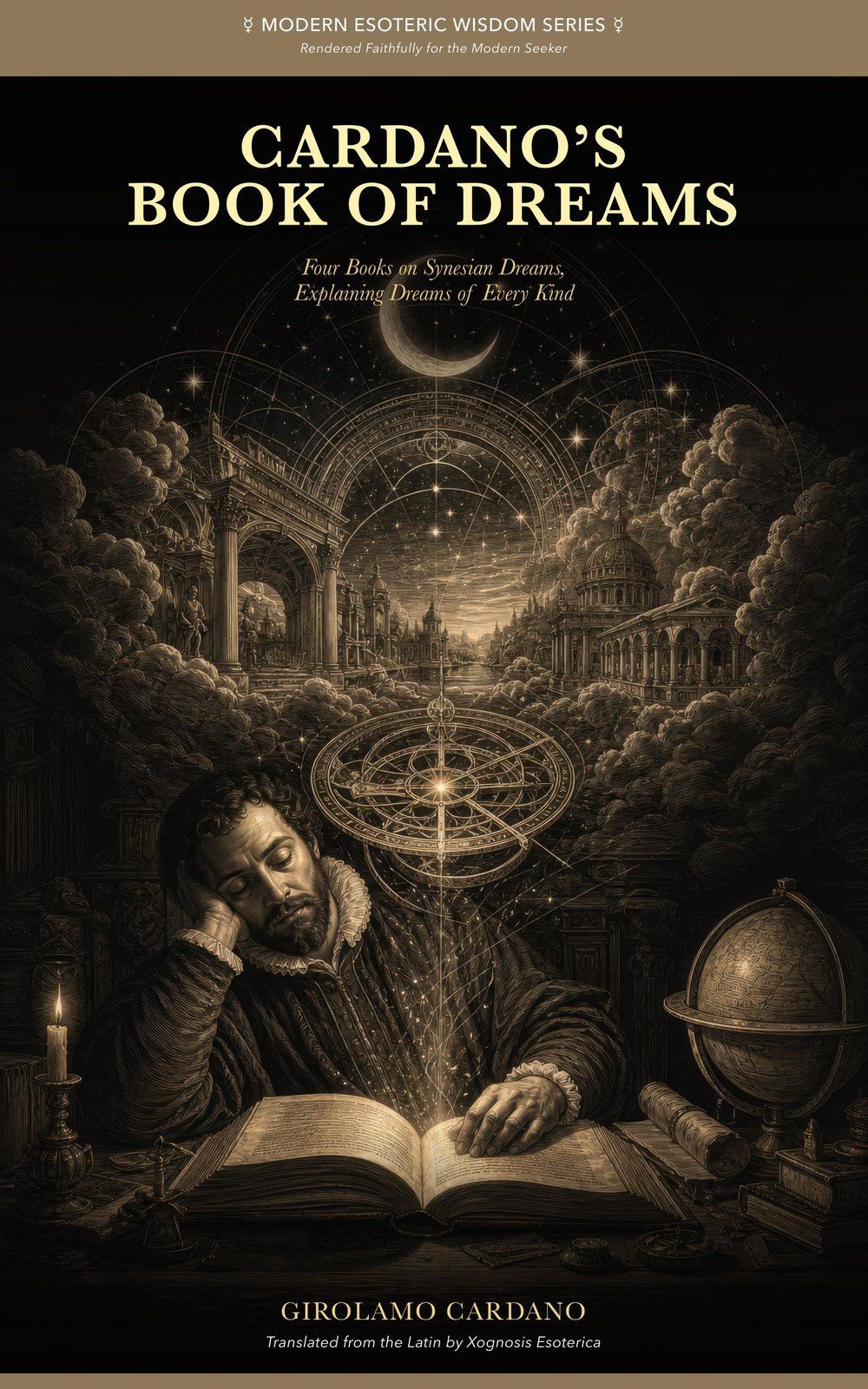
There is a final irony. The RCPSG blog notes, as of its 2018 writing, "The book has unfortunately never been translated into English." The Latin original is digitized, and the 1663 Lyon Opera omnia includes it in volume five, but an English reader has long needed either Latin or the Boriaud Latin-French edition. An accessible modern English rendering, Cardano's Book of Dreams, now exists, which matters for exactly the reasons above: the book rewards being argued with, and you cannot argue with a text you cannot read.
Cardano ended his life under a cloud, arrested by the Inquisition in 1570 over his astrology and his published horoscope of Jesus, forced to abjure. The dream book sits inside that contested career, half medicine, half metaphysics, all attention. Its central question has lost none of its grip. How can a dream know something you don't? Cardano's answers are period pieces. His habit of demanding answers is not.
Read the book
Related Articles
Continue through articles sharing this topic.
In the summer of 1552, two of the most restless minds in Europe were, as far as anyone can tell, in the same city at the same time.
6 min read
In 1936, C. G. Jung began a seminar in Zurich on children's dreams. Over the following years it grew into something larger: a survey, delivered to a circle…
6 min read
Sometime in 1547, in the Lombard city of Pavia, a quarrelsome professor of medicine went to sleep and did what almost no one in Europe did in 1547: he wrote…
6 min read
In February 2018 the heritage blog of the Royal College of Physicians and Surgeons of Glasgow published a post about a sixteenth-century Latin book from the…
5 min read