 Xognosis EsotericaArcane Publishing Studio
In 1659 a London printer named D. Maxwell, working for the bookseller T. Garthwait, issued one of the strangest volumes of the century: the private diaries of Dr. John Dee, the Elizabethan mathematician who had spent years recording conversations with angels.
Share
In 1659 a London printer named D. Maxwell, working for the bookseller T. Garthwait, issued one of the strangest volumes of the century: the private diaries of Dr. John Dee, the Elizabethan mathematician who had spent years recording conversations with angels. The diaries covered the period when Dee worked with Edward Kelley as his scryer, the man who claimed to see the spirits in a shewstone and relay their words. Dee had kept these records in his own hand, and after his death in 1609, reportedly in poverty, the manuscript made its way into the library of Sir Thomas Cotton. Half a century later it reached print. The man who prepared it for the press, Meric Casaubon, a Doctor of Divinity, did something in his preface that shaped how readers understood John Dee for the better part of three centuries. He published the document in full, vouched for its honesty, and declared its contents to be the work of the Devil.
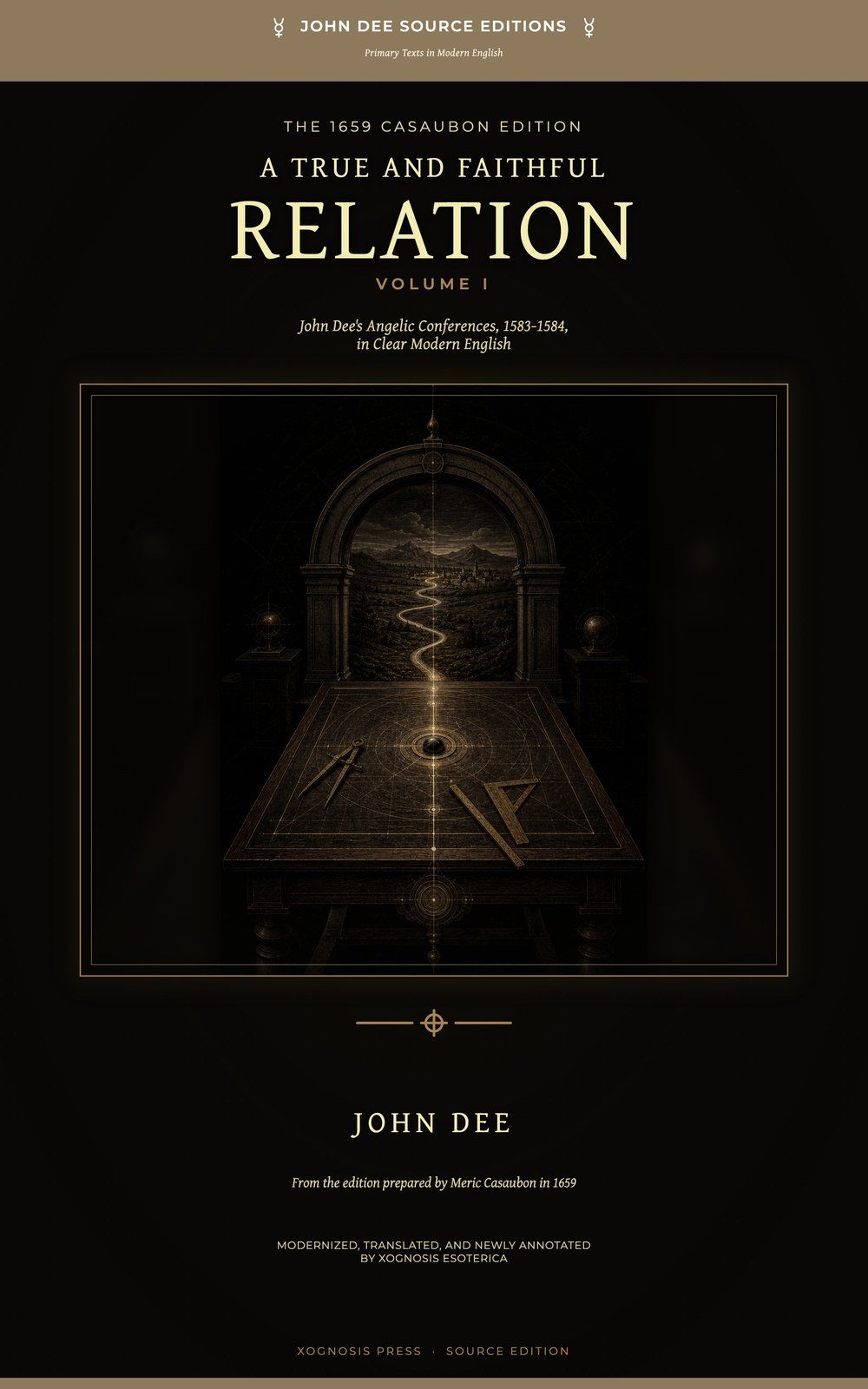
The full title is a document in itself. "A True & Faithful RELATION OF What passed for many Yeers Between DR. JOHN DEE (A Mathematician of Great Fame in Q. Eliz. and King James their Reignes) and Some Spirits: Tending (had it Succeeded) To a General Alteration of most STATES and KINGDOMES in the World." The imprint places it at "the Little North door of S. Pauls" in 1659, and a note records the provenance: "The Original Copy, written with Dr. Dees own Hand: Kept in the library of Sir THO. COTTON, Kt. Baronet."
Everything about the packaging takes Dee seriously. He is a mathematician of great fame, operating at the centre of Elizabethan and Jacobean life. The angel conversations are presented as an affair of state, something that might have altered most kingdoms of the world. The packaging reads like a suppressed history breaking into print.
Casaubon's preface carries its own heading: "A PREFACE Confirming the Reality (as to the Point of Spirits) of This RELATION: and shewing the several good Uses that a Sober Christian may make of All." Read that twice, because the two clauses pull against each other. The editor confirms that spirits are real and that Dee genuinely contacted something. Then he explains what a sober Christian can salvage from the wreck.
He commits to the document's honesty without reservation. "I shall not be afraid to profess," he writes, "that I never gave more credit to any Humane History of former times." And of Dee himself: "I think no man will make any question but the poor man did deal with all possible simplicity and sincerity." The phrasing is careful. Dee is sincere, and Dee is poor, in both senses a man to be pitied rather than admired.
Then comes the verdict. Dee's failure, in Casaubon's words, was "his only (but great and dreadful) error being, that he mistook false lying Spirits for Angels of Light, the Divel of Hell (as we commonly term him) for the God of Heaven." The diaries are true, the medium was honest, and the entire enterprise was diabolic deception. Casaubon consigns Dee and Kelley to the ranks of the deceived, and the book's own frontispiece goes further: as the Fellows' Library at Jesus College, Oxford notes of their copy, the engraved image groups Dee and Kelley among the false prophets.
Casaubon published Dee's diaries as authentic records of real contact with the spirit world, then argued that the spirits were demons and the whole affair was deception. The frame he built in 1659, sincere man, real spirits, diabolic outcome, is the frame through which Dee was read for centuries.
The title of this essay is an interpretation, and honesty requires saying so plainly. There is no known passage in which Casaubon says he dislikes or regrets the volume he edited. What the record supports is stranger than simple hostility. He believed the underlying events were real. He defended Dee's character against any charge of fraud. He argued the text had "several good Uses" for the right kind of reader. And he nonetheless treated its contents as a catalogue of theological catastrophe, the story of a good man led into communion with the Devil by trusting the wrong messengers.
The Jesus College account adds a political dimension: the preface was written "both to endorse the existence of miracles and to discredit the 'enthusiastic' Protestant sects to which many politicians of the time belonged." Published in 1659, in the last years of the Interregnum, the book was also a polemical instrument. Dee and Kelley, dead for decades, were useful exhibits in an argument about religious enthusiasm and deception. Casaubon sympathetically maintained that Dee's faith was genuine, and placed him among the false prophets anyway.
For modern readers the accident of this publication is that Casaubon's frame became the standard edition. The diaries survived because he printed them, and for a long time they were read largely through his conclusions. Scholarly reappraisal came late. Peter French's 1972 study of Dee and Deborah Harkness's 1999 monograph on the angel conversations are the standard modern works, and both are cited by the Jesus College librarians as the correct further reading; the specifics of their arguments, and the full case for how completely Casaubon's preface governed later reception, rest on that scholarship rather than on the 1659 pages themselves.
One provenance story deserves caution. It is often said that the diaries were discovered decades after Dee's death in a secret compartment. That tale circulates widely, but the verified bibliographic fact is narrower and plainer: the printed edition states that the manuscript, in Dee's own hand, was kept in Sir Thomas Cotton's library. How it left Dee's possession and entered that collection is a question for the modern literature, and this essay will not dress a legend up as a fact.
The irony is that Casaubon's editorial defeat is the reader's gain. Because he believed the diaries were true records of real spiritual contact, he had every reason to print them whole rather than abridge them into a moral anecdote. A hostile skeptic might have published excerpts to hold Dee up to ridicule. Casaubon, convinced the events happened, gave the conversations their full textual body: the angelic calls, the Enochian material, the day-by-day record of what passed between Dee, Kelley, and the voices in the stone.
That is why the book remains in print today, and why a reader wanting to meet the primary record rather than the legend can do so directly, in A True and Faithful Relation, Volume I. The preface is part of the historical document, worth reading as the thing itself: the voice of a seventeenth-century divine trying to contain what he had unleashed. But the diaries underneath no longer need his permission. More than three and a half centuries after Maxwell printed them at the north door of St Paul's, the frame has cracked, and the records speak for themselves.
Read the book
Related Articles
Continue through articles sharing this topic.
Two books sit at the far ends of the esoteric shelf, and they answer the same question in opposite ways.
6 min read
In the summer of 1552, two of the most restless minds in Europe were, as far as anyone can tell, in the same city at the same time.
6 min read
Open a modern edition of A True and Faithful Relation and you meet a problem before you meet a single angel.
7 min read
Open a page of John Dee's Monas Hieroglyphica at random and you see a strange object: a single compound sign, part astronomical, part alchemical, drawn once…
6 min read