 Xognosis EsotericaArcane Publishing Studio
There is a shelfmark in Glasgow that every serious student of John Dee eventually learns: Sp. Coll. Hunterian R.6. It holds what the scholar A. Campbell, writing in Studies in History and Philosophy of Science, identified as Dee's personal copy of the 1564 Antwerp first edition of the Monas Hieroglyphica.
Share
There is a shelfmark in Glasgow that every serious student of John Dee eventually learns: Sp. Coll. Hunterian R.6. It holds what the scholar A. Campbell, writing in Studies in History and Philosophy of Science, identified as Dee's personal copy of the 1564 Antwerp first edition of the Monas Hieroglyphica. Of all the surviving copies of that strange little book, this is the one a reader most wants to meet. Dee wrote it, Dee owned it, Dee presumably read it. If any copy on earth were going to carry the author's own notes, decoding his own riddle in the margins, this would be the one.
It carries nothing of the kind. Campbell's dry sentence states the whole problem: "Dee left no clues in his personal copy of the 1564 edition of the Monas, which is held in the University of Glasgow Library, shelfmark Sp. Coll. Hunterian R.6."
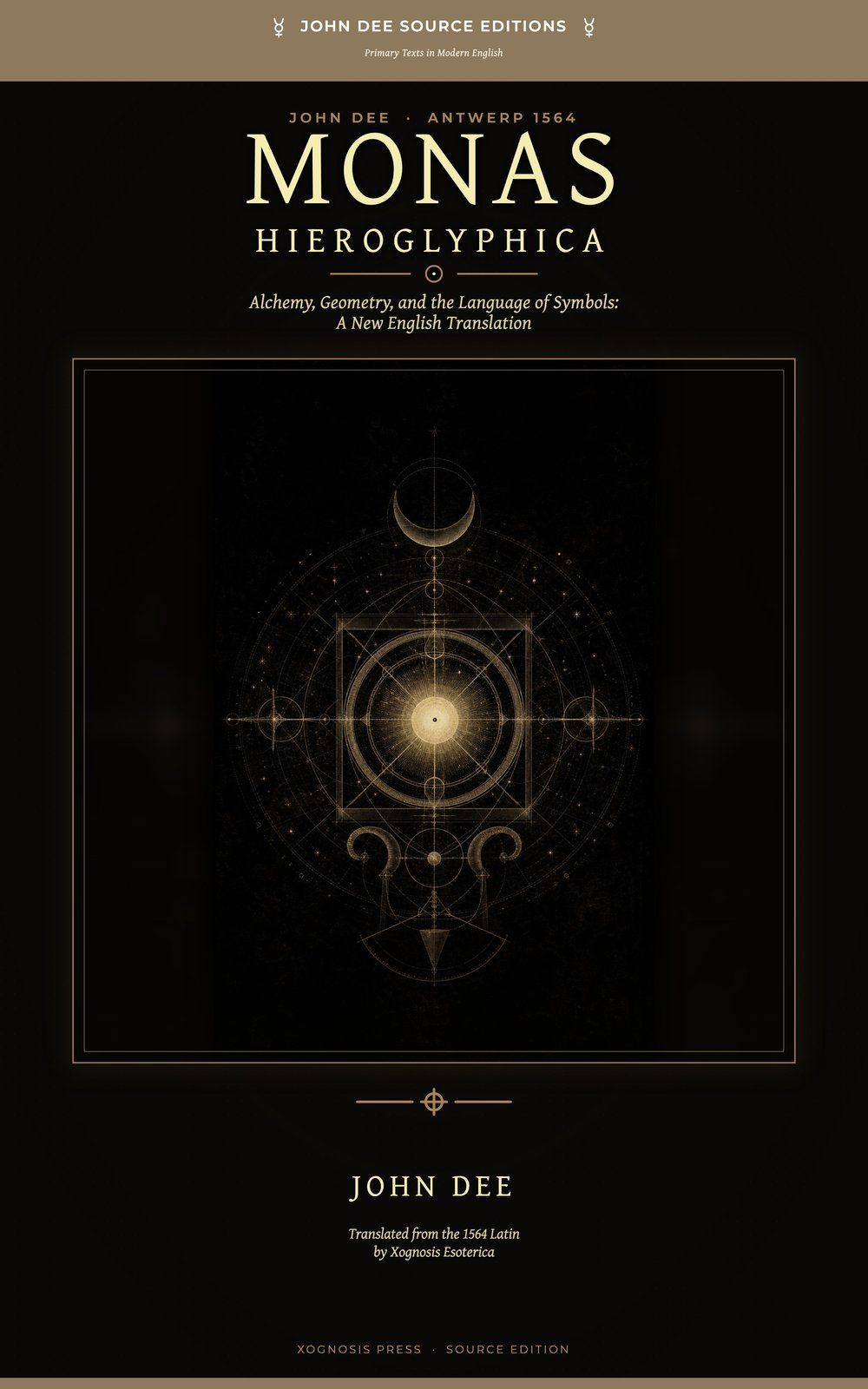
The Monas Hieroglyphica has always had an explanation problem, and by design. Dee printed it at Antwerp early in 1564, with the preface, the dedication to Maximilian II, and the closing author's statement all dated in January of that year. The book runs to 107 pages, though much of the page area is white space and diagram. Its argument unfolds in 24 theorems built around a single composite sign, the Monas, a figure Dee assembled from the shapes of the astronomical symbols. He claimed for his sign an unusual compression. It was meant to be read, he insisted, by those who already understood alchemy, astrology, and the sacred alphabets, and to remain mute to everyone else.
The claim was part of the performance. Modern scholarship reads the Monas as a dense, deliberately obscure synthesis of alchemy, astrology, Greek letters, and symbolic language: a book that announces its own difficulty and treats that difficulty as a filter. Occult retellings that bill it as a key to all mysteries overstate the case; the book itself promises understanding through labor, not possession through recitation. C. H. Josten's 1964 English translation, with its introduction and annotations, remains the standard scholarly route through the text, which is itself telling: the work needs a Josten.
So the reader who wants the Monas explained has always had to look outside the Monas. Which returns us to Glasgow, and to the odd fact that the author's own copy declines to help.
What does it mean that Dee's personal copy carries no interpretive notes? The honest answer is that we cannot know, and the object itself will not tell us. A few explanations suggest themselves, and all of them are speculation.
Perhaps Dee knew the book too well to annotate it. He had carried the argument in his head for years before Silvius set it in type, and a man who has just finished composing a text has little need to gloss it for himself. Perhaps the margins stayed clean out of a kind of respect: this was a handsome production from a serious printer, dedicated to an emperor, and Dee may have treated it as a presentation object rather than a working copy. Or perhaps he simply never got around to it. Silence in a margin is compatible with reverence, with familiarity, and with indifference, and the paper does not distinguish between them.
There is a further caution worth stating plainly. Campbell's statement, made in a peer-reviewed study of the book's reception, tells us the copy contains no interpretive "clues" from Dee. It does not tell us the book is otherwise blank. Whether it bears Dee's signature, an ownership mark, a bookplate, or corrections of the type a proofing author might make has not been established in the material gathered for this essay, and the exact route by which the volume entered the Hunterian collection and thus reached Glasgow also awaits verification against the library's own catalogue. What we have is a well-attested absence: no decoder ring in the one place a decoder ring would have been treasure.
That absence is worth taking seriously rather than lamenting. It tells us something about how Dee understood the book's transmission. The Monas was written to travel without its author. Its explanations were to be earned by readers across time, not handed down in a private margin.
The transmission history is where the story gets crowded. Within Dee's lifetime the Monas found its first serious commentator: the physician and alchemist Gerard Dorn, whose Monarchia Physica of 1577 deployed a line-and-circle figure that P. J. Forshaw, in his study of the book's early alchemical reception, reads as an engagement with Dee's sign. Dorn read the Monas and then put its diagrammatic method to his own use. Whatever Dee thought of this, his own copy stayed quiet.
Dee died in 1608 or 1609. His extraordinary library, dispersed piecemeal from the 1580s onward, had already scattered across Europe, and the Monas began a second career in anthologies. In 1602 the Strasbourg printer Lazarus Zetzner reprinted it in the great chemical compendium the Theatrum Chemicum, and the second edition of that collection, issued in 1659-1661, reproduced the work in full. Reprint in the Theatrum meant something specific: it delivered the Monas to generations of readers who encountered it alongside Paracelsus, Arnald of Villanova, and the whole alchemical canon, as a classical text among classics. The Frankfurt firm of Wechel and Fischer had already issued a third edition in 1591, the copy now digitized from the Getty Research Institute's alchemy collection.
The glyph then escaped the book entirely. It appears beside the invitation text in the Rosicrucian Chymical Wedding of Christian Rosenkreutz (1616), one of the movement's founding fictions. Forshaw's survey of the reception also records its reappearance in esoteric printing of the following decades, in works such as della Riviera's 1605 text and Khunrath's Amphitheatrum of 1609. Frances Yates, in The Rosicrucian Enlightenment, traced the influence further still, recording that Dee's reach extended to Puritanism in the New World through John Winthrop the Younger, an alchemist and a follower of Dee, who adopted the monas as his personal mark. A symbol designed to compress the heavens into one figure ended up as a gentleman's brand on a colonial frontier.
Here the border between history and legend must be drawn firmly. Rosicrucian tradition has long claimed Dee as a hidden founder or the true author of the manifestos. The verifiable record is narrower: the glyph appears in a Rosicrucian document, and Dee's influence on the movement's intellectual milieu is widely argued by serious historians, Yates among them. Influence is not authorship, and the Chymical Wedding remains an anonymous fiction regardless of whose sign it borrowed.
The Glasgow copy closes the circle in an unexpected way. A book designed to be completed by its readers now survives in an author's copy that waits, unannotated, for the same completion. Dee's margins are blank because, on the argument of the book itself, they were always supposed to be. The Monas does not hand over its meaning to anyone, and that demonstrably included its own author's bookshelf.
The one copy of the Monas Hieroglyphica that could have explained everything explains nothing, and in that silence it performs the book's own doctrine: the sign is finished only in the reader who works to read it.
Readers who want to take up that work can start with a modern edition; ours is available at Monas Hieroglyphica. Those who want to stand closer to the historical object can consult the 1591 Wechel and Fischer printing in the Getty digitization, or make an appointment in Glasgow, where a short shelfmark guards a quiet book that has been keeping its author's secret for more than four and a half centuries.
Read the book
Related Articles
Continue through articles sharing this topic.
Two books sit at the far ends of the esoteric shelf, and they answer the same question in opposite ways.
6 min read
In the summer of 1552, two of the most restless minds in Europe were, as far as anyone can tell, in the same city at the same time.
6 min read
Open a modern edition of A True and Faithful Relation and you meet a problem before you meet a single angel.
7 min read
Open a page of John Dee's Monas Hieroglyphica at random and you see a strange object: a single compound sign, part astronomical, part alchemical, drawn once…
6 min read