 Xognosis EsotericaArcane Publishing Studio
The Dhammapada is everywhere now. It fits in a pocket, loads free onto any e-reader, and turns up in bookstore poetry sections between Rumi and Mary Oliver. Two centuries ago none of its verses existed in English print in any complete form, and the first serious Western edition of the Pali text was not even in English.

Share
Open the Dhammapada today and the difficult part is choosing an edition. There are pocket translations, scholarly translations, free nineteenth-century scans, and versions written for meditation groups. That abundance can make the book seem as though it has always been available in English. It has not. The route into English print was slow, international, and shaped by the people doing the translating: a Methodist printer in Ceylon, a Danish scholar working in Latin, and an Oxford professor with a talent for large publishing projects.
The familiar story jumps from Viggo Fausbøll's Latin edition in 1855 to Max Müller's English Dhammapada in 1881. That skips the first substantial English attempt and gives Müller the wrong starting date. The fuller sequence is more useful:
| Year | Publication | What changed |
|---|---|---|
| 1840 | Daniel John Gogerly publishes selections in The Friend in Colombo | The first substantial English rendering, eventually covering verses 1 through 255 |
| 1855 | Viggo Fausbøll publishes the Pali text with a Latin translation | The first European critical edition of a Pali text gives scholars a text they can compare and challenge |
| 1870 | F. Max Müller publishes his complete English translation | All 423 verses become available in English in one volume |
| 1881 | Müller issues a revised translation in Sacred Books of the East, volume X | A major Oxford series carries the Dhammapada into libraries and classrooms across the English-speaking world |
Those dates describe different achievements. Gogerly was first into English but incomplete. Fausbøll established a printed Pali text for European scholarship. Müller completed an English translation in 1870, then gave it much wider reach in 1881. Saying only that “Müller translated the Dhammapada in 1881” turns three distinct stages into one.
Daniel John Gogerly did not begin as a university specialist. He arrived in Ceylon in 1818 to run a Methodist mission press, became a minister, and started learning Pali in the 1830s. In 1840 he printed selections from the Dhammapada in the mission journal The Friend. Later editions of his collected work preserve translations of the first 255 verses and note that he left the final eight chapters unfinished.
His motives matter. Gogerly studied Buddhism partly to argue against it as a Christian missionary. At the same time, he learned from the monks and former monks around him. Historian Peter Friedlander argues that this gave his translation a view of how Sri Lankan Buddhists then understood the verses, rather than a reading constructed only from dictionaries and old manuscripts. The result is not neutral, but no translation is. It came out of a real encounter, with all the asymmetry and friction of colonial Ceylon.
Gogerly's work did not become the standard English Dhammapada. It appeared in a local periodical, stopped before the end, and was hard for later European translators to obtain. Its importance is easier to see now: English readers first met a large part of the text in Colombo, not Oxford.
In 1855 the Danish scholar Viggo Fausbøll published Dhammapadam, a printed Pali text with a Latin translation and notes. Its title says that he worked from three Copenhagen manuscripts. The Pali Text Society describes the Dhammapada as the first Pali text edited in Europe.
A “critical edition” can sound more forbidding than it is. Imagine three handwritten copies of the same poem. They disagree over a word here, a line there, and perhaps a spelling almost everywhere. An editor compares them, decides which reading is most likely to be earlier, and records the alternatives so another scholar can inspect the choice. Fausbøll gave European readers that kind of working text. He used Latin because scholars in Denmark, Germany, Britain, and elsewhere could share it even when they could not share a modern language.
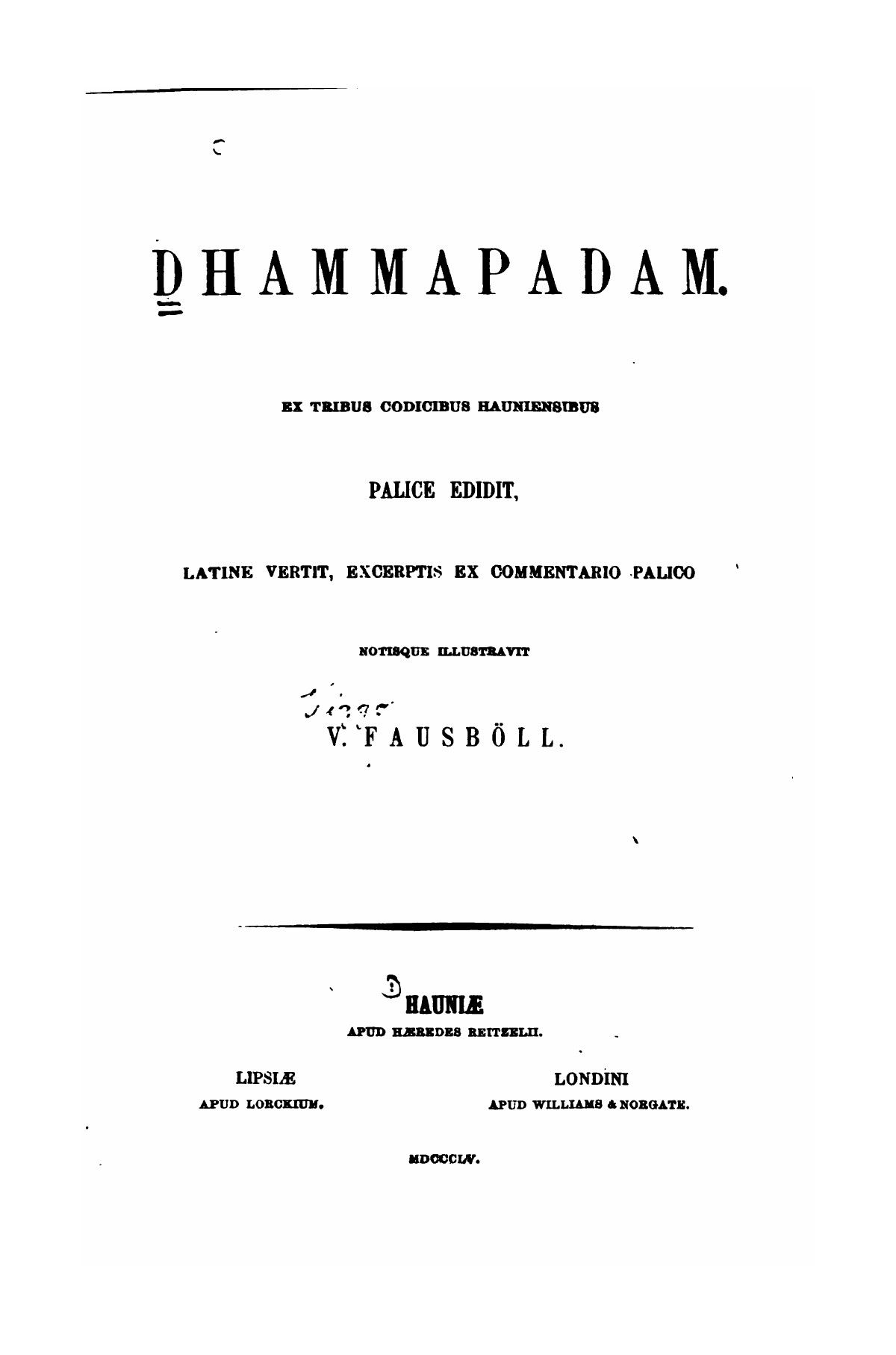
The title page is a small piece of publishing history in its own right. Copenhagen and London both appear on it. A Pali Buddhist text had entered a European network of libraries, booksellers, and philologists, but it did so through Latin. Fausbøll was making the work usable for other scholars, not yet for a general English reader.
Friedrich Max Müller supplied the missing complete English version in 1870. It appeared in Buddhaghosha's Parables, a volume built around Captain T. Rogers's English translation of Burmese narrative material. Müller's contribution was an introduction containing all 423 Dhammapada verses, translated from Pali under the title “Path of Virtue.” This is the first complete English translation identified in the modern translation history.
The date often given instead is 1881. That was when Müller published a revised version in volume X of The Sacred Books of the East, alongside Fausbøll's translation of the Sutta-Nipata. The revision had a substantially new introduction, including a long account of the Pali canon. More important for the book's afterlife, it belonged to a uniform Oxford series designed to place Asian religious texts in English libraries.
That series worked like a distribution system. A translation inside a specialist or colonial periodical might be read by dozens of people who already knew the field. A Clarendon Press volume could be ordered by universities and libraries across Britain, its empire, Europe, and the United States. The 1881 edition became the one later readers reprinted and encountered, which helps explain why it is so often remembered as the beginning.
Müller also illustrates a truth that can disappear behind a famous translator's name. Translation is never a word-substitution exercise. He had to decide what dhammapada meant, how Buddhist ideas should sound in Victorian English, and when a commentary clarified or distorted a verse. His choices made the text readable to a new audience. They also carried his own religious and intellectual assumptions into that reading.
A translation date tells you more than when English words appeared on paper. It tells you which Pali text the translator used, whose explanations they trusted, and which readers they imagined on the other side of the page.
The Pali Text Society was founded by T. W. Rhys Davids in 1881, the same year as Müller's revised translation. Its purpose was to publish Pali texts in Roman type, English translations, and the tools needed to study them. Over time, that institutional work made it possible to compare more witnesses, correct old readings, and separate the job of editing the Pali from the job of translating it.
For the Dhammapada, Oskar von Hinüber and K. R. Norman produced a new Pali edition in 1994, followed by a corrected reprint in 1995. A second edition with indexes appeared in 2014. Norman's English Word of the Doctrine followed in 1997 and was based on the corrected 1995 text.
The distinction between an edition and a translation is easy to miss. The edition asks, “What Pali words should we print, given the surviving evidence?” The translation asks, “How should those words be understood in another language?” A better Pali edition does not mechanically produce a final English answer, but it gives every translator firmer ground.
Older translations are not merely failed drafts waiting for a modern replacement. Gogerly preserves something of nineteenth-century Sri Lankan explanation, filtered through a missionary's aims. Fausbøll shows the first European attempt to establish the Pali text systematically. Müller's versions reveal how Victorian comparative religion introduced Buddhist literature to a large English readership. Norman represents a later philological tradition with more evidence and sharper tools.
If two translations disagree, the useful question is not immediately “Which one is right?” First ask whether they began from the same Pali reading, whether one follows the commentary, and what each translator is trying to help the reader hear. An annotated edition should make those choices visible rather than hiding them behind fluent English. That is the approach taken in our translated and annotated Dhammapada.
The book now found in a pocket or on a phone arrived there through many acts of selection. Knowing who made them does not put distance between the reader and the verses. It makes the meeting more honest.
Read the book
Related Articles
Continue through articles sharing this topic.
Somewhere around the year 1310, a Latin author sat down to write a book about furnaces.
6 min read
Pick a shelf of spiritual books at random and you will find, somewhere in the first twenty pages, the same accusation: you are not actually awake.
7 min read
Two texts, separated by something like two millennia and with no documented line of transmission between them, open with the same move.
6 min read
The Dhammapada is one of the most widely read Buddhist scriptures, and it has probably been abandoned by more readers than any other short classic.
6 min read