 Xognosis EsotericaArcane Publishing Studio
The Dhammapada is one of the most widely read Buddhist scriptures, and it has probably been abandoned by more readers than any other short classic. The reason is usually the same. Someone opens it with good intentions, reads the first page, and meets a statement like this: "Mind precedes all mental states.
Share
The Dhammapada is read across Buddhist traditions and far beyond them. It has probably also been abandoned by more readers than any other short classic. The reason is usually the same. Someone opens it with good intentions, reads the first page, and meets a statement like this: "Mind precedes all mental states. Mind is their chief; they are all mind-wrought. If with an impure mind a person speaks or acts suffering follows him like the wheel that follows the foot of the ox." That is Dhammapada verse 1, in Acharya Buddharakkhita's translation, and it is a lot to walk into cold. The verse is not obscure, but it assumes you have already agreed to a certain view of how actions and consequences work. Page one of this book begins mid-argument.
The instinct to start at the beginning feels like respect for the text. In this case it is a misunderstanding of what the text is. The Dhammapada is an anthology of 423 verses arranged in 26 chapters, and the chapters, not any continuous narrative, are its organizing unit. Each chapter gathers verses on a theme: pairs, flowers, the fool, anger, the path, the brahmin. Nothing in chapter 12 depends on chapter 11. The collection sits in the Khuddaka Nikaya, the "minor collection" of the Pali Canon, and it was assembled over time rather than issued as a unified work. Wikipedia's overview notes that no compiler is named in the text itself, and that parallel versions survive in Gandhari, Buddhist Hybrid Sanskrit, Sanskrit-Tibetan, and Chinese, with the shared verses arranged differently in each. Tradition attributes the verses to the Buddha; the anthology as we have it is the product of editors whose names we do not know. An anthology of this kind earns the right to be read the way anthologies are read: selectively, by appetite.
It helps to know how the familiar arrangement reached us. The oldest surviving Pali manuscripts of the Dhammapada date only to around 1500 CE, centuries after the composition of the verses themselves; the text's antiquity rests on recension and commentary rather than on surviving palm leaves. The first critical edition of the Pali was made by Viggo Fausboll in 1855, in Latin, and the first widely circulated English translation was F. Max Muller's, which appeared in 1870 and was later reprinted in Volume X of the Sacred Books of the East. The chapter sequence that Muller's readers met, running from the Yamakavagga (verses 1 to 20) to the Brahmanavagga (verses 383 to 423), is the sequence most English editions still follow.
But "most editions follow it" is a statement about publishing history, not about the verses. A later commentary, the Dhammapada Atthakatha, traditionally attributed to Buddhaghosa in roughly the 4th or 5th century, supplies 305 narrative settings for the verses: stories of monks, laypeople, and occasions on which the Buddha supposedly spoke particular lines. The attribution is tradition rather than documented fact, and the stories are legend and commentary layered onto the verses, not eyewitness records. Still, notice what the commentary does. It reads the Dhammapada out of order, jumping to whichever verse a story needs. Reading by story rather than by sequence is one of the oldest approaches to this text that we know of.
So where should you start, if not at verse 1? Wherever the question you already carry is being argued. If your question is practice, the obvious door is chapter 20, the Maggavagga or Path chapter. It contains some of the most direct statements in the collection, again in Buddharakkhita's translation: "Of all the paths the Eightfold Path is the best; of all the truths the Four Noble Truths are the best" (Dhp 273), and the famous insistence of verse 276: "You yourselves must strive; the Buddhas only point the way. Those meditative ones who tread the path are released from the bonds of Mara." A reader who begins here meets the text as instruction rather than as metaphysics, and the hard opening verses about mind and karma become easier to hear afterward, once the framework has some shape.
Other chapters work the same way. A reader wrestling with anger can begin at chapter 17. A reader curious about what the tradition means by wisdom can start near the end, with the Brahmanavagga's revaluation of who counts as a worthy person. The chapter titles in any decent table of contents are themselves a map of concerns. Pick your concern. The order in which you visit the territories is yours to choose, and the verses do not punish you for choosing.
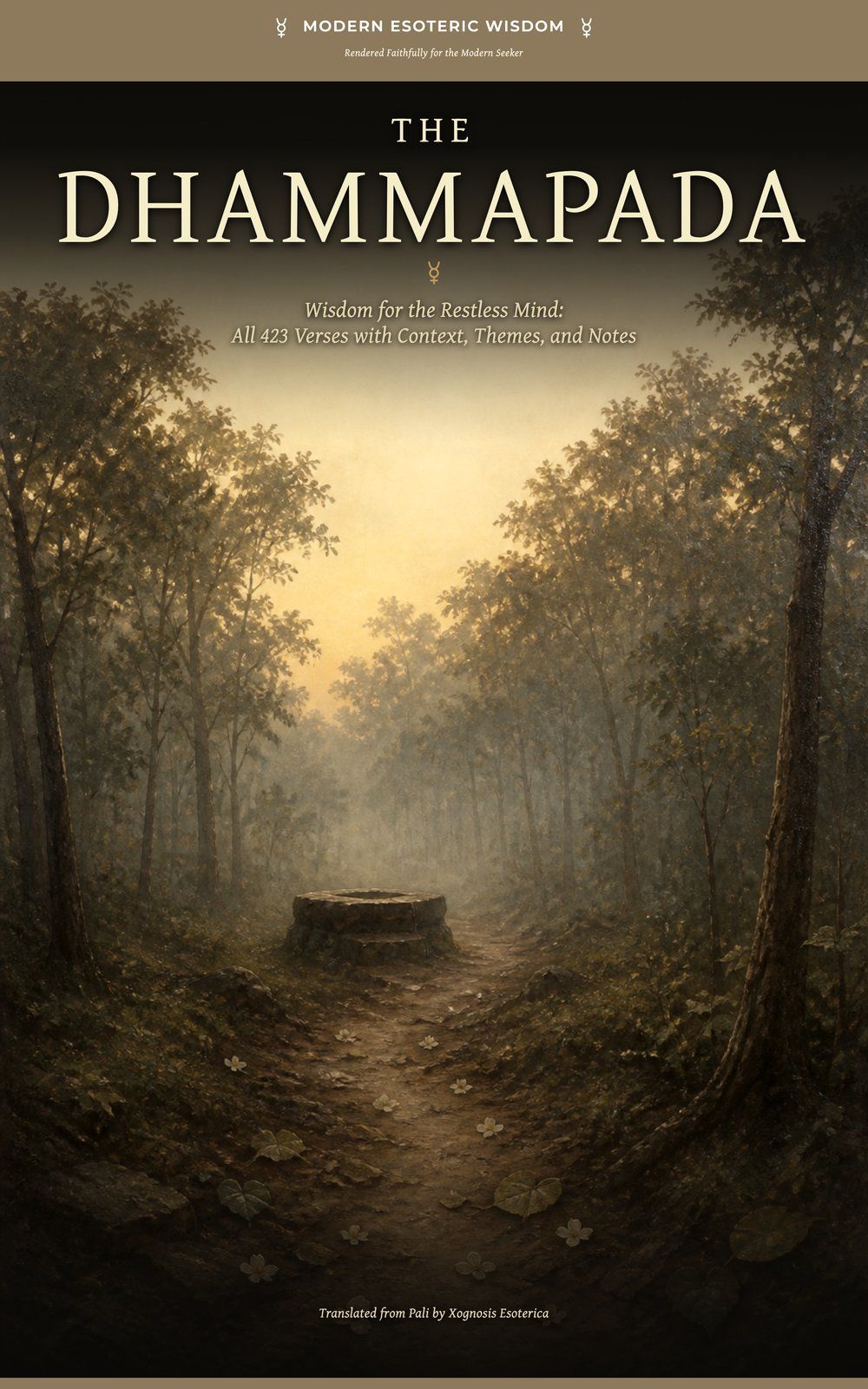
The natural next step is to stop treating the 26 chapters as the only grouping and to organize the whole 423 verses around questions instead. Our own edition, The Dhammapada: Wisdom for the Restless Mind, does exactly this. It keeps the traditional 26-chapter sequence with the full verse text, checked word by word against Fausboll's 1855 Pali edition, and alongside it offers five thematic paths: (1) mind and consequence, (2) heedfulness and training, (3) change and release, (4) non-harm and discernment, and (5) religious worth revaluation.
Be clear about what this scheme is. It is not a classical division. The Pali text's own organization is the 26 vaggas, full stop. The five paths are a modern editorial choice, ours, designed for readers who want a directed route through an anthology rather than a flat 26-chapter march. Honesty demands saying so, and the honesty is the point: chapter order is traditional, thematic order is a choice, and any reading of the Dhammapada that pretends otherwise is selling something.
A note on the scholarship behind these dates. Fausboll's 1855 edition, Muller's 1870 translation, and the traditional dating of the commentary all rest on standard references and catalog records rather than on a single specialist monograph. They agree across the sources consulted here, and they are the dates you will find in any reference work, but a reader who wants the full textual history should go to the specialist literature on the parallel Dharmapada versions.
The Dhammapada is an anthology, and anthologies tolerate being entered anywhere. Chapter order is a tradition handed down by editors; thematic order is a choice made by a reader. Choose your door, and let the verses argue with you from wherever you actually stand.
Concretely, for a restless first-time reader: begin with the Maggavagga (chapter 20) for the shape of the path. Then read the Yamakavagga (verses 1 to 20), which will now land as a thesis statement rather than a wall. From there, follow a theme rather than a page number, whether that is the training verses, the verses on impermanence, or the closing revaluation of worth. Read a few verses at a time. The Dhammapada is built from short, memorizable units; it rewards the pace of memorization, not the pace of a novel. And reread in a different order the second time. If the parallel recensions teach anything, it is that there was never exactly one Dhammapada to be faithful to.
Read the book
Related Articles
Continue through articles sharing this topic.
Somewhere around the year 1310, a Latin author sat down to write a book about furnaces.
6 min read
Pick a shelf of spiritual books at random and you will find, somewhere in the first twenty pages, the same accusation: you are not actually awake.
7 min read
Two texts, separated by something like two millennia and with no documented line of transmission between them, open with the same move.
6 min read
The Dhammapada is everywhere now. It fits in a pocket, loads free onto any e-reader, and turns up in bookstore poetry sections between Rumi and Mary Oliver.
5 min read