 Xognosis EsotericaArcane Publishing Studio
Open any grand history of Elizabethan England and you will find Dr. John Dee holding conversations with angels, naming the British Empire, or lending his mathematical instruments to navigators.
Share
Open any grand history of Elizabethan England and you will find Dr. John Dee holding conversations with angels, naming the British Empire, or lending his mathematical instruments to navigators. Open his private diary and you find something stranger: a man writing down the exact minute his children were born, how much he paid the maid, and how much his shoulder hurt. Between 1577 and the early 1600s, in cramped Latin-English entries, Dee kept a running record of his household, first at Mortlake and then across Europe. Edited by James Orchard Halliwell for the Camden Society in 1842, it gives us an unusually intimate view of Elizabethan daily life.
The famous conjuror, it turns out, spent most of his ink on ordinary things.
Why did Dee timestamp everything? The popular historian Debbie Kilroy puts it plainly: the diary is "more properly called an ephemeris", a book of timed observations, because a working astrologer needed the exact moment of a birth or an illness to judge the heavens presiding over it. That is the documented purpose of the timestamps. The intimacy we prize in the document today is largely a modern discovery: Dee was not confessing, he was filing data, and the data happened to be his own life.
So we get entries like this, for his son Arthur: "July 13th, Arthurus Dee natus puer mane hor. 4 min. 30 fere, vel potius min. 25, in ipso ortu solis, ut existimo." A boy born at sunrise, by his father's own reckoning, and a father correcting his minute-reading as he went. Three days later: "July 16th, Arthur was christened at 3 of the clok afternone." The 1842 edition's year heading gives 1579, which is the date biographers use. Daughter Katherine followed in June 1581, born at half past seven in the morning and baptized three days later at half past five in the afternoon. Later children, Madinia, Frances, Theodore, Rowland, fill the pages the same way: born, christened, timed.
For all its domesticity, the diary catches the court flickering at the edge of the garden. On September 17th, 1580, Elizabeth I came from Richmond in her coach:
"The Quene's Majestie cam from Rychemond in her coach, the higher way of Mortlak felde, and whan she cam right against the church she turned down toward my howse: and when she was against my garden in the felde she stode there a good while, and than cam ynto the street at the great gate of the felde, where she espyed me at my dore making obeysains to her Majestie."
The entry continues with the Queen beckoning him to her, and then stops; the diary does not dramatize what followed. Legends grew later about Dee the court conjuror, but Glyn Parry's biography, built on the primary sources, is the corrective: Dee was a sought-after scholar with precarious patronage, and the relationship shows in gifts rather than salaries. In November 1580, "the Lord Threasurer sent me a haunche of venison." In July 1583, as the family prepared to leave England, came "the Quene's gift of 40 angells sent by the Erle of Lecester." A haunch of venison is a graceful thing to receive. It is not an income.
The illness entries are among the most physically immediate in the whole document. In March 1577 Dee recorded "my fall uppon my right nuckul bone", adding that it was "wyth oyle of Hypericon in 24 howres eased above all hope". In July 1581 he noted flatly that his shoulder and elbow joint were so bad he could not lift his arm an inch for fourteen days: "the payn was extreme". In August 1590, "the second fytt of the stone in my kydneys did molest me."
His children's medicine appears too. "Arthur and Katharine were let blud at London by Doctor Dodding's cownsayle." Bloodletting for two of his children, on a physician's advice: ordinary Tudor medicine, recorded in the same tone as a christening.
The darkest entry of the continental years is the death of his son Michael. In Debbie Kilroy's account the boy died on July 13th, 1594, Dee's own birthday, his last words "O Lord, have mercy uppon me!", and Dee entered the death in the flat phrase "did give up the ghost". Those wordings come from her popular history rather than a verified transcription of the diary, so read them as reported. The death itself is settled, and the diary carried a father's grief in the same ink as everything else.
Money is the diary's quiet obsession. In September 1577 Dee hired a servant and wrote the terms straight into the record: "Jane Gaele cam to my servyce, and she must have four nobles by the yere, 26s. 8d." Other entries show the ordinary churn of a household: a maid giving "a quarter's warning" in June 1577, another falling sick, a man named George "dismissed my servys and payd all reconings", and, years on, "I discharged Robert Web of my service, and gave him 40 shillings for a full satisfaction." Unpaid wages, the one drama this article's title promises, are the one drama the diary declines to deliver: on this evidence the servants left with their reckonings paid.
What the record does show is a scholar repeatedly borrowing. "June 18, 1577. borrowed £40 of John Hilton of Fulham." Five months later, £30 more from Edward Hynde of Mortlak, repayable at Hallowtide the following year. Occasionally the ledger turns: in October 1580 a jury at Guildhall awarded him £100 in damages against Vincent Murphyn. And threading through it all, the Queen's intermittent angels and haunches of venison, patronage arriving as gifts where a modern reader expects a salary. Parry's The Arch-Conjuror of England draws out this precarity across Dee's whole career: the great library at Mortlake, the continental travels, the slow decline into dependence.
Amid the timed births and itemized debts, one entry stands almost alone for its plainness. On October 10th, 1580, Dee recorded: "At 4 of the clok in the morning my mother Jane Dee dyed at Mortlak; she made a godly ende: God be praysed therfor! She was 77 yere old." Four o'clock in the morning: even grief got its timestamp, because even grief had its horoscope. But the sentence that follows the data is pure son: she made a godly end, and he thanked God for it.
The diary was kept to time the heavens over a household, and in doing so it accidentally preserved the household itself: the exact hour of a birth, the yearly wage of a maid, the cost of a fall. Few Elizabethan documents let a reader stand so close to the ordinary day of an extraordinary man.
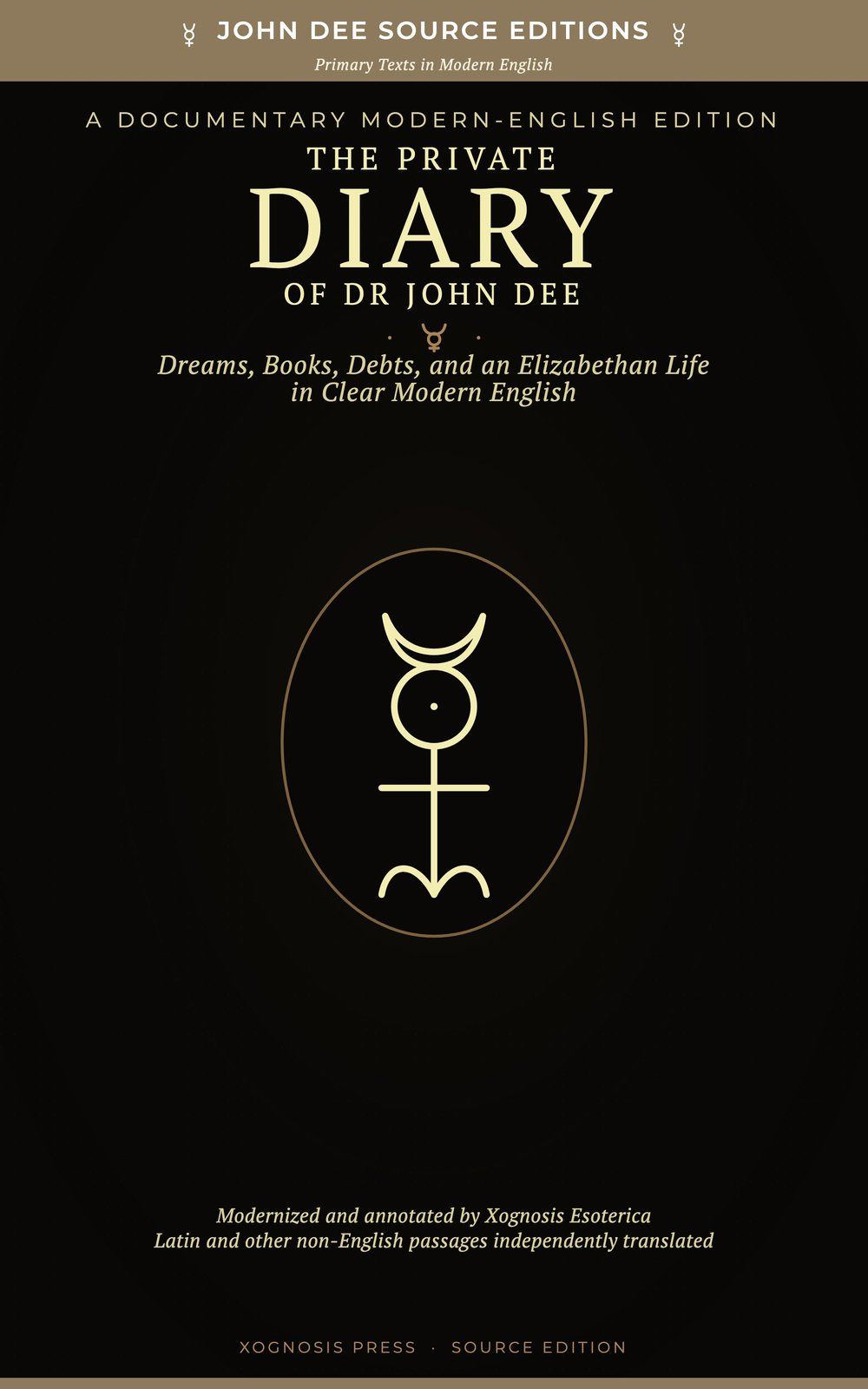
The diary rewards reading straight through, precisely because nothing in it is staged. You can find it in our edition of The Private Diary of Dr John Dee, which follows Halliwell's 1842 text. Read a few pages and the magus steps out of the legend: a man in a Mortlake garden, bowing to a queen, counting his shillings, and writing down, to the half-minute, when his children came into the world.
Read the book
Related Articles
Continue through articles sharing this topic.
Two books sit at the far ends of the esoteric shelf, and they answer the same question in opposite ways.
6 min read
In the summer of 1552, two of the most restless minds in Europe were, as far as anyone can tell, in the same city at the same time.
6 min read
Open a modern edition of A True and Faithful Relation and you meet a problem before you meet a single angel.
7 min read
Open a page of John Dee's Monas Hieroglyphica at random and you see a strange object: a single compound sign, part astronomical, part alchemical, drawn once…
6 min read