 Xognosis EsotericaArcane Publishing Studio
Somewhere in Europe, near the close of the thirteenth century, a writer sat down and produced the most influential chemistry textbook of the Middle Ages. He signed it with someone else's name.
Share
Somewhere in Europe, near the close of the thirteenth century, a writer sat down and produced the most influential chemistry textbook of the Middle Ages. He signed it with someone else's name. The name he chose was Geber, the Latin form of Jabir ibn Hayyan, the legendary Arabic alchemist, and the borrowed signature held for six hundred years before anyone thought to check it. When the checking came, the unmasking took decades to settle, and a minority of scholars still disputes it. The books themselves never stopped being read. That is the strange part: the exposure changed the author's name in the catalog and almost nothing else.
Start with the original, so far as there was one. Jabir ibn Hayyan is traditionally placed between roughly 721 and 806 to 816, a disciple of the Imam Ja'far al-Sadiq (died 765) and an associate of the powerful Barmakid family. All of these dates are reported ranges, not established facts. The first biographical notice we have, Ibn al-Nadim's Fihrist of 987, already records people claiming Jabir never existed at all. Later tradition made him a court alchemist to the caliph Harun al-Rashid in Baghdad, and that image is legend, not history.
The corpus is another matter. Around 600 works were attributed to Jabir, roughly 215 survive, and the count rises toward 3,000 counting chapters separately. Paul Kraus dated the Arabic corpus to about 850 to 950, generations after the historical man would have died, and that dating is now widely accepted. Even on the Arabic side, "Jabir" was already a pen name before Europe ever heard it.
In the late thirteenth century, a cluster of Latin alchemical works began circulating under the name Geber. The core four were the Summa perfectionis magisterii, De investigatione perfectionis, De inventione veritatis, and the Liber fornacum, the Book of Furnaces. Two more, the Testamentum Geberi and the Alchemia Geberi, joined later and are judged spurious additions. No author's name survives in the works themselves, only the borrowed one on the outside.
Europeans read these as translations of the great Arabic master, and the books rewarded the reading. They were clear, systematic, and argumentative in a way medieval readers trusted. The corpus carried practical chemistry too. The 1911 Encyclopaedia Britannica records the tradition plainly: nitric acid "is mentioned in the De inventione veritatis ascribed to Geber, wherein it is obtained by calcining a mixture of nitre, alum and blue vitriol." Aqua regia, the solvent that attacks gold, appears here as well. For centuries, Europeans who wanted to think seriously about chemistry likely learned it from these pages.
The manuscripts circulated for about two hundred years before print, then printed editions spread everywhere: an incunable in Rome around 1486 to 1490, printings across Strasbourg, Venice, Basel, Leiden, and Gdansk, translations into German, Italian, and English. In 1678, London printed Richard Russell's English version under a title page that shows the legend in full flower: "THE WORKS OF GEBER, The Most Famous ARABIAN PRINCE AND PHILOSOPHER." An Arabian prince. No source in the research tradition supports that rank, but there it stood, in type, nearly four centuries into the impersonation.
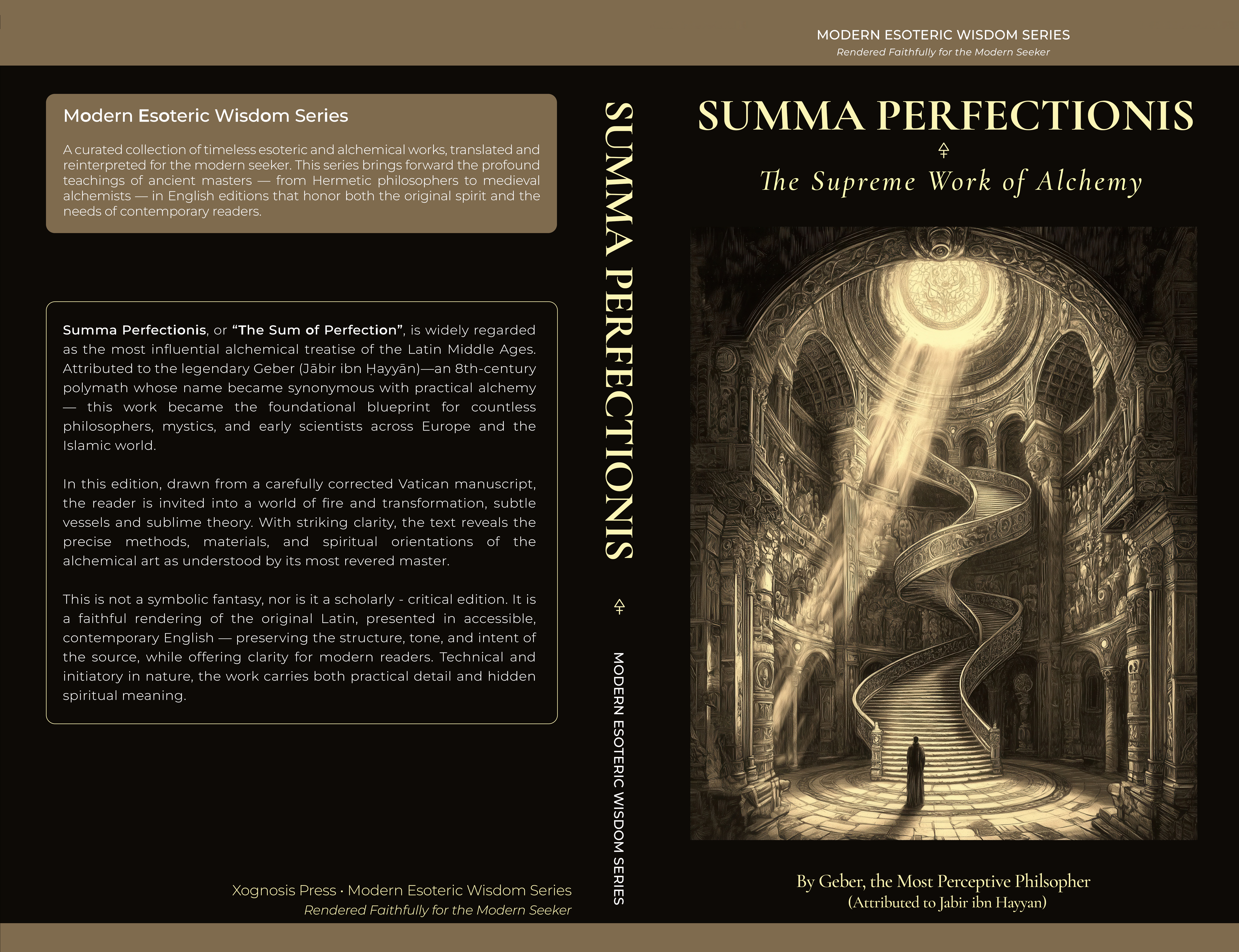
The confidence lasted because nothing forced a comparison. Europeans had few Arabic Jabir texts, so the Latin books simply were Jabir. Anyone curious today can follow the whole arc in the Summa Perfectionis itself, the central work of the corpus, still in print.
The doubts began with the nineteenth-century historians of chemistry, among them Hoefer, Kopp, and Lippmann, who questioned the attribution on stylistic grounds. The decisive blow came from Marcellin Berthelot, the French chemist and historian who did what nobody had done and read the Arabic manuscripts.
Berthelot worked through the Jabir manuscripts of the Bibliothèque nationale in Paris and, above all, those of Leiden University Library, publishing his three volumes on the origins and transmission of alchemy between 1885 and 1893. His verdict, stated in the 1893 preface, is quiet and total: "Cette étude se termine par celle des ouvrages latins attribués à Géber et dont j'ai été amené à contester complètement l'authenticité." This study ends with the Latin works attributed to Geber, whose authenticity I was led to contest completely. As he put it, "C'est par la lecture des textes orientaux que j'ai été conduit à ce résultat." The Arabic texts and the Latin ones, side by side, did not match: the Leiden manuscripts "n'ont, comme je le montrerai, guère de ressemblance avec les auteurs latins apocryphes qui ont usurpé ce nom," bear hardly any resemblance to the apocryphal Latin authors who usurped that name.
Usurped. The 1911 Britannica article on Geber absorbed the finding, reporting that the Summa "contains no indication of an Arabic origin, either in its method, which is conspicuous for clearness of reasoning and logical co-ordination of material, or in its facts, or in the words and persons quoted."
If the Latin books were not translated from Arabic, someone wrote them, and in 1985 William R. Newman proposed a candidate: Paul of Taranto, a thirteenth-century Franciscan from southern Italy, author of a Theorica et practica defending alchemical transmutation. Newman developed the argument in his 1991 critical edition of the Summa for Brill, resting the case on doctrinal and textual parallels between the two bodies of work. Britannica's current topic page says the Summa was probably composed in the late 13th century by a Franciscan monk known as Paul of Taranto.
Note the hedges, because they matter. The identification is an inference from parallels, not a documented fact. Paul is sparse in the records; al-Hassan observes that he was "an unidentified Franciscan Friar" who, on Newman's own reading, lectured in the monastery of the Friars Minor in Assisi in the second half of the thirteenth century.
The attribution seeded a longer argument about influence. Newman has traced the Summa's corpuscular matter theory through Daniel Sennert and onward to Robert Boyle, which would make this one forged signature a working ancestor of seventeenth-century chemistry. That lineage is Newman's interpretation, argued in his 1996 and 2006 books, and it rests on his case for the Summa as a Latin original.
Berthelot's verdict became the mainstream, and the 2020 specialist survey by Sébastien Moureau states the consensus flatly: "The other Latin texts attributed to Geber are pseudepigraphs." Yet the dissent is real and quotable. E. J. Holmyard published refutations of Berthelot's assumptions between 1922 and 1928, and his 1957 book Alchemy still judged the Latin works "the product of an occidental rather than an oriental mind" on stylistic grounds, while arguing their content drew on Arabic sources. Darmstaedter and Partington sympathized with an Arabic origin. More recently, Ahmad Y. al-Hassan has argued the Summa is a translation-adaptation of Arabic originals, though his papers are self-published and should be weighed accordingly. His sharpest point lands anyway: Berthelot "based all his conclusions regarding the authorship of Geber's Latin works on a very limited number of Arabic manuscripts." A verdict built on what survived in two libraries is built on an accident of preservation.
One popular claim deserves a flag. Walk the internet today and you will find that the eighth-century Jabir invented nitric acid, sulfuric acid, and the rest. The verifiable position is narrower: the earliest clear Latin recipes appear in the thirteenth-century corpus, and al-Hassan's intermediate view holds that some Arabic recipes predate them. The prince-inventor of popular legend is exactly that, legend.
About the title's arithmetic, some honesty is owed. From composition around 1290 to Berthelot's verdict in the 1880s is roughly six centuries of uncontested attribution. You reach seven only by counting to Newman's confirmation in 1985 to 1991, or to the readers who still open the Summa. Either way, one borrowed name, applied by one unknown hand, directed European chemistry for hundreds of years and is still argued over by professors. Few forgers can claim a run like it.
The works mattered more than the name. Europe learned its chemistry from books signed by a man who never wrote them, attributed to an Arabian prince who was no prince at all, and when the forgery was exposed, the books kept their place on the shelf. Read them as what they are: thirteenth-century Latin originals wearing an Arabic legend.
Read the book
Related Articles
Continue through articles sharing this topic.
Esoteric literature has a way of swallowing beginners whole. You pick up one book about alchemy, and within a week you have six tabs open about Renaissance…
7 min read
Somewhere around the year 1310, a Latin author sat down to write a book about furnaces.
6 min read
Sometime around the end of the thirteenth century, a writer working in Latin composed a long, disciplined treatise on the art of alchemy.
6 min read
There is a story about alchemy that almost everyone knows. For centuries, so it goes, clever men wasted their lives stirring molten metals and muttering…
6 min read
Related Books
Catalog volumes sharing this article’s lead tag.
Mutus Liber Reimagined (The Silent Book): A Modern Restoration & Commentary in Full Color Discover the Hidden Wisdom of Alchemy's Most Enigmatic Masterpiece, Now in Stunning Full…
Xognosis Esoterica
Mutus Liber Reimagined (The Silent Book): A Modern Restoration & Commentary in Monochrome Discover the Hidden Wisdom of Alchemy's Most Enigmatic Masterpiece, Now in Striking Monoc…
Xognosis Esoterica
Rendered Faithfully for the Modern Seeker Summa Perfectionis, or "The Sum of Perfection," is widely regarded as the most influential alchemical treatise of the Latin Middle Ages.…
Xognosis Esoterica