 Xognosis EsotericaArcane Publishing Studio
Sometime around the end of the thirteenth century, a writer working in Latin composed a long, disciplined treatise on the art of alchemy. He signed it with a name that was already five hundred years old: Geber, the Latin form of Jabir ibn Hayyan, the great Arabic alchemist of the eighth century.
Share
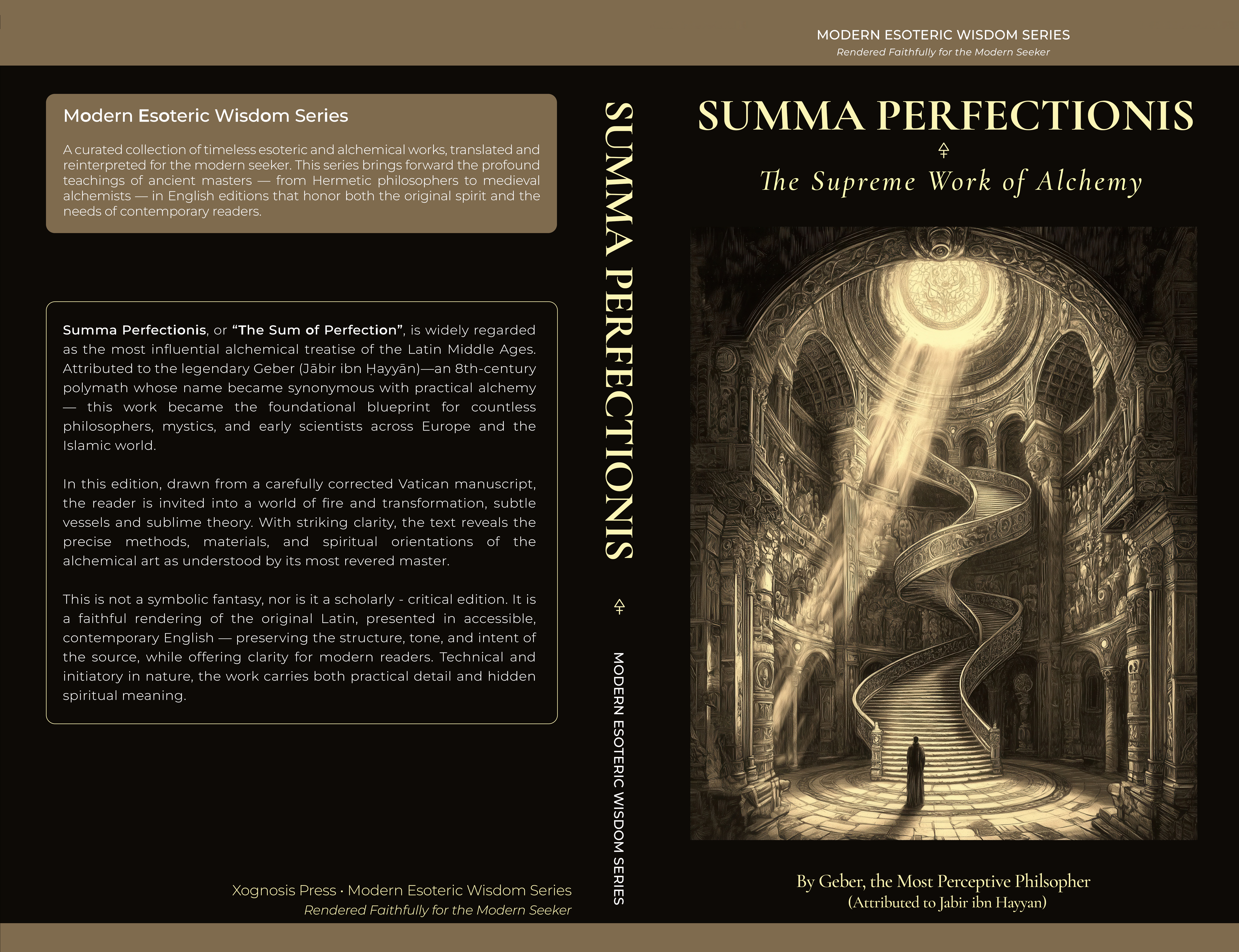
Sometime around the end of the thirteenth century, a writer working in Latin composed a long, disciplined treatise on the art of alchemy. He signed it with a name that was already five hundred years old: Geber, the Latin form of Jabir ibn Hayyan, the great Arabic alchemist of the eighth century. The signature was a gesture of inheritance, and it worked so well that readers believed it for centuries. The book, the Summa perfectionis magisterii, went on to have one of the longest publishing careers in the history of science: copied by hand, set in type within living memory of the medieval period's end, translated into English in 1678, edited by a modern historian in 1928, given a critical scholarly edition in 1991, and rendered into fresh modern English in 2025. Few texts have stayed in circulation, in some form, for seven hundred years. This is the story of how it did.
Start with the legend, because the legend is the frame readers have carried for most of this book's life. Jabir ibn Hayyan was a real historical figure, an Arabic alchemist of the eighth century whose name attached to an enormous body of writings. When the Summa appeared in Latin Europe around 1300 under the name "Geber", readers naturally took it as the work of that same master, translated at last.
The problem is that no Arabic prototype of the Summa has ever been found, and none of the major thirteenth-century authors who wrote about alchemy, figures like Albertus Magnus or Roger Bacon, cite it. The book appears on the scene, fully formed, only at the close of the century. Scholarship therefore treats the text as pseudepigraphic: written in Latin Europe and deliberately attributed to an older authority. Hence the standard modern label, "Pseudo-Geber", for the unknown author. That label is a modern convenience. The attribution itself is the historical fact we can verify, and it tells us something about how authority worked in medieval science: you borrowed a giant's name because a giant's name got read.
Who was the actual author? The most developed answer is William R. Newman's hypothesis, published with his 1991 critical edition, that the Summa was written by Paul of Taranto, a thirteenth-century Franciscan. It is a serious argument, built on close comparison of texts, but it remains what the literature calls it: a tentative identification. Honest readers should hold it as a hypothesis, not a settled name. The anonymous Latin alchemist is the only author we can point to with certainty.
Eric John Holmyard, assessing the corpus in his 1957 book Alchemy, put the stylistic case plainly: "The general style of the works is too clear and systematic to find a close parallel in any of the known writings of the Jabirian corpus ... the general impression they convey is that they are the product of an occidental rather than an oriental mind." Clarity and system, in other words, betrayed the forger.
For its first two centuries the Summa lived as a manuscript, copied by hand for readers who wanted the most authoritative statement of alchemical theory and practice available. Manuscript culture is slow distribution, but it was enough to make the book the reference point of late medieval alchemy. The publisher's description of the modern critical edition calls it "the Bible of the medieval" alchemists, and while that is a publisher's superlative rather than a measured scholarly claim, it reflects a real dominance. When print arrived, the Summa was ready for it.
The first printed edition came in 1525, produced in Rome under the editorship of Faustus Sabaeus and printed by Marcellus Silber. Print then did what print does: it multiplied. A Strasbourg edition followed around 1528 to 1529, another from Johann Grüninger in Strasbourg in 1531, editions from Peter Schoeffer the Younger in 1541 and Nuremberg in 1545. In 1572 the text joined the collected volume Artis Chemicae Principes in Basel. By 1598 there was another Strasbourg edition, and by 1668 Georgius Hornius brought out an edition in Leiden. A Gdansk edition appeared in 1682.
Look at that list of cities: Rome, Strasbourg, Basel, Leiden, Gdansk. The Summa was a pan-European commodity, reissued whenever a market could bear it. It is worth being precise about what this record shows and what it does not. It shows demand, sustained across two centuries and multiple confessional and political boundaries. It does not, by itself, show how many copies each house ran off or who bought them; the surviving record is of editions, and print-run figures belong to the parts of the story the sources do not preserve.
The year 1678 marks the book's crossing into English. In London, the translator Richard Russell published "The Works Of Geber", an English version of the pseudo-Geber corpus with the Summa at its heart. The translation was reprinted in 1686, evidence that it found and kept an audience. Russell's English is the language of the Restoration, stiff and periodic to a modern eye, but it made the text available to readers who had no Latin and no intention of acquiring any.
For the "manuscript to modern English" arc, this is the hinge. Before 1678, the Summa reached English-speaking readers only as reputation and secondhand report. After 1678, it existed as an English book, one that could sit in a gentleman's library beside works of natural philosophy. The date matters for another reason: Russell was translating a text already nearly four hundred years old, still attributed to Geber. The legend survived the crossing into vernacular print intact.
By the twentieth century the Summa had receded into specialist territory. Eric John Holmyard, a historian of chemistry and Arabic science, brought it back. In 1928 he published an edition of Russell's 1678 translation, making the English Geber available again to modern readers in a scholarly package. Three decades later his Penguin book Alchemy carried his assessment of the corpus to a mass audience.
Holmyard's contribution was double: he kept the text circulating, and he sharpened the authorship question. The man who republished the old translation was also one of the readers who could see that the work's style pointed west, not east.
The decisive modern intervention came in 1991, when William R. Newman published "The Summa Perfectionis of Pseudo-Geber" with E.J. Brill: a critical Latin edition, a fresh English translation, and an extended study. This is the edition that fixed the dating (end of the thirteenth century, slightly before 1310), advanced the Paul of Taranto hypothesis, and gave scholars a reliable text to argue from. Everything the present article can say about when the book was written and who might have written it rests on that foundation.
And the career continues. Our own modern English edition of the Summa Perfectionis, published in 2025, faces the same choices every publisher in this lineage has faced: which text to follow, how to handle Russell's seventeenth-century English, how to present an author whose name is a mask. Seven centuries of intermediaries stand between the anonymous Latin alchemist and the reader of today. Each one, from the Roman printers of 1525 to the modern editor, made decisions that shape what the book now is.
The Summa Perfectionis has survived for seven hundred years by being repeatedly remade: signed with a borrowed name around 1300, set in type in 1525, translated in 1678, historicized in 1928 and 1991, and translated anew in 2025. Its subject is alchemy, but its history is the history of publishing itself.
Read the book
Related Articles
Continue through articles sharing this topic.
Esoteric literature has a way of swallowing beginners whole. You pick up one book about alchemy, and within a week you have six tabs open about Renaissance…
7 min read
Somewhere around the year 1310, a Latin author sat down to write a book about furnaces.
6 min read
There is a story about alchemy that almost everyone knows. For centuries, so it goes, clever men wasted their lives stirring molten metals and muttering…
6 min read
Ask most people who Jabir ibn Hayyan was and you will get a biography with the confidence of an encyclopedia entry: born at Tus in 721, son of a druggist,…
6 min read
Related Books
Catalog volumes sharing this article’s lead tag.
Mutus Liber Reimagined (The Silent Book): A Modern Restoration & Commentary in Full Color Discover the Hidden Wisdom of Alchemy's Most Enigmatic Masterpiece, Now in Stunning Full…
Xognosis Esoterica
Mutus Liber Reimagined (The Silent Book): A Modern Restoration & Commentary in Monochrome Discover the Hidden Wisdom of Alchemy's Most Enigmatic Masterpiece, Now in Striking Monoc…
Xognosis Esoterica
Rendered Faithfully for the Modern Seeker Summa Perfectionis, or "The Sum of Perfection," is widely regarded as the most influential alchemical treatise of the Latin Middle Ages.…
Xognosis Esoterica