 Xognosis EsotericaArcane Publishing Studio
Ask most people what the Gospel of Mary is about, and you will hear a story about a secret marriage. Jesus wed Mary Magdalene, the church buried the proof, and this forgotten gospel survived to tell the tale. None of that survives contact with the text itself.
Share
Ask most people what the Gospel of Mary is about, and you will hear a story about a secret marriage. Jesus wed Mary Magdalene, the church buried the proof, and this forgotten gospel survived to tell the tale. None of that survives contact with the text itself. The marriage belongs to a different gospel, the Magdalene is an inference rather than a certainty, and the dramatic heart of the document is an argument between two men about whether a woman's testimony counts. Read it plainly, and you find one of the sharpest portraits we have of a fight over authority in early Christianity.
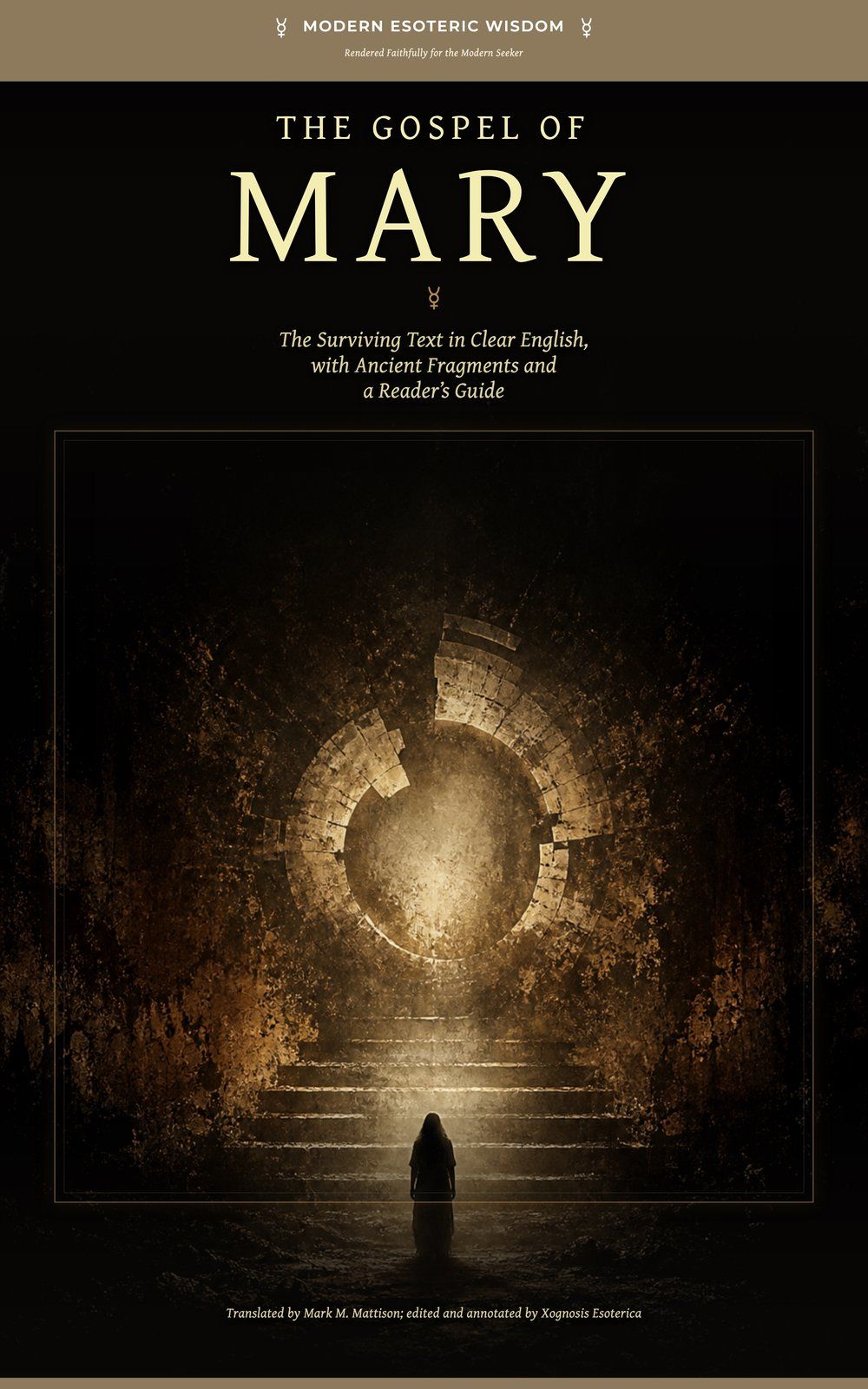
The longer surviving witness, Papyrus Berolinensis 8502, was bought in Cairo in 1896 and then waited fifty-nine years for publication, delayed by two world wars and ordinary scholarly misfortune. When Walter Till finally printed the Coptic text in 1955, the Nag Hammadi discovery had already crowded it out of the headlines. The codex is a Coptic manuscript usually dated to the fifth century, preserving pages 7 to 10 and 15 to 19 of the Gospel of Mary, bound alongside the Apocryphon of John, the Sophia of Jesus Christ, and the Act of Peter. Two third-century Greek fragments, published in 1938 and 1983, confirm bits of the same text. Less than half of the work survives. The title, "The Gospel According to Mary," stands at the very end, after page 19, and no surviving line ever adds "Magdalene."
There was no suppression in the modern sense. The Greek fragments appeared in ordinary papyrological series, and the gospel has been included in the standard one-volume collections of early Christian literature since Robinson's Nag Hammadi Library in 1981. The legend of the buried gospel is the frame the text arrived in, so it helps to state that record plainly. For readers who want the full document with the page gaps left visible, our edition of The Gospel of Mary prints the text with the Berlin Codex pagination intact and appends the Greek of the Rylands fragment.
Strip away the missing pages and the surviving story is short. The risen Savior answers a question about matter and sin, telling the disciples there is no sin as a force in itself: "The Savior said There is no sin, but it is you who make sin when you do the things that are like the nature of adultery, which is called sin." He warns them against legislating: "Do not lay down any rules beyond what I appointed you, and do not give a law like the lawgiver lest you be constrained by it." Then he departs.
The disciples despair. Mary steadies them: "Do not weep and do not grieve nor be irresolute, for His grace will be entirely with you and will protect you." Peter asks her directly to share what she alone remembers, and she reports a vision in which she saw the Lord. After a missing stretch of pages, her account of the soul's ascent past hostile powers resumes and concludes, and then the scene everyone remembers erupts.
Andrew dismisses her teaching as strange. Peter goes further: "Did He really speak privately with a woman and not openly to us? Are we to turn about and all listen to her? Did He prefer her to us?" Mary weeps and asks whether Peter thinks she invented it. And Levi delivers the verdict: "Peter you have always been hot tempered. Now I see you contending against the woman like the adversaries. But if the Savior made her worthy, who are you indeed to reject her?" The disciples go out to preach. That is the ending.
Notice what is absent. The words wife, husband, marriage, bride, and companion appear nowhere in the surviving text. The only personal language is the affection formula, "the Savior loved you," used by Peter and again by Levi, and it is presented there as a reason for listening to her, not as a romance.
The married-Jesus claim comes from the Gospel of Philip, a separate Nag Hammadi text that calls Magdalene the Savior's koinonos and shows him kissing her, both in passages damaged by lacunae. Karen King's 2013 study is the most careful treatment, and it cuts both ways: she argues Philip does portray the incarnate Jesus as actually married, as a Valentinian theological construction, while stating flatly that Philip "does not provide evidence useful in resolving the question of the historical Jesus's marital status." She also observes that early Christian literature discusses marriage constantly but "never is it asserted that he was married." A later ritual theology is being read backward as biography. The Gospel of Mary contributes nothing to the claim either way.
The text says only "Mary." The Magdalene identification is an inference, drawn from her role in parallel texts: rivalry with Peter, beloved-disciple language, witness by vision. King accepts the inference; scholars including Stephen Shoemaker and Antti Marjanen have argued that in several so-called Gnostic texts the Mary in question could as easily be Mary the mother of Jesus, and a 2002 symposium volume was titled Which Mary? for exactly this reason. The identification is probable and widely held, but it is a scholarly judgment, and honest writing should say so.
Here the text becomes genuinely revealing, because Peter's objection to Mary recurs across independent works. Gospel of Thomas 114 has Peter demand that "Mary leave us, for females don't deserve life." In the third-century Pistis Sophia, Peter complains that Mary "taketh the opportunity from us and hath let none of us speak," and Mary later admits she is "afraid of Peter, because he threatened me and hateth our sex." Karen King reads these scenes as reflexes of real second-century tensions over esoteric revelation and the authority of women to teach.
There is a finer point, and it is King's interpretation rather than a bare fact: the earlier Greek fragments of the Gospel of Mary seem to treat Mary's leadership as a woman as settled, with only her teaching challenged, while the Coptic revision sharpens the attack toward women's leadership as such. If she is right, the gender framing we now read as the text's essence may partly be a later, defensive development.
The Gospel of Mary is not evidence about a marriage. It is evidence about an argument: one woman's vision set against the institutional claim of Peter, with Levi casting the deciding vote for private revelation. Everything modern audiences love to imagine in it was brought to it afterward.
The rest is layered legend. The penitent prostitute, fixed in Western imagination, was assembled in 591 by Gregory the Great, who merged Luke's unnamed sinful woman, Mary of Bethany, and the Magdalene into one figure and observed that her ointment had once served "to perfume her flesh in forbidden acts." The Gospels themselves say only that seven demons went out of her. The Da Vinci Code layer arrived in 2003. Whether the text should even be called "Gnostic" is its own live debate, one that Esther de Boer has answered with a no, and which our Gnosticism Explained covers in full. What the gospel actually says comes in Levi's voice: if the Savior made her worthy, who are you to reject her?
Read the book
Related Articles
Continue through articles sharing this topic.
Esoteric literature has a way of swallowing beginners whole. You pick up one book about alchemy, and within a week you have six tabs open about Renaissance…
7 min read
In January 1896 the German scholar Carl Reinhardt bought a Coptic papyrus codex in Cairo.
7 min read
Every few decades, someone translates the esoteric classics again. New Enoches appear. New Pistis Sophias.
6 min read
Pick a shelf of spiritual books at random and you will find, somewhere in the first twenty pages, the same accusation: you are not actually awake.
7 min read
Related Books
Catalog volumes sharing this article’s lead tag.