 Xognosis EsotericaArcane Publishing Studio
The Gospel of Mary opens mid-sentence. The first words we have, at the top of page 7 of the surviving Coptic codex, are a question from a disciple: "Then will [matter] be [destroyed], or not?" Everything before it, six full pages, is gone. So are four pages from the middle. Of a text that Karen L.
Share
The Gospel of Mary opens mid-sentence. The first words we have, at the top of page 7 of the surviving Coptic codex, are a question from a disciple: "Then will [matter] be [destroyed], or not?" Everything before it, six full pages, is gone. So are four pages from the middle. Of a text that Karen L. King dates to the early second century CE, written originally in Greek, "fewer than eight pages of the ancient papyrus text survive, which means that about half of the Gospel of Mary is lost to us, perhaps forever." What survives is extraordinary: a post-resurrection dialogue in which a disciple named Mary relays private teaching from the Savior, is challenged by Peter and Andrew, and is defended by Levi. What is missing has shaped the text's afterlife almost as much, because readers have been filling the gaps with their own hopes and suspicions for a century.
The story begins with a purchase. In January 1896, a German scholar, Dr. Carl Reinhardt, bought a codex in Cairo from a dealer based in Akhmim and took it to Berlin, where it was catalogued as Codex Berolinensis 8502. It contained four texts: the Gospel of Mary, the Apocryphon of John, the Sophia of Jesus Christ, and the Act of Peter. Carl Schmidt brought it to the notice of the Royal Prussian Academy that July.
The find story attached to the purchase deserves skepticism, and retellings decorate it further with feathers and a Christian burial site. King is blunt: "The dealer told him that a peasant had found the book in a niche of a wall, but that is impossible," since no book could have survived fifteen hundred years in the open air. Where the codex actually lay hidden all those centuries is unknown. What is certain is that the pages were already missing when the codex surfaced: it reached Schmidt protected in its original cover, with leaves jumbled and six pages of the gospel gone. Schmidt blamed whoever found the book, but nothing has ever been learned about the pages' fate. The loss is ancient, anonymous, and unexplained.
The Coptic copy was made in the fourth or fifth century (e-Clavis says fourth or fifth, King says fifth). The text covers codex pages 7 to 10 and 15 to 19, with page 19 breaking off partway down. Pages 1 to 6 and 11 to 14 are missing entirely. As Judith Hartenstein notes in her e-Clavis survey, "less than half of the text is preserved."
The lost opening held the frame. In Hartenstein's reconstruction, the first pages "probably narrated an appearance of the risen Jesus," followed by a dialogue now headless. When the text picks up, the Savior is answering questions and delivering sayings that read as compressed theology: "Sin doesn't exist, but you're the ones who make sin when you act in accordance with the nature of adultery, which is called 'sin.'" Then he commissions the disciples and departs. The disciples are afraid to preach until Mary encourages them, and Peter asks what the Savior told her privately.
She does. "I'll tell you what's hidden from you," she begins, and recounts a vision: "I saw the Lord in a vision and I said to him, 'Lord, I saw you in a vision today.'" Within that vision comes a line often quoted as the gospel in miniature, spoken to Mary by the Lord: "For where the mind is, there is the treasure."
Then the second gap swallows the heart of the text. The vision section breaks off mid-thought, and the next surviving line, on page 15, is a voice from the soul's ascent: "And Desire said, 'I didn't see you going down, but now I see you're going up.'" Four pages of the ascent are gone. Hartenstein flags the consequence precisely: the ascent's beginning is lost, and "therefore it is unclear whose soul is being discussed." Is it Mary's soul, every soul, an exemplary soul? The text as we have it cannot say.
What survives complete is the ending, and it is the part that made the text famous. Andrew doubts that these teachings came from the Savior. Peter challenges Mary directly, in effect questioning whether Jesus would have taught a woman privately. Levi answers him: "Peter, you've always been angry. Now I see you debating with this woman like the adversaries. But if the Savior made her worthy, who are you then to reject her? Surely the Savior knows her very well. That's why he loved her more than us." Then, in the Mattison translation, "When [Levi said these things], they started to go out to teach and to preach," and the scribal title follows at the very end: "The Gospel According to Mary."
Two honest cautions belong here. First, the manuscript title says Mary, not Mary Magdalene; the Magdalene identification is scholarly inference, and the University of Manchester's catalogue of the Greek fragment calls it tentative. Second, the text never describes Mary as a prostitute, a wife, or a romantic partner of Jesus. The prostitute image entered Western tradition after Gregory the Great conflated Mary Magdalene with Mary of Bethany and the penitent woman, an identification modern scholars have abandoned. Whether the quarrel with Peter reflects a real second-century dispute over women's authority or is a literary device is interpretation; King argues the former.
Even getting these pages into print took nearly six decades. Schmidt finished his edition by 1912. As King tells it, "The printer was nearing completion of the final sheets when a burst water pipe destroyed the entire edition." World War I followed. Schmidt died in 1938; Walter Till took over in 1941; a finished edition in 1943 was blocked by World War II. "At last in 1955, the first printed edition of the text of the Gospel of Mary finally appeared with a German translation."
Meanwhile, two small Greek fragments had surfaced at Oxyrhynchus, both copied in the third century: P.Ryl. 463, published by C. H. Roberts in 1938, and P.Oxy. 3525, published by P. J. Parsons in 1983. One measures about nine by ten centimeters, the other about twelve centimeters across. Both overlap the surviving Coptic pages rather than filling either gap, which is why Hartenstein writes that they "do not enhance the known text." The opening and the middle of the ascent remain dark.
Why did the text vanish at all? King's formulation is worth keeping intact: "As far as we know, the Gospel of Mary was never recopied after the fifth century; it may have been that the Gospel of Mary was actively suppressed, but it is also possible that it simply dropped out of circulation." Suppression is a hypothesis. Most ancient texts died the ordinary way: nobody copied them.
Yet the missing pages invite something stronger than hypothesis. The Da Vinci Code used the gospel in an expository scene as evidence for a marriage between Jesus and Mary Magdalene, a claim the text nowhere makes. The X-Files episode "Hollywood AD" (2000) built a fictional forgery plot around it. Then in 2012 life imitated the plot: Karen King announced a "Gospel of Jesus's Wife" containing the line "Jesus said to them, My wife." Physical tests found ancient papyrus and ink with no obviously modern ingredients, and the question stayed open for years. Ariel Sabar's Atlantic investigation traced the object to Walter Fritz, who had studied Egyptology in Berlin and registered the domain gospelofjesuswife.com weeks before the announcement. Fritz denies forging it. The Vatican newspaper had earlier labeled the papyrus "an inept forgery." Laboratory dating could not fill that gap; provenance work did.
The Gospel of Mary is half a text, and the missing half is not a puzzle to be solved but a discipline to be kept: everything the fragments cannot support belongs to the reader, not to the gospel.
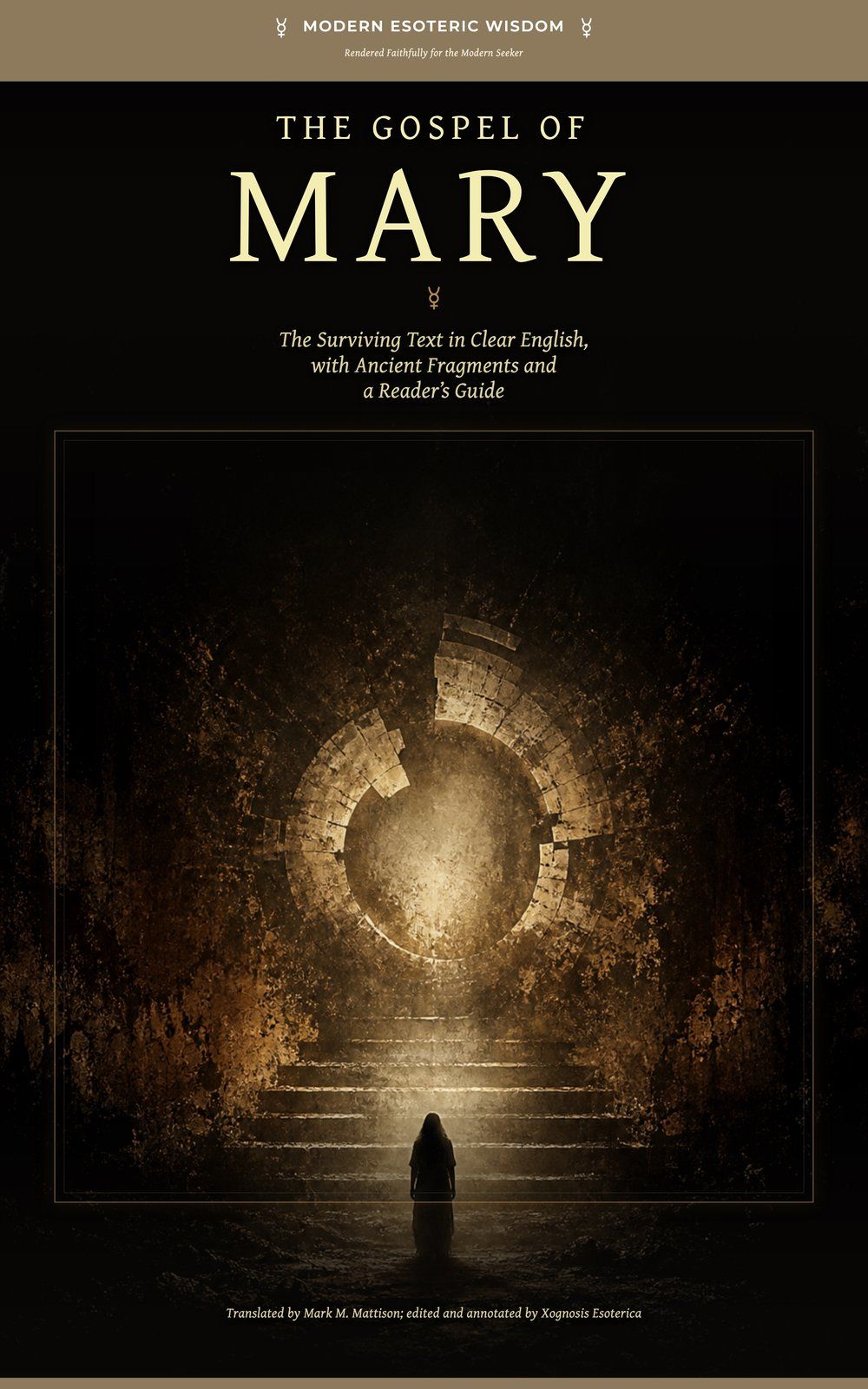
Reading the surviving pages with the gaps left visible, as our own edition of The Gospel of Mary does, is the posture that respects both the text and the centuries of projection laid over it. What remains is enough: a soul confronting Desire, an argument about authority, and a defense of a woman teacher that needed no missing pages to be heard.
Read the book
Related Articles
Continue through articles sharing this topic.
Esoteric literature has a way of swallowing beginners whole. You pick up one book about alchemy, and within a week you have six tabs open about Renaissance…
7 min read
In January 1896 the German scholar Carl Reinhardt bought a Coptic papyrus codex in Cairo.
7 min read
Every few decades, someone translates the esoteric classics again. New Enoches appear. New Pistis Sophias.
6 min read
Pick a shelf of spiritual books at random and you will find, somewhere in the first twenty pages, the same accusation: you are not actually awake.
7 min read
Related Books
Catalog volumes sharing this article’s lead tag.