 Xognosis EsotericaArcane Publishing Studio
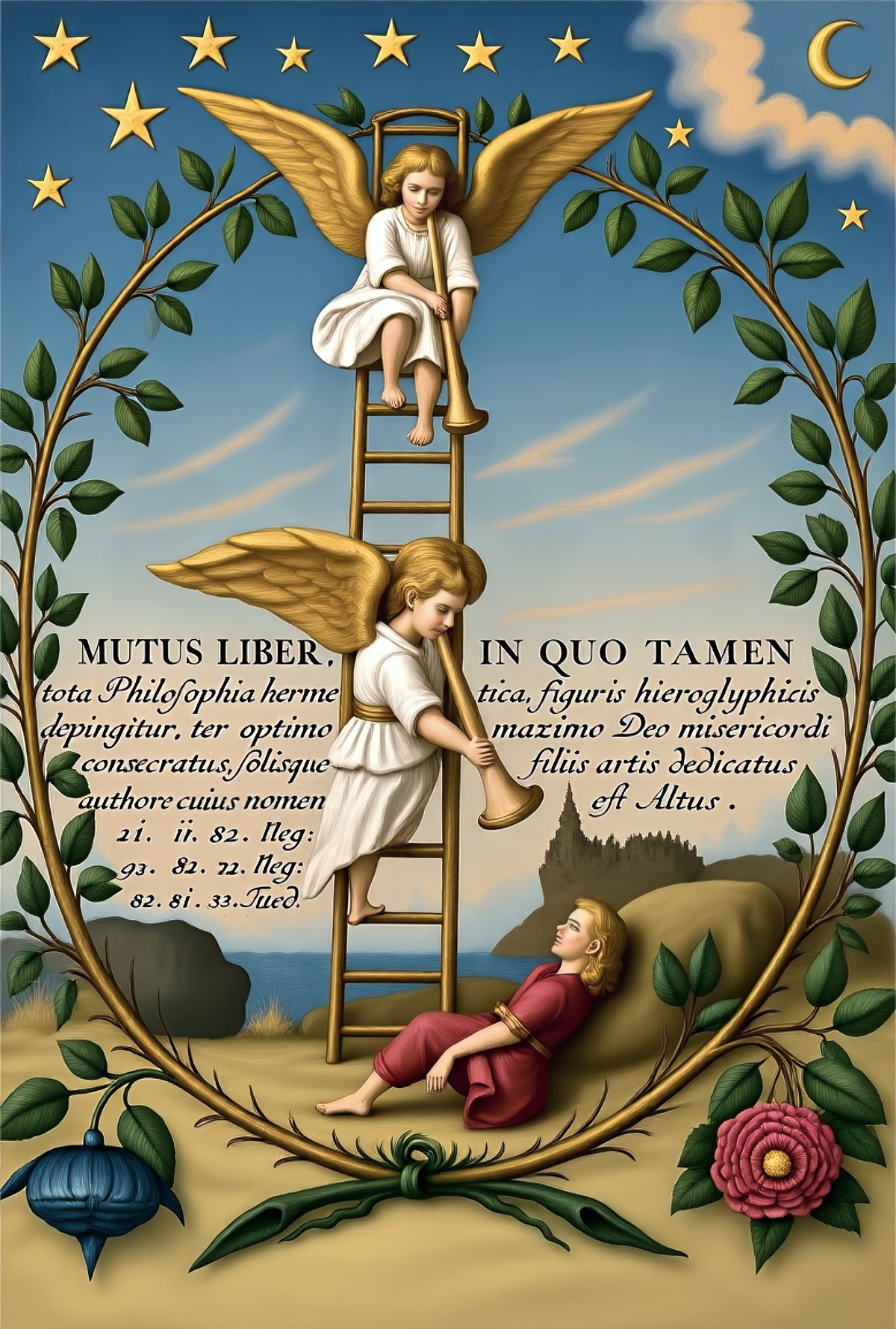
Somewhere near the start of the Mutus Liber, a ladder leans against the sky. Figures climb it, and above them angels wring out clouds like wet linen, squeezing dew into sheets spread below. The book prints no caption, no gloss, no footnote. It prints almost no words at all.
Share
Somewhere near the start of the Mutus Liber, a ladder leans against the sky. Figures climb it, and above them angels wring out clouds like wet linen, squeezing dew into sheets spread below. The book prints no caption, no gloss, no footnote. It prints almost no words at all. That is the premise of the book's title, the "mute book", and it is why a ladder drawn three and a half centuries ago can still hold an argument: whatever the ladder means, the reader has to climb toward it unaided.
The bibliographic facts are firm. The first edition appeared in 1677, published by Pierre Savouret at La Rochelle, and it was tiny. English Wikipedia reports a print run of "no more than a few dozen copies", and that "Twelve original copies are conserved in main Western libraries." The Library of Congress catalog describes the work as "1 v. (15 plates) 31 cm": one volume, fifteen images, nothing else to hold.
Fifteen plates, no text. The book announces itself as the work of "Altus, a 'scholar in high chemistry of Hermès'", with one "Jacob Saulat, Sire of Marez" credited as inventor. Wikipedia notes that both assertions "were soon proven to be fictitious." The Library of Congress record adds a wrinkle that reads like a puzzle left in the book's own spirit: "Attributed to a possibly fictitious Jacob Saulat or Sulat (of which Altus is an anagram) and also to a doctor Tolié." A pseudonym, in other words, anagrammed out of another pseudonym. Modern scholarship has better candidates. Jean Flouret's article established the author as Isaac Baulot, a La Rochelle apothecary and bookseller; Patrick Sembel later proposed a small collaboration around Baulot, including a probable engraver, Abraham Thévenin. These are attribution debates, not settled biography, and honesty requires they stay that way.
Here the ground shifts from bibliography to interpretation, and it should be labeled as such. The early plates show the ladder with climbers ascending toward the angel-wrung dew. Readers have long taken this as the pursuit of the celestial matter itself: dew, the "ros", the moisture of heaven that the operator must gather before anything else can happen. On this reading the ladder is the instrument of the work's opening phase, the means by which the earthly reaches up to collect the heavenly.
But the Mutus Liber never says this. It never says anything. Every gloss, including the one in the previous paragraph, is commentary laid over mute images, and the book's design forces that arrangement deliberately. Where a treatise would argue, the Mutus Liber shows. Its silence is the pedagogy: the reader supplies the words, and in supplying them performs the first act of the work. Whether that was Baulot's intention, or his unknown collaborators', is beyond recovery.
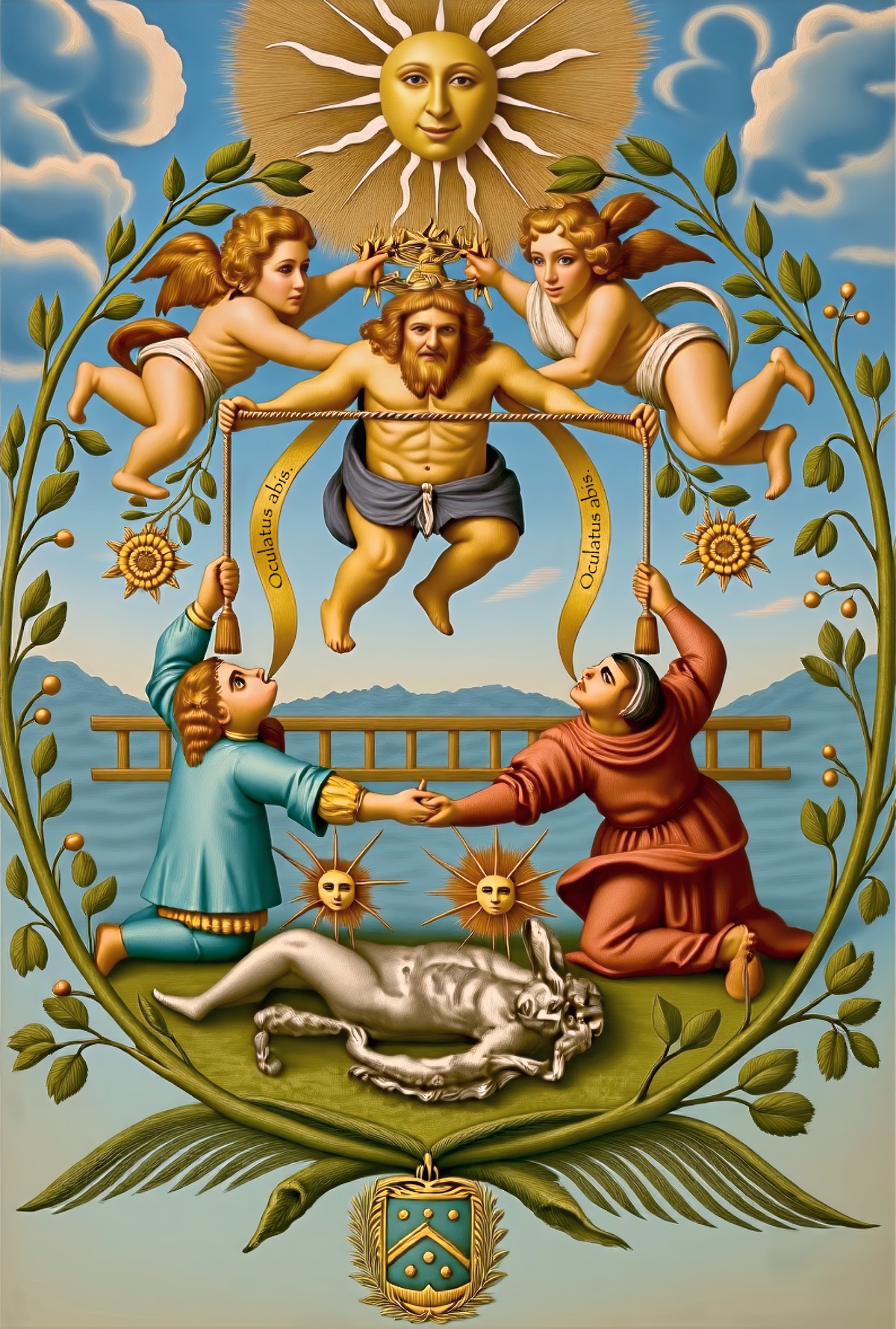
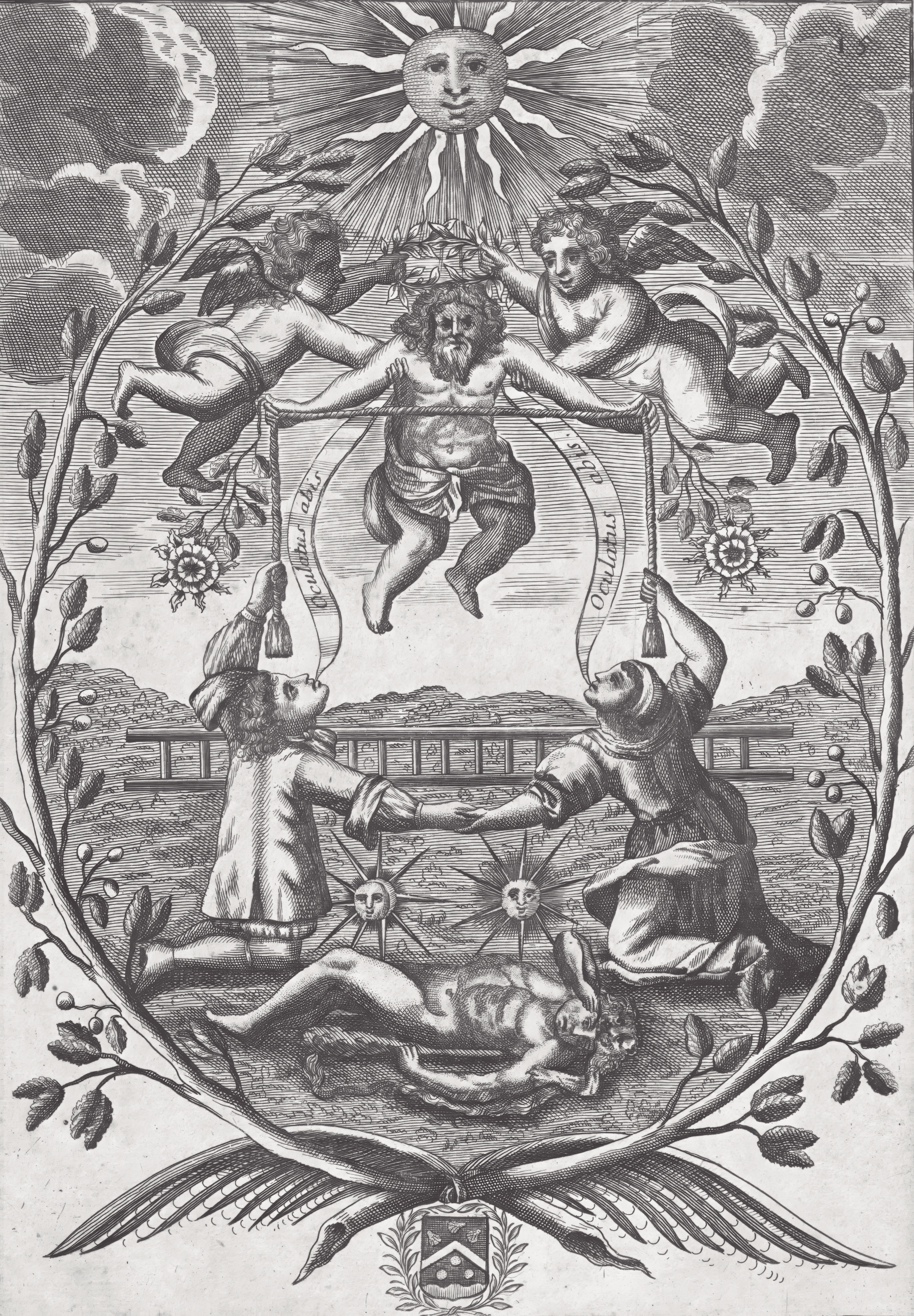
The final plate changes key. In contrast to the opening scene, the ladder is gone, the moon is gone, and a sun-dominated composition closes the book. Traditional readings have long taken this as the completed work: the instrument that carried the operator upward is no longer needed, because there is nowhere left to climb.
That tidy formulation deserves caution. A modern commercial caption circulating on a stock-photo site glosses plate 15 as the ladder having served its purpose and being no longer required, but that caption has no traceable scholarly authorship and cannot be cited as interpretation with any weight behind it. A secondary text describes the last plate as the apotheosis of Saturn, victorious over Jupiter; the identification is appealing, since Saturn belongs to the old alchemical cast of endings and returns, but it could not be confirmed in this research pass against the plate itself or against Eugène Canseliet's 1967 study, L'Alchimie et son Livre muet, the standard modern reference the Library of Congress itself cites. What can be said plainly is structural: the book that opens with a ladder pointed at the sky closes without one, and the sun stands where the climbing used to be.
Hold the two images side by side and the book's shape becomes visible. A ladder appears when something above is needed and cannot be reached. It disappears when the distance it crossed has closed. The Mutus Liber, read as a sequence rather than as a set of emblems, seems to chart exactly that closing: the dew gathered, the ascent completed, the mediating instrument retired.
There is a quieter, more personal reading available too, and it belongs to the reader rather than to the plates. Every commentary on this book, including this essay, is a ladder. The images are mute; the explanations talk. And at some point the explanation has done its work, and the plate is left standing alone, which is how it was made to be read in the first place.
The Mutus Liber opens with a ladder and ends without one. Whatever else fifteen mute plates may mean, their sequence says that instruments are for crossing, and that what is crossed no longer needs the bridge.
The book's later history is nearly as strange as its content. A 1702 Geneva edition with re-engraved plates was produced under the direction of Jean-Antoine Chouet and Jean-Jacques Manget; the Library of Congress note records that "The plates, re-engraved after the 1st ed. (published at La Rochelle in 1677) wrer [sic] also issued at the end of v. 1 of J. J. Manget's Bibliotheca curiosa, Genevae, 1702." A rare Paris reprint followed around 1760. Carl Jung owned a 1677 copy and used it to illustrate Psychology and Alchemy, carrying a silent Baroque picture book into the machinery of twentieth-century psychology.
For the reader who wants to make the climb today, the digitized 1702 plates at the Library of Congress (38 page images, freely downloadable) are the place to stand before the images themselves. Our own editions, Mutus Liber Reimagined in full color and a monochrome edition, present the plates with the same restraint the original intended: the pictures do the talking.
One last caution. The famous title motto often attached to the book, the chain of prayers and readings ending in "work and you will find", could not be verified in this pass against a digitized title page, so it is deliberately not quoted here. The book's truest motto may be its silence. It shows a ladder, then takes it away, and leaves you standing in the light the pictures were pointing at all along.
Read the book
Related Articles
Continue through articles sharing this topic.
Some books resist being read aloud. You can summarize a novel over dinner, and a history book lends itself to bullet points, but a certain strain of…
7 min read
Two books sit at the far ends of the esoteric shelf, and they answer the same question in opposite ways.
6 min read
A book with no sentences is a bold wager. In 1677, at La Rochelle on the French Atlantic coast, the publisher Pierre Savouret printed a slim volume of…
6 min read
The Mutus Liber arrived in 1677 as a book with almost no words in it. Fifteen engraved plates, published in La Rochelle by Pierre Savouret, credited to an…
5 min read
Related Books
Catalog volumes sharing this article’s lead tag.