 Xognosis EsotericaArcane Publishing Studio
In 1785 the British Museum paid the heirs of a dead London physician for a damaged Coptic manuscript that almost no one in England could read. Few noticed the transaction. Nobody guessed that this book would become one of the most argued-over religious texts of the next two centuries.
Share
In 1785 the British Museum paid the heirs of a dead London physician for a damaged Coptic manuscript that almost no one in England could read. Few noticed the transaction. Nobody guessed how fiercely readers would argue over this book during the next two centuries. That quiet purchase is how Pistis Sophia, a long dialogue in which the risen Jesus answers his disciples' questions about the fallen figure of divine Wisdom, entered Western scholarship.
The story begins with Anthony Askew, remembered as "a London doctor and collector of old manuscripts." Askew reportedly acquired the codex in 1772, from a bookseller. How it had traveled from Egypt, where it was almost certainly produced, to the London book trade is unknown. The findspot is not recorded anywhere, and every romantic tale about its surfacing belongs to legend rather than documentation.
The object itself survives in the British Library today as Additional MS 5114. It is a parchment quarto, 21 by 16.5 centimeters, running to 178 leaves with two leaves missing. Two scribal hands share the work. Its physical modesty is worth pausing on: this was never a treasure in the visual sense, and its importance stayed invisible until someone could read it.
Askew died on 28 February 1774. His library of nearly 7,000 books was auctioned soon after, in a nineteen-day sale run by Baker and Leigh that began in February 1775 and attracted buyers including the British Museum itself. The Coptic codex, however, was not part of that famous dispersal. It stayed with the family, and in 1785 the Museum purchased it from Askew's heirs. Some retellings compress the story and say the Museum bought it from Askew himself, which is loose phrasing; he had been dead for over a decade. The 1785 date of the purchase is well attested. The exact form of the transaction with the heirs rests on the usual secondary literature rather than a surviving invoice, so it is best described simply as a purchase from his estate.
Once the codex reached the Museum, the slow work of making it legible began. In the late 1700s the scholar Carl Gottfried Woide examined the manuscript and gave it the name by which we now know it. He took "Pistis Sophia", meaning Faith and Wisdom in Greek, from a heading at the beginning of the second book of the text: "The Second Book of the Pistis Sophia." That heading, notably, was added by a later hand.
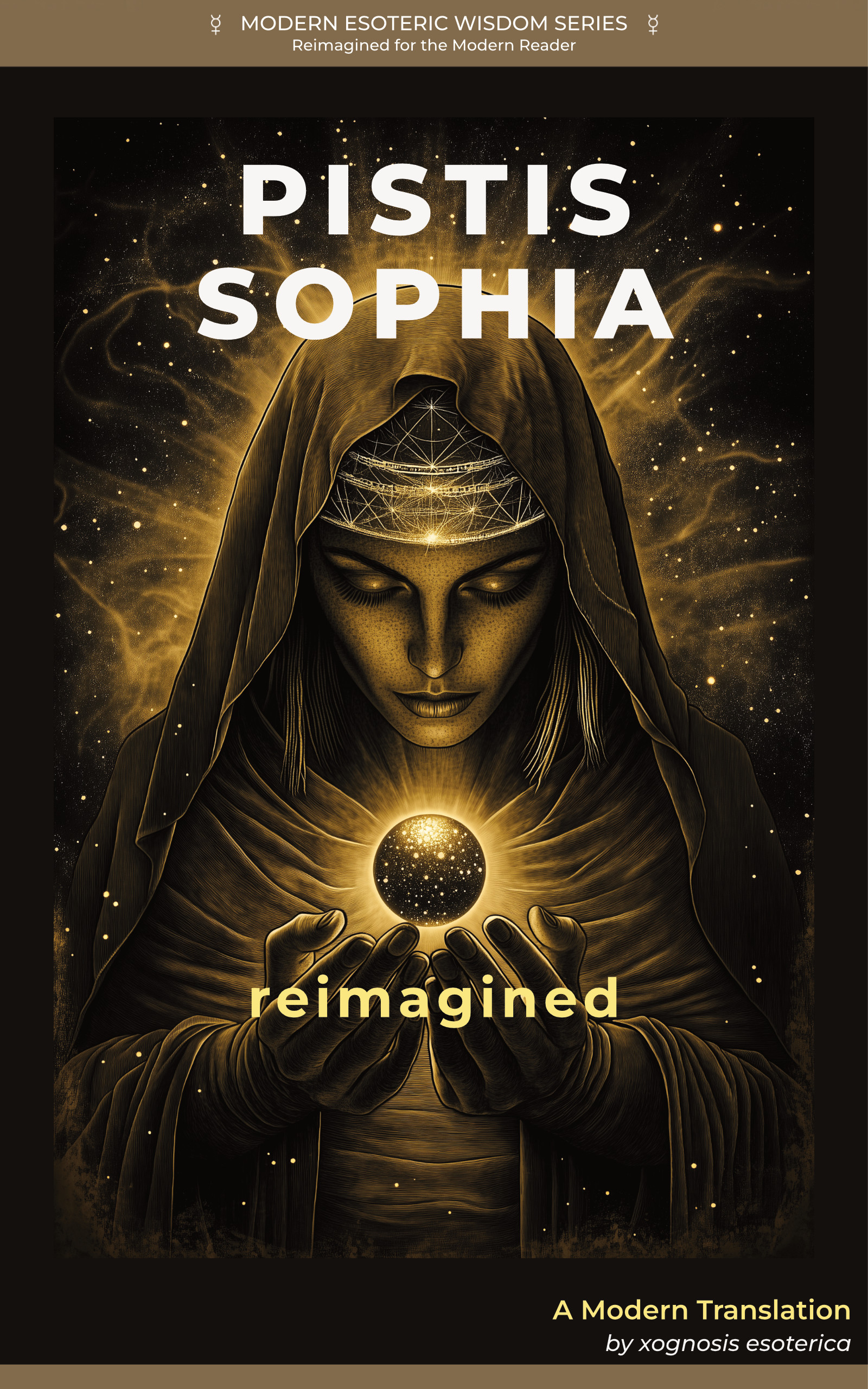
This matters more than it first appears. The name is a modern scholarly label, not what any ancient reader called the work. The heading Woide borrowed covers only part of the codex, which contains several distinct writings. When we speak of Pistis Sophia as a single book, we are repeating an eighteenth-century scholar's convenience. Readers approaching the text for the first time, for instance through a modern edition like Pistis Sophia Reimagined, inherit Woide's decision with every mention of the title.
After Woide, the codex waited. Coptic was a specialist's language, and the manuscript's dialect made it harder still. The first printed edition did not appear until 1851, when Moritz Gotthilf Schwartze's Coptic text with a Latin translation was published in Berlin by Julius Heinrich Petermann, after Schwartze's death. Sixty-six years separate the Museum's purchase from the first edition. For that entire span, a major surviving Gnostic text sat in London, owned but effectively unread.
Then the pace quickened. Carl Schmidt produced German editions in 1905 and again in 1925, correcting Schwartze's work where it had gone astray. G. R. S. Mead brought the text to English readers with translations in 1896 and 1921. Violet MacDermot's 1978 English translation of Schmidt's text, published by Brill in the Nag Hammadi Studies series, kept the Schmidt edition accessible, and further English versions followed, including J. J. Hurtak's in 1999.
The content deserves a word, since the manuscript did not earn its reputation by remaining a curiosity. Pistis Sophia presents itself as dialogue: Jesus, after his resurrection, instructs his disciples, and the figure of Sophia, divine Wisdom who fell into the material world, anchors the theology. Questions and answers pile up across the codex's books, covering the fate of souls, the structure of the heavens, and the mechanics of repentance.
When was it written? Here fact gives way to interpretation, and honest accounts say so. Dating scholarship has swung between the second and third centuries for generations, and the named positions are a roll call of nineteenth- and early twentieth-century scholarship: Woide and Schwartze argued for the second century, Harnack and Schmidt for the third. According to the survey at Early Christian Writings, Puech and Blatz concluded that the first three books form one work "probably composed between 250 and 300", while treating the fourth section as "a distinct work, composed in the first half of the 3rd century and thus older than those which precede it." The manuscript itself may be later still, with some scholars placing it in the fourth century. The short answer for a general reader: the work is usually placed in the third century, but the debate has never fully closed.
To understand why an unread quarto commanded such attention once deciphered, consider what else existed. Before 1945, when the Nag Hammadi codices came to light in Egypt, only three codices carrying substantial Gnostic texts were known: the Askew Codex, the Bruce Codex, and the Berlin Codex. Between them they held almost everything of Gnostic writing that had survived, and everything the orthodox heresy-hunters had not already described, denounced, and filtered for posterity.
For roughly a century of scholarship, Pistis Sophia served as the primary source one could read in the Gnostics' own words rather than in their enemies'. That burden has been shared since 1945, but the Askew Codex kept the field alive through the years when there was almost nothing else to read.
The book that opened modern study of Gnostic thought to the West was not found in a desert cave by adventurers. It was bought in 1785 from the estate of a London doctor, by an institution that could not yet read it, and then waited sixty-six years for its first printed edition.
The manuscript itself has not moved in two centuries; it rests in the British Library under its Additional MS shelfmark. Its afterlife continues in editions and translations, from Schwartze's posthumous Latin of 1851 through Schmidt, Mead, MacDermot, and beyond. Each generation has had to decide again what kind of text this is: a late Gnostic compilation, a window into devotional practice, a theological curiosity.
For the curious reader today, the entry point is easier than at any point since 1785. Modern retellings and fresh translations, including our own Pistis Sophia Reimagined, let you meet Sophia's fall and the disciples' questions without first learning Coptic or Latin. The codex began as a purchase from a physician's estate, mute and misunderstood. It ended as one of the founding documents of the study of Gnosticism.
Read the book
Related Articles
Continue through articles sharing this topic.
Esoteric literature has a way of swallowing beginners whole. You pick up one book about alchemy, and within a week you have six tabs open about Renaissance…
7 min read
In January 1896 the German scholar Carl Reinhardt bought a Coptic papyrus codex in Cairo.
7 min read
Every few decades, someone translates the esoteric classics again. New Enoches appear. New Pistis Sophias.
6 min read
Pick a shelf of spiritual books at random and you will find, somewhere in the first twenty pages, the same accusation: you are not actually awake.
7 min read
Related Books
Catalog volumes sharing this article’s lead tag.