 Xognosis EsotericaArcane Publishing Studio
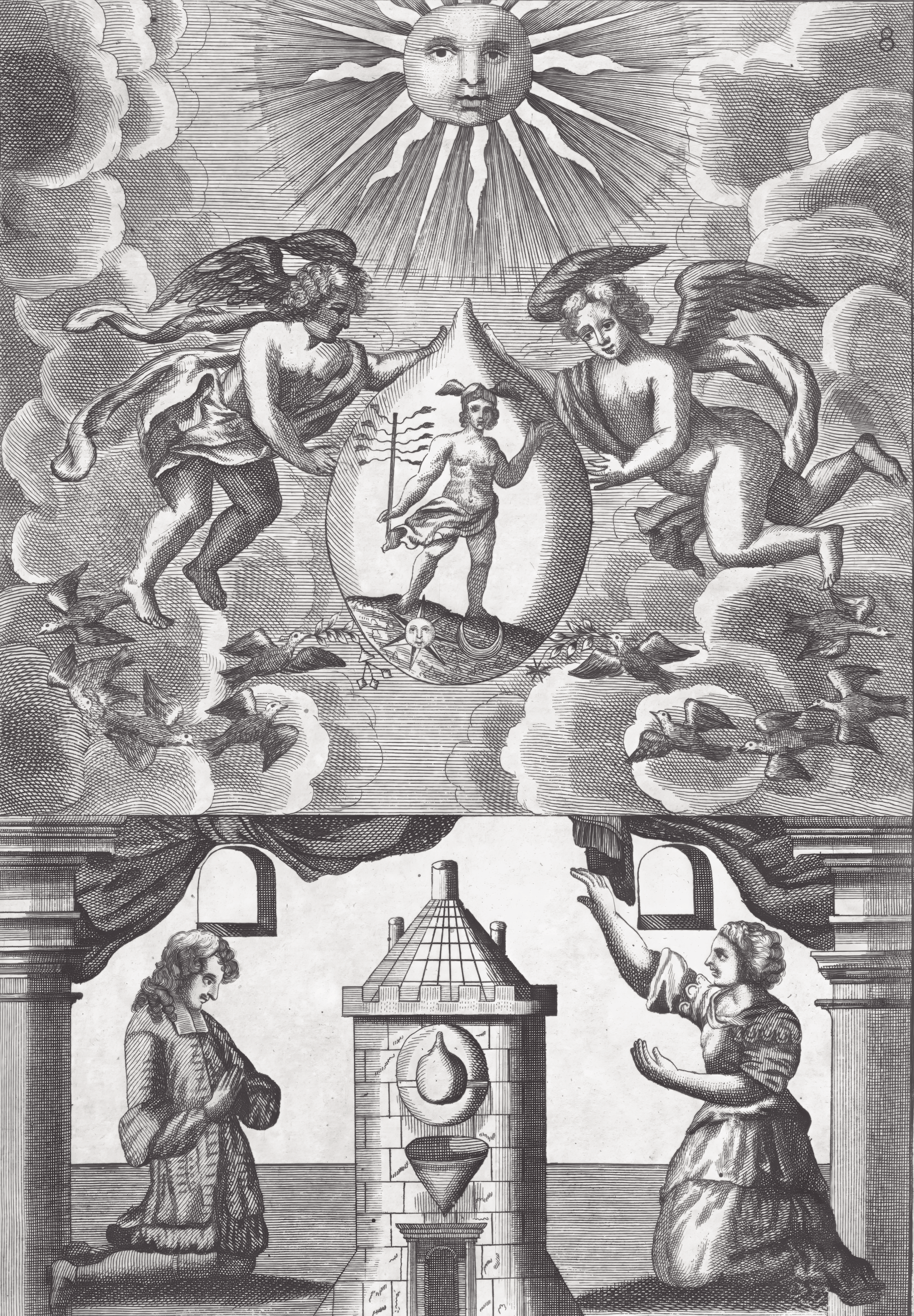
Of the fifteen plates in the Mutus Liber, the eleventh is the one where the whole doctrine squeezes itself into a single drop of water. Plate 8 showed us the laboratory from a distance: two pillars, draped curtains, a couple at prayer. Plate 11 removes the architecture and gives us the close-up.
Share
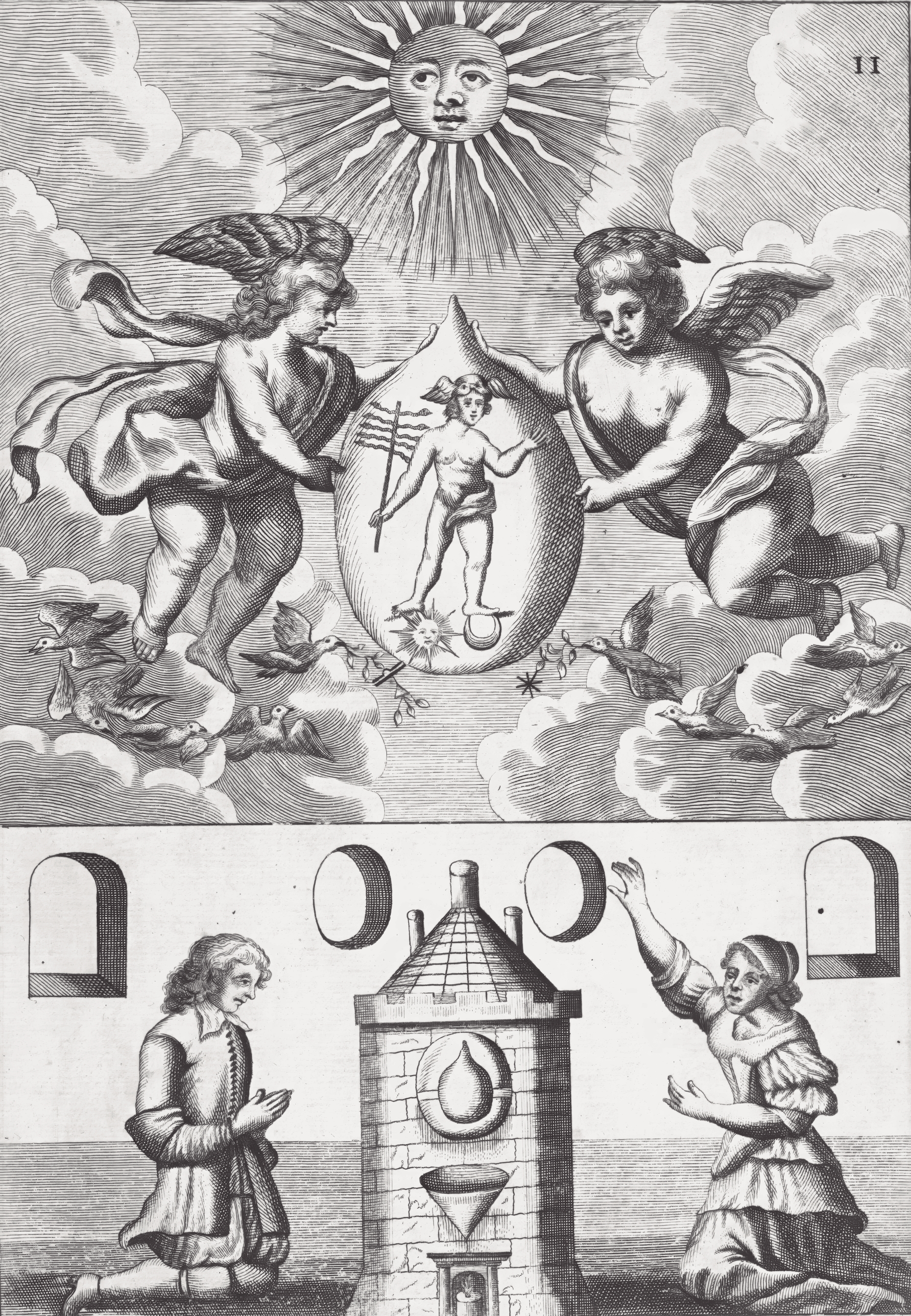
Of the fifteen plates in the Mutus Liber, the eleventh is the one where the whole doctrine squeezes itself into a single drop of water. Plate 8 showed us the laboratory from a distance: two pillars, draped curtains, a couple at prayer. Plate 11 removes the architecture and gives us the close-up. Inside one enormous dewdrop, Mercury stands on a luminous earth with the sun and moon beneath his feet. Birds fly in from either side bearing gifts. And in the sun, a human face looks back at the reader.
The book itself was published in La Rochelle in 1677 by the Protestant printer Pierre Savouret, with fifteen plates and no running text beyond a few captions. The name printed on it, Jacob Saulat, and the pseudonymous "Altus" were, in the words of the standard account, "soon proven to be fictitious." The real author surfaced only in 1976, when Jean Flouret traced a copy at Trinity College Dublin carrying a handwritten note: "Author Isaac Baulot." Baulot was an apothecary of La Rochelle, born in 1612, sixty-five years old when the book appeared. That is the documented chain. Everything symbolic about the plates, by contrast, is commentary laid on top, and the eleventh plate has attracted more of it than most.
Eugène Canseliet, the twentieth-century commentator whose plate-by-plate reading accompanies the modern edition, opens on the comparison that defines this image: "At first glance the allegorical composition of this eleventh plate seems to resemble that of the eighth plate in all aspects. Nevertheless there are some differences." Those differences are the whole point. Writing a few pages earlier, he notes that "the pillars and the draped curtains have disappeared to make way for action." Where plate 8 had two windows, plate 11 opens two more. The lamp at the bottom of the furnace, dark in the earlier plate, is now lit.
The commentators do not agree on what this economy of repetition means. Magophon, the pen name of Pierre Dujols, read plate 11 as repeating the operations as its predecessor. Canseliet read it as the completion of the work begun in plate 8. A modern picture-library caption, unsigned and interpretive, splits the difference and calls the eleventh plate one that "recapitulates and echoes" the eighth. The honest position is to report the disagreement. The book is wordless by design, and wordless books invite their readers to fight over them politely.
At the center stands Hermes, and Canseliet is precise about what he wears. "The god Mercury, instead of wearing his usual petasos, this time wears a kind of cap. This type of head covering, pierced with two open eyes and with unfolded wings on either side, resembles an owl in flight." An owl: the bird that sees in the dark, perched on the head of the god of interpreters. Whether Baulot intended the owl reading we cannot know; the attribution belongs to a commentator writing two and a half centuries after the engraving.
The face in the sun carries the plate's most quoted exegesis. Canseliet reads its ten fine rays as ten eagles or sublimations. Sublimation, in the alchemical vocabulary, is the repeated raising and refining of the volatile principle. He connects the count to Eirenaeus Philalethes' regimen of the eagles, and it is his comparison, not something the Mutus Liber states; the book never states anything, which is its entire method. The ten birds carry the same association forward in a later plate's commentary: "These ten birds bring to mind Philalethes' famous eagles that symbolise sublimation."
Here is where the tria prima, the three principles of Paracelsian theory, compress into a single image, though the compression is a modern reading and should be worn as one. According to that unsigned modern caption, the bird at the left offers the sun the sigil of Libra together with the symbol for sulphur; the bird at the right offers an eight-pointed star read as salt. Mercury, already present as the standing god, would then be the third principle, harmonising the two extremes. Sulphur and salt presented by winged messengers, mercury mediating between them: the entire three-principle scheme in the space of a dewdrop.
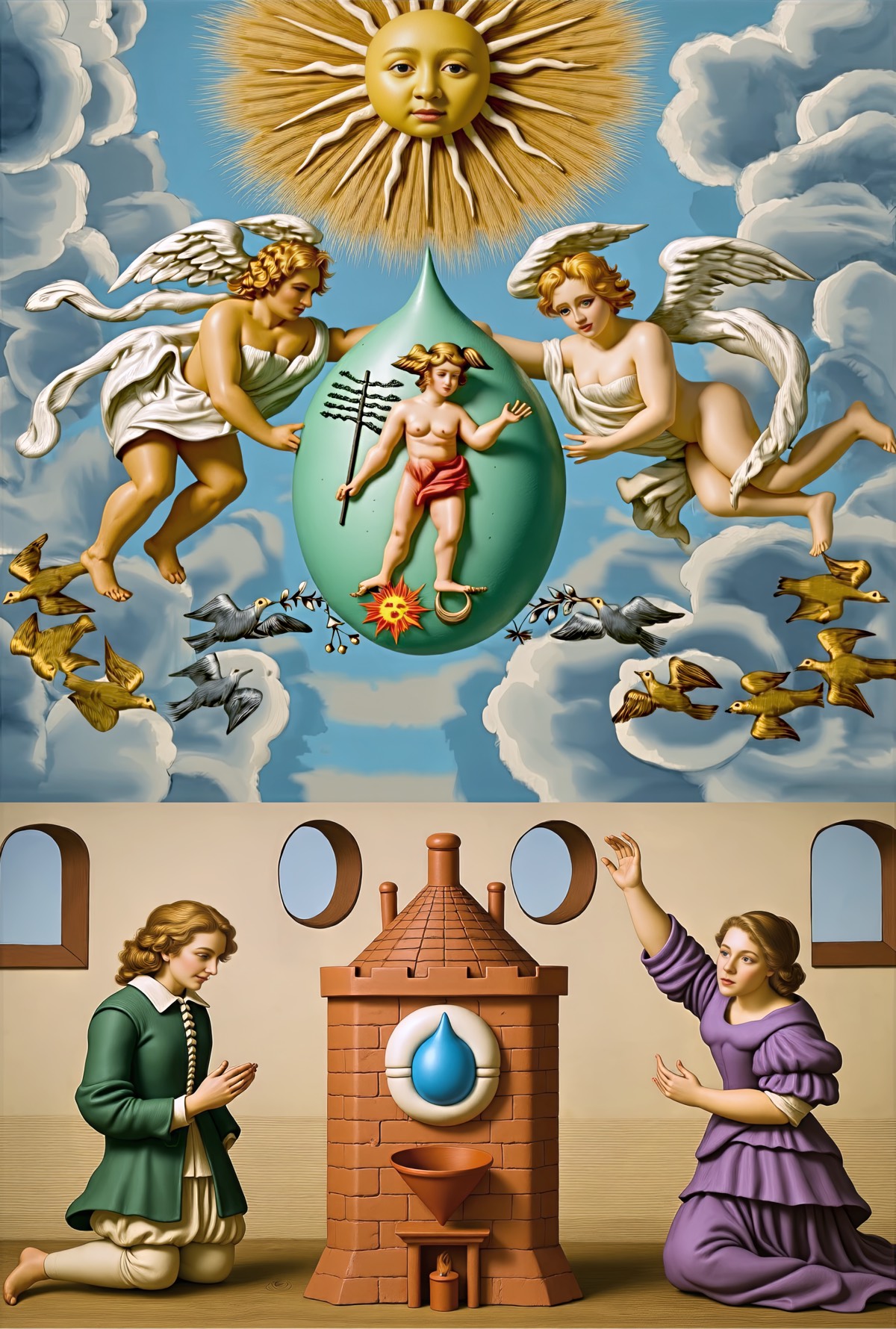
Nothing in the 1677 book confirms this. The reading is the captioner's, in spirit close to Canseliet's, and it should be tagged as such. That is not a complaint. A wordless book functions as a mirror for commentary, and the layered readings, each attributed to its author, are the book's afterlife. The Xognosis edition, Mutus Liber Reimagined, presents all fifteen plates in full color with the imagery cleaned for close reading, which is precisely what a plate this dense rewards.
The drop is not an arbitrary vessel. The Mutus Liber's famous practical instruction, preserved in the Manget tradition, concerns dew gathered at specific seasons: "The spirit of the dew of May is prepared in the following way. Take a sufficient quantity of May dew or rainwater, or snow in the same way, obtained in March or the beginning of April, and distil its spirit in the ordinary way." The Latin original, "Spiritus roris maialis," sits in the same volume. Whatever one makes of distilling dew, the plates return to the substance obsessively, and plate 11 magnifies it to the scale of a world. A couple still kneels in prayer before the furnace at the bottom of the frame, small now, almost an afterthought: the devotional frame of the earlier plates reduced to a signature.
The moon's face, it should be said plainly, is the article's one unverified motif. Canseliet dwells on the sun's face; I found no commentary text in the edition that specifically glosses a face in the moon within this dewdrop. The moon appears under Hermes' feet alongside the sun, that much is visible in the plate and confirmed in the modern caption. Whether it carries a face, and what that face means, the reader can judge with the plate in front of them. Honesty about the gap is more useful than a confident invention.
Plate 11 takes everything plate 8 built, strips the scaffolding, and compresses sun, moon, Mercury, the birds, and the three principles into a single drop of dew. The engraver left no words. Every reading on this page, Canseliet's, Magophon's, and our own, is a guest in a silent house.
Read the book
Related Articles
Continue through articles sharing this topic.
Some books resist being read aloud. You can summarize a novel over dinner, and a history book lends itself to bullet points, but a certain strain of…
7 min read
Two books sit at the far ends of the esoteric shelf, and they answer the same question in opposite ways.
6 min read
A book with no sentences is a bold wager. In 1677, at La Rochelle on the French Atlantic coast, the publisher Pierre Savouret printed a slim volume of…
6 min read
The Mutus Liber arrived in 1677 as a book with almost no words in it. Fifteen engraved plates, published in La Rochelle by Pierre Savouret, credited to an…
5 min read
Related Books
Catalog volumes sharing this article’s lead tag.