 Xognosis EsotericaArcane Publishing Studio
Somewhere in Europe, probably in Italy, in the first decade of the fourteenth century, an alchemist sat down and wrote one of the most detailed laboratory manuals of the Latin Middle Ages. He did not sign it.
Share
Somewhere in Europe, probably in Italy, in the first decade of the fourteenth century, an alchemist sat down and wrote a laboratory manual unusually rich in detail for the Latin Middle Ages. He did not sign it. Instead, his words traveled under the name of Geber, the Latinized form of Jabir ibn Hayyan, the great eighth-century Arabic alchemist, and under that borrowed name the Summa Perfectionis circulated for the next three hundred years and more, from manuscript copies into the age of print. Modern scholarship calls its author Pseudo-Geber: the false Geber, a ghost with a furnace.
The book itself is anything but ghostly. Open it and you find yourself not in allegory but in hardware: furnaces built to specified heights, vessels luted and sealed, flames raised and lowered by degrees, hours counted through the night. The Summa survives because it told its readers exactly what to build and how to run it. And when printing arrived, publishers understood the appeal. The 1542 Venice edition opens with a furnace even before the text begins, as the Science History Institute's catalog describes it: "a full-page woodcut of a furnace on the verso of the title page, and woodcuts of furnaces and alembics on 8 additional pages throughout."
The misattribution was the engine of the book's authority. Early printers advertised the work as Geberis philosophi perspicacissimi, of Geber the most perspicacious philosopher, and readers believed they were holding the wisdom of the Arabian master himself. That belief is legend, and it deserves to be named as legend. The scholarly consensus, built largely on William R. Newman's critical edition of 1991, is that the Latin text cannot be Jabir's. Nothing points back to an Arabic original; the text's arguments and style belong to late medieval Latin scholastic culture. No reference to the Summa has been found in any source from the thirteenth century or earlier, and the work was likely written slightly before 1310.
Who wrote it, then? Newman's candidate is Paul of Taranto, a Franciscan friar whose known activity falls in the late thirteenth century. This is a leading hypothesis, argued with care and widely accepted as plausible, but it remains an interpretation, and it is contested: Ahmad Y. Al-Hassan has argued for a different account of the corpus's origins. The honest position is that the author's identity is unknown, with Paul of Taranto the strongest name on the table. What is not in doubt is the book. Its manuscripts multiplied, printers kept it in print, and its procedures entered the working vocabulary of European chemistry. The pseudo-Geber corpus was among the first to describe aqua fortis (nitric acid) and aqua regia, and the second of these could dissolve gold itself, which gave the art a genuinely experimental edge.
The apparatus chapters are where the Summa most rewards slow reading. The author names his instruments, then goes past the names: he specifies their construction, their placement, and their failures. Furnaces of different designs serve different operations, matching the printed editions' own summary of contents: "calcination, cupellation, furnaces for distillation, etc." A furnace for driving off volatile spirits is not the furnace you want for calcining metals, and the text knows the difference the way a cook knows the difference between an oven and a stockpot.
Reading these passages, you begin to see the workshop behind the prose. Someone built these furnaces, watched them crack, rebuilt them with better clay, learned where the flame had to sit. The *Summa*'s theory of metals, its arguments about mercury and sulfur and the hidden structure of matter, sits on top of thousands of hours of that patient, repetitive, physical work. The theory is the part historians of philosophy debate. The furnaces are the part you can almost smell.
For readers who want the apparatus chapters in a modern English text, our edition of the Summa Perfectionis presents the work with the apparatus descriptions intact and readable.
The famous illustrations carry a caution that this article will state plainly: they are not authorial. The 1542 Venice printer Pederzanus, and before him the Strasbourg printer Johann Grüninger, whose 1531 edition of Geber's De Alchimia Libri Tres is recorded in the bibliographic literature, were Renaissance craftsmen visualizing a text already two centuries old. The woodcuts show us how a sixteenth-century printer imagined a fourteenth-century furnace, filtered through the equipment of his own workshop. They are evidence of reception, and wonderful evidence, but the pairing of text and image is an act of interpretation performed long after the author's death.
The Strasbourg 1531 woodcuts in particular deserve a note of honesty. The edition's existence, printer, place, and year are documented, and the scholarly literature references its woodcuts, but no digitized copy was examined in preparing this article, so we do not reproduce or describe its specific images here. The fully verified illustrated edition is the 1542 Venice printing, and that is where the reader should look for contemporary visualization of the *Summa*'s furnaces.
For contrast, the Wellcome Collection holds a woodcut from 1658, printed by Janssonius in Amsterdam in a publication associated with Johann Rudolf Glauber, and it is emphatically not a Geber illustration. It shows an alchemist at a furnace with a large receiver, surrounded by diagrams of apparatus, each part labeled in Latin: "A. Fornax cum sibi incamerato instrumento ferreo, & recipiente" runs the first label, a furnace with an iron chamber built into it and a receiver; further letters mark the operator lifting the lid with his left hand while charging material with his right, and the forms of the outer vessel, the inner vessel, and another vessel curved over the coals.
Why pair it with the Summa at all? Because the continuity is the story. Roughly three and a half centuries separate the Latin text from this Dutch workshop scene, and the furniture of the craft barely changed: the furnace, the chamber, the receiver, the controlled fire, the lone attendant minding an operation measured in days. Glauber's own chemistry was far removed from fourteenth-century theory, yet his laboratory would have been recognizable, in its bones, to the man who wrote the apparatus chapters. When you read the *Summa*'s furnace specifications and then look at the 1658 cut, you are seeing one long tradition of bench practice in two snapshots.
That is the quieter claim this old book can make on a modern reader. Strip away the false name, the aura of the Arabian master, and the disputations on metallic principles, and what remains is a craftsman's text: someone telling his successors precisely how to build, seal, fire, and watch. Chemistry's later history, from Glauber's furnaces to the modern lab, descends in part from workshops like his.
The Summa Perfectionis came down to us under a famous false name, but its furnaces were real. The book's authority was legend; its apparatus was not. Read the instrument chapters and you are watching practical chemistry take its first careful notes.
Read the book
Related Articles
Continue through articles sharing this topic.
Esoteric literature has a way of swallowing beginners whole. You pick up one book about alchemy, and within a week you have six tabs open about Renaissance…
7 min read
Somewhere around the year 1310, a Latin author sat down to write a book about furnaces.
6 min read
Sometime around the end of the thirteenth century, a writer working in Latin composed a long, disciplined treatise on the art of alchemy.
6 min read
There is a story about alchemy that almost everyone knows. For centuries, so it goes, clever men wasted their lives stirring molten metals and muttering…
6 min read
Related Books
Catalog volumes sharing this article’s lead tag.
Mutus Liber Reimagined (The Silent Book): A Modern Restoration & Commentary in Full Color Discover the Hidden Wisdom of Alchemy's Most Enigmatic Masterpiece, Now in Stunning Full…
Xognosis Esoterica
Mutus Liber Reimagined (The Silent Book): A Modern Restoration & Commentary in Monochrome Discover the Hidden Wisdom of Alchemy's Most Enigmatic Masterpiece, Now in Striking Monoc…
Xognosis Esoterica
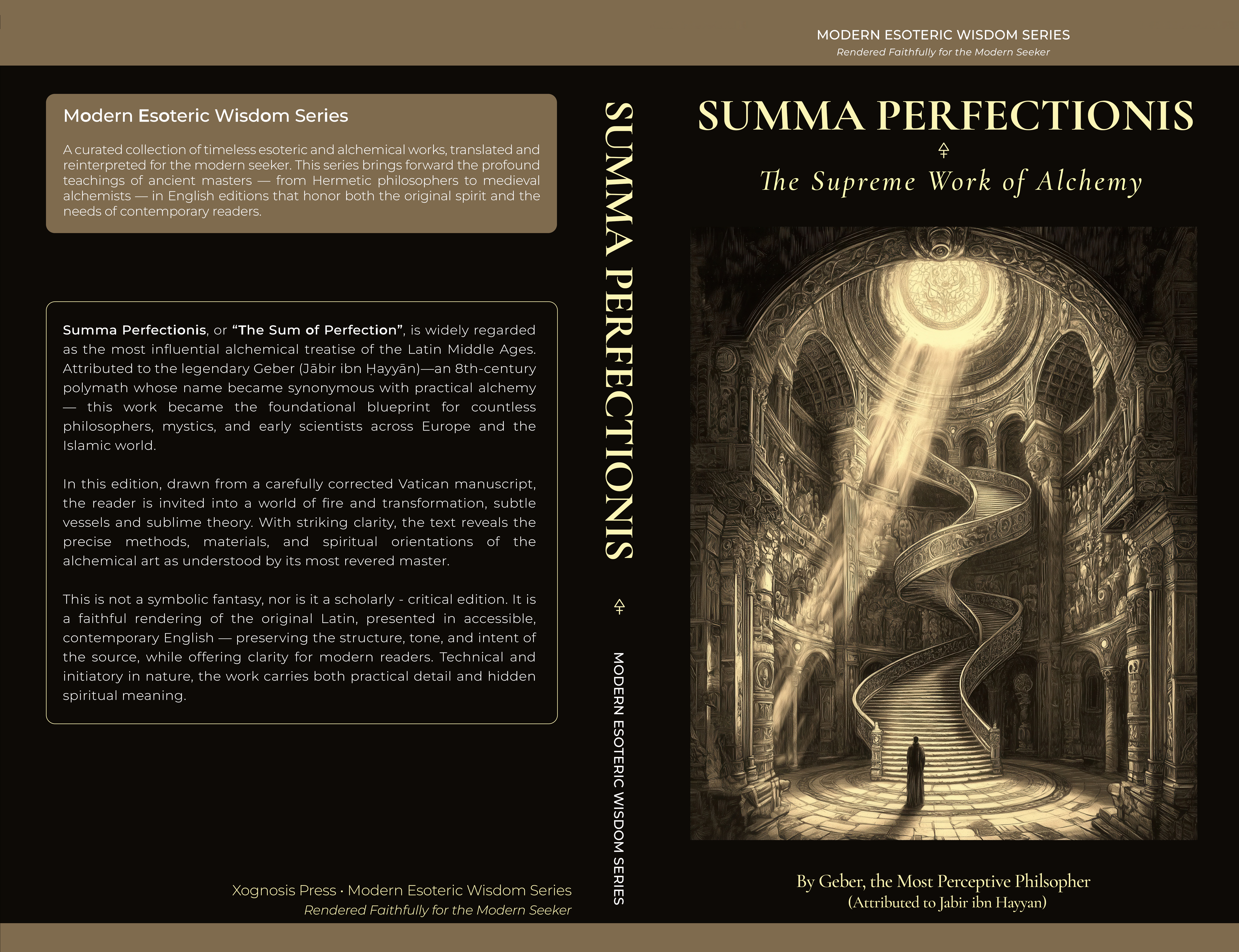
Rendered Faithfully for the Modern Seeker Summa Perfectionis, or "The Sum of Perfection," is widely regarded as the most influential alchemical treatise of the Latin Middle Ages.…
Xognosis Esoterica