 Xognosis EsotericaArcane Publishing Studio
Open a copy of the Mutus Liber and the first thing you notice is what is missing. Fifteen engraved plates, a short notice to the reader, a royal privilege, and no instructions anywhere.
Share
Open a copy of the Mutus Liber and the first thing you notice is what is missing. Fifteen engraved plates, a short notice to the reader, a royal privilege, and no instructions anywhere. The anonymous reviewer in the Journal des sçavans put it plainly in August 1677: the author claims to show "the whole mystery of that high Philosophy and the whole progress of that Art by hieroglyphic figures alone, with no discourse and no explanation." That silence is the book's method. And it is why most readers close the book within ten minutes, feeling they have been shown a locked door.
They are reading it like a text. The Mutus Liber asks to be read like a stage play told in stills. It has a recurring cast, repeated sets, and props that carry over from scene to scene. Once you track those, the sequence stops being a puzzle and becomes a narrative. This is a field guide to doing exactly that, plate by plate, using the 1677 numbering in which plate 1 is the engraved title itself.
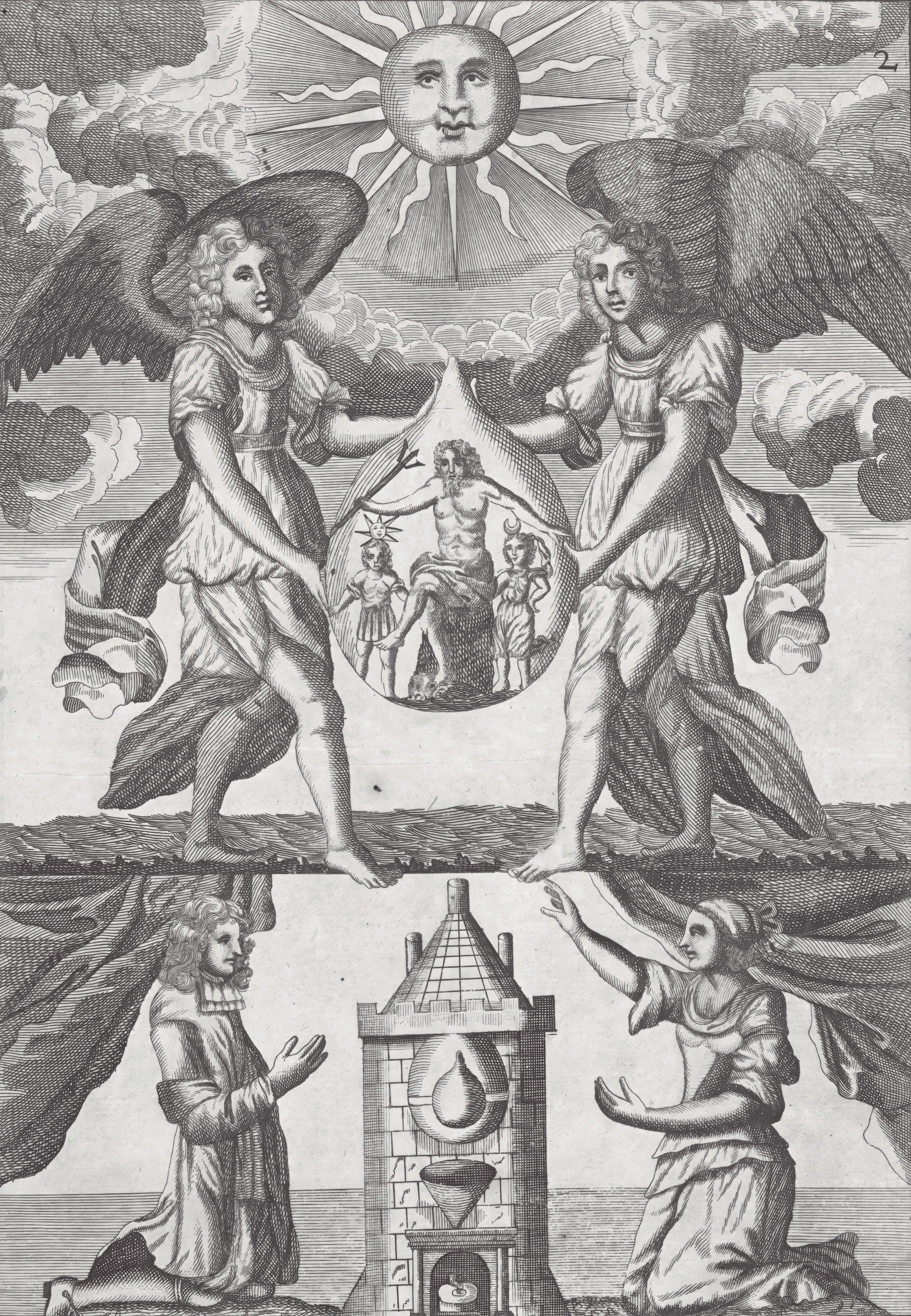
Two figures anchor nearly every interior scene: a man and a woman, an adept and his wife in the Bibliothèque nationale de France's description, "performing the different operations of the great work in their laboratory and outdoors." That is your cast list, and it comes from the library that owns the only known vellum copy, not from any decoder.
Watch what they wear and where they stand. On plate 2 they kneel in contemporary dress, flanking the furnace called the athanor, drawing curtains apart as if opening the play itself. Later, on plate 9, the same pair reappears in antique costume, he with a sun for a face, she diademed with the moon. Serge Hutin, whose 1966 commentary tracks the plates closely, noted that the couple appears three times on plate 2 alone: kneeling in the lower part of the frame, again in the foreground, and once more in miniature inside the glass vessel. Costume changes mark act changes. When the pair shifts from city clothes to cosmic regalia, the work has moved from the laboratory to the sky.
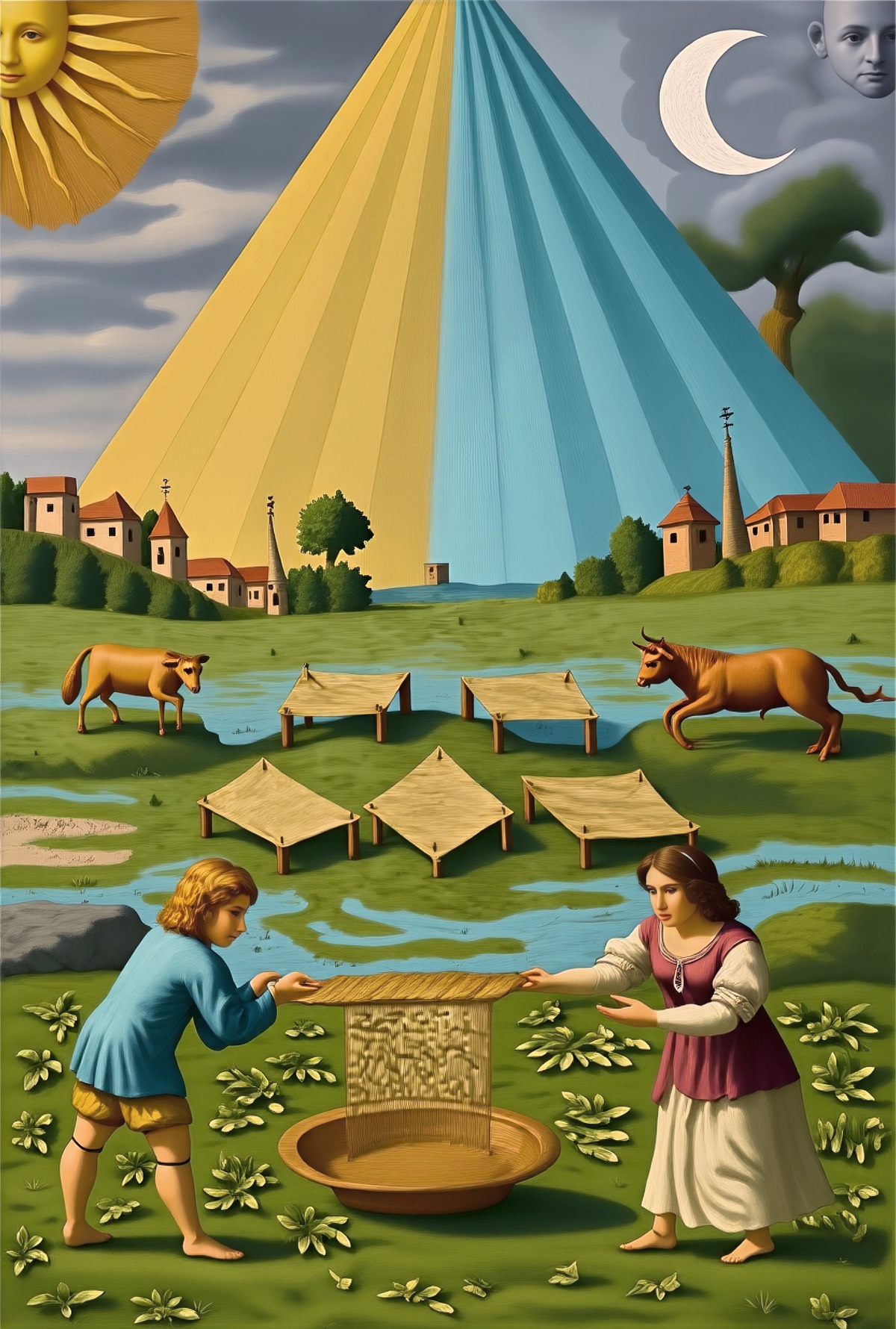
Three sets recur. First, the laboratory: plates 5 through 7, and again plate 10, are crowded interiors of furnaces and glass vessels. Second, the outdoors: plate 4 is a field scene with a radiant sun, cattle, and the couple working linen cloth and basins. Third, the visionary landscape, castles, dogs, waterside towns on plates 9 and 12, where the imagery leaves the workshop entirely.
The practical move is simple. Before interpreting anything, sort each plate into one of these three settings and write it down. You will find the book alternates deliberately: outdoor collection (plate 4), indoor work (plates 5 to 7), cosmic vision (plates 8 and 9), back to the bench (plate 10). The alternation is the pacing. Reading it as a rhythm rather than a code is the single habit that most changes the experience.
Pick a small number of images and follow them the whole way through. Five do most of the work.
The sun with a face. It appears on plates 2, 4, 8, 9, 11, 12, and 15, sometimes with rays that alternate straight and wavy (Hutin counts nine of each on plate 2; take the number as his, since fine counts shift between reproductions). Ask each time: is the sun above the scene, inside a vessel, or worn as a face?
Sun and moon as a pair. Apollo and Diana show up inside the enlarged egg on plate 2, where the 1677 reviewer saw "a Neptune, rising on a Dolphin, having under his arms two human figures with the characters of gold and silver on their heads." The pair returns as the costumed couple on plate 9 and, per that same first review, reaches its end on plate 15, where common Mercury is "at last thrown down" and "after its death the Sun and the Moon form from it." Track them and you have the book's spine.
Dew and linen. Plate 4 shows cloth spread to gather moisture, and the earliest review read it as an instruction: "when the Sun is in the sign of Aries or Taurus, one must gather on clean linen cloths the celestial Dew." The linen and basins recur in later laboratory scenes. This is the plate that anchors the book's reputation as practical rather than purely spiritual.
The ladder. On plate 1, beside a sleeping man, two angels climb up and down a ladder sounding trumpets. Hutin identified it as Jacob's ladder, which is his interpretation; what the engraving itself gives you is a sleeper who must be woken before anything else happens. Treat plate 1 as the overture: everything later plays variations on waking, ascending, and descending.
The vessels. The glass egg of plate 2, the matrass containing a miniature couple, the balances of plate 14, and of plate 10 in Hutin's reading. The vessels are where the macrocosm gets folded into the microcosm: sky-borne suns and moons keep turning up inside laboratory glass.
The last three plates need honest handling. The 1677 review describes plate 13 as containing the Projection, plate 14 as an artificial mine in which gold and silver grow like plants, and plate 15 as common Mercury figured as an overthrown Hercules, with Sun and Moon forming from his death. Its capsule readings are easy to match against the engravings on plates 2, 4, and 8. On 13 through 15 the correspondence is harder to hold onto at ordinary reproduction scale, so if you are following along in a copy, treat the review's ending as one early reader's account, filed under attribution rather than fact.
Attribution is the discipline that keeps this reading honest. The plates themselves are historical objects: the couple, the furnaces, the ladder, the egg. Every decoding is somebody's interpretation, and the book's afterlife is a chain of named readers. The 1677 reviewer read a chemical process of nitre and dew. Eugène Canseliet and the initiatic line read instructions for the Great Work. C.G. Jung, who owned a 1677 copy now digitized by the Stiftung der Werke von C.G. Jung, read alchemical imagery psychologically. Lee Stavenhagen, in a 1979 study of narrative illustration in the wordless books of alchemy, placed the Mutus Liber in that genre. You are allowed your own reading. You are required to know it is yours.
The Mutus Liber has no text to disagree with. The skill it demands is attention: learn the cast, memorize the sets, follow one motif across all fifteen plates, and let the sequence argue with itself in front of you.
Edition choice matters more than usual here. The 1702 Geneva re-engraving in Manget's Bibliotheca chemica curiosa is the source of most circulating reproductions, and Adam McLean deliberately avoided it when he hand-coloured the series in 1999, using "the plates from the original La Rochelle 1677 edition" instead, because the re-engravings quietly alter detail. For motif work, small differences compound.
Our own Mutus Liber Reimagined, full color edition restores all fifteen plates from the 1677 sequence with side-by-side originals and commentary plus practical exercises per plate, which suits the tracking method above. The monochrome edition takes the opposite approach, and its publisher's note is fair: monochrome "highlights form, gesture, and composition, the key elements in the visual logic of the Mutus Liber." Color for the atmosphere, monochrome for the grammar. Either way, the method is the same, and the book stays mute. Fifteen plates, two people, three rooms, and a sky that keeps descending into the glassware. That is the whole cast.
Read the book
Related Articles
Continue through articles sharing this topic.
Some books resist being read aloud. You can summarize a novel over dinner, and a history book lends itself to bullet points, but a certain strain of…
7 min read
Two books sit at the far ends of the esoteric shelf, and they answer the same question in opposite ways.
6 min read
A book with no sentences is a bold wager. In 1677, at La Rochelle on the French Atlantic coast, the publisher Pierre Savouret printed a slim volume of…
6 min read
The Mutus Liber arrived in 1677 as a book with almost no words in it. Fifteen engraved plates, published in La Rochelle by Pierre Savouret, credited to an…
5 min read
Related Books
Catalog volumes sharing this article’s lead tag.