 Xognosis EsotericaArcane Publishing Studio
Open a copy of A True and Faithful Relation and the first thing you meet is not Dee's diary but a wall of preliminary matter: a title page promising revelations "TENDING (had it Succeeded) To a General Alteration of most STATES and KINGDOMES in the World", a long preface by Meric Casaubon, an apology Dee wrote for the Archbishop of…
Share
Open a copy of A True and Faithful Relation and the first thing you meet is not Dee's diary but a wall of preliminary matter: a title page promising revelations "TENDING (had it Succeeded) To a General Alteration of most STATES and KINGDOMES in the World", a long preface by Meric Casaubon, an apology Dee wrote for the Archbishop of Canterbury, and a table of contents that doubles as a repair kit for the printing itself. The book is a folio of 1659, printed by D. Maxwell for T. Garthwait, and it has frightened readers for centuries largely because nobody explains its odd architecture. This essay is the map I wish someone had handed me. Once you know the order of the parts, and where the gaps sit, the folio becomes navigable, and a modern three-volume edition becomes traceable onto it almost section by section.
The manuscript behind the folio is Cotton Appendix XLVI, parts I and II, in what is now the British Library. Jennifer Rampling states the descent plainly: "Casaubon (1659) is based on a transcription of British Library MSS Cotton Appendix XLVI, parts I and II." The title page's claim to be printed from "the Original copy, written with Dr. DEES own Hand" is advertising. Casaubon's own preface admits the truth: Sir Robert Cotton bought the library remnant after Dee's death, the original manuscript had been buried in the earth and had begun "to moulder and perish", and Sir Thomas Cotton paid to have it copied before it was too late. So the folio is a printed copy of a transcription of a decaying original. Keep that chain in mind whenever a passage reads strangely.
Casaubon himself counted the structure. "There be some fourteen or fifteen Divisions in all now remaining," he writes in the preface, "and so many Titles: There is a Table at the beginning, that doth refer to the beginning of every division." Those divisions carry Latin headers you can spot in any scan: the opening Liber Mysteriorum leaf dated 28 May 1583, then Liber Peregrinationis Primae for the travels, Mensis Mysticus Sabbaticus, the Cracow material of 1584, the Prague Mysteriorum Pragensium of 1585 to 1586.
A complete first edition runs: frontispiece with six engraved portraits, title page in red and black, Casaubon's preface (55 pages), Dee's Apology (pp. 56 to 64), then the actions themselves at pp. 1 to 256 and 353 to 448, then a short second sequence of 45 pages. That jump from 256 to 353 alarms every first-time reader. It is a printer's flaw; no text is missing, as the Weiser Antiquarian catalogue notes of a described copy.
The final 45-page sequence is where Casaubon's preface becomes your guide. "And the last Division hath only some Fables," he warns, "and before them, some five or six pages of unknown mystical words; which we know not what to make of." That sample of Liber Loagaeth, the book Dee so named, closes the volume with its strangest artifact.
Even the printing errors have a map. The errata note at the end of the preliminaries explains that Dee's preface references pointed to manuscript pages that no longer matched the printed ones, "which nevertheless hath bred some confusion in some places; as P. 46. 47. and elsewhere: but may easily be rectified by the Table, at the beginning." The Table is not decoration. It is the instrument Casaubon gives you for steering around his printer.
The printed actions open abruptly on 28 May 1583, with Edward Kelley already seated at the shewstone. Casaubon knew this and explained it: "Our Book, or first Action here, beginneth 28 May, 1583." Everything before that, the first action of 22 December 1581 with the scryer Barnabas Saul, and Kelley's first appearance on 10 March 1582 under the name Edward Talbot, survives in Sloane manuscripts 3188 and 3189, found in 1682 and only later published, notably in Joseph Peterson's Five Books of Mystery. If you want the whole story, the 1659 alone will never give it to you.
The other break is at the far end. Casaubon dates the continuous run to 4 April 1587, then declares "a vast chasma or hiatus, of no less then twenty years" before the record resumes on 20 March 1607. Those last actions at Mortlake, with the scryer Bartholomew Hickman, run through July and September 1607. Dee was then around eighty, and Casaubon inserts a note doing the arithmetic on his age. Between those endpoints sit the Cracow revelations of the Calls and Aires (the printed Table places the nineteen Calls at pp. 198 to 199), the Prague actions including the vision of a four-square book with seven seals, the 1587 covenant at Trebon, and the recovery of the three burned books, "Enoch his Book", the "48 Claves Angelica", and the book of the thirty Aires.
The 1659 folio is a book with two doors and a hole in the middle: it starts in May 1583 without its own first two years, ends with a coda from 1607, and between them carries a Table that exists to correct the printing. Read the preface first, trust the Table, and treat every odd pagination as the printer's problem rather than Dee's.
The editor is a presence throughout, and an ambivalent one. His stated aim: "not to satisfie curiosity, but to do good; and promote Religion." Peterson, editing Five Books of Mystery, reads the same act hostilely, saying the records were published "with the intent of discrediting Dee and Kelley." The preface makes the first case in its own words; the second belongs to a modern editor reading the same documents. Casaubon's marginal notes are set in italic in the original, a distinction the errata note declines to explain, saying only that the Printer, "or some body else, pleased their phantasies therein." Learn to see that typographic seam and you can always tell witness from commentator.
He is also candid about the content's difficulty. Of Dee he concludes the poor man "did deal with all possible simplicity and sincerity", his one error being his "mistaking of evil Spirits for good". On the 1587 covenant, Dee's own record says the two couples covenanted with God and subscribed to "indissoluble and inviolable unities"; Casaubon's gloss speaks of "Promiscuous carnal Copulation". Both texts stand in the book. The layering is the document.
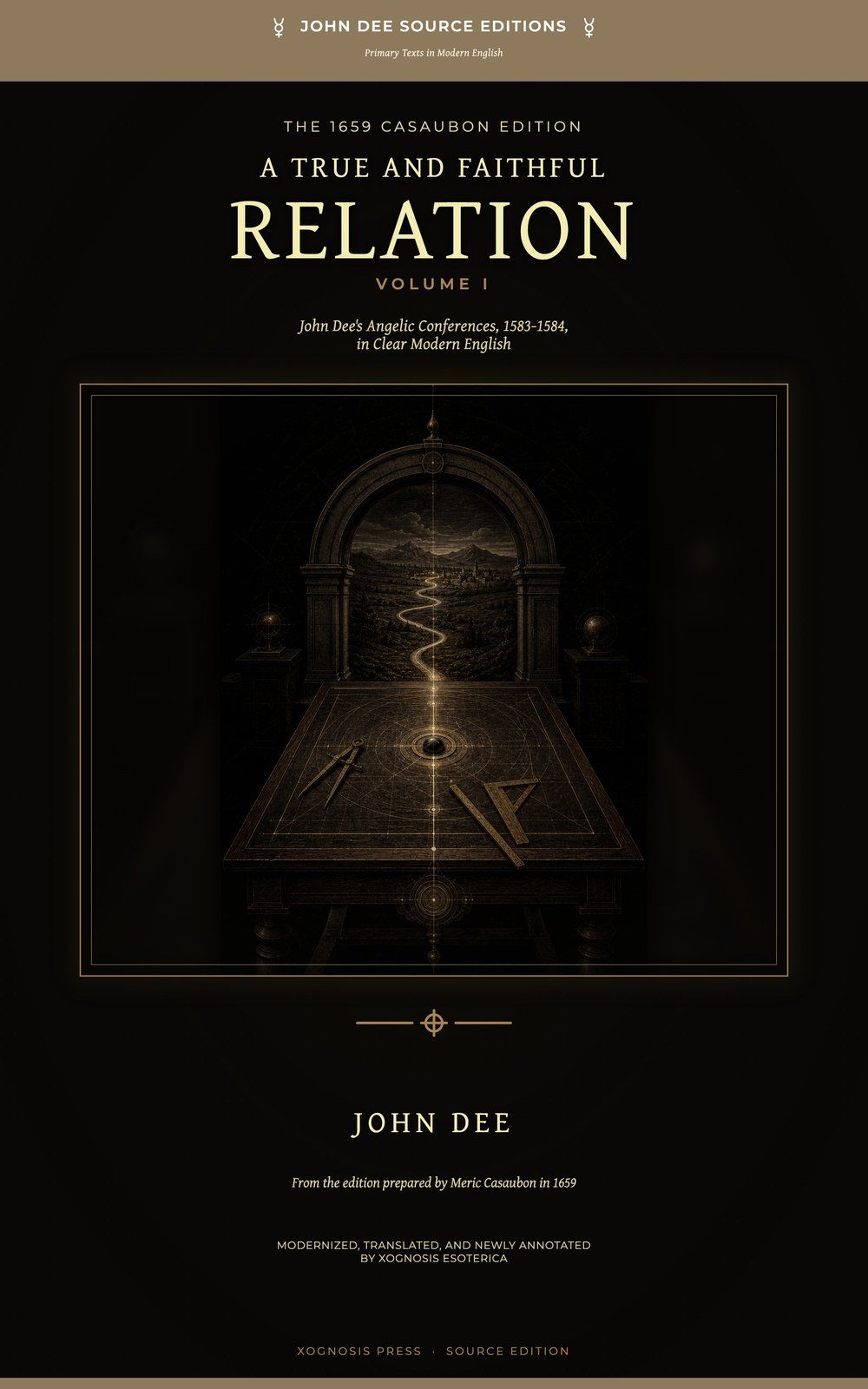
The Xognosis edition divides the folio's run across three volumes, and the mapping is straightforward once you hold the structure in your head. Volume I carries the conferences of 28 May 1583 to 4 March 1584 together with the 1659 preliminary matter and Dee's printed Apology, keeping Casaubon's 231 notes distinct from modern editorial ones so the two voices never blur. Volume II covers the Cracow year, 10 April to 8 October 1584, the stretch the Table indexes under Calls and Aires. Volume III takes 1585 to 1607 across Prague, Krakow, Trebon, and Mortlake, preserving the covenant sequence and the 1607 resumption. All three modernize the text against the Wellcome digitization, which sits in the public domain.
A caution on divisions: Casaubon counted fourteen or fifteen; the modern volumes group the material differently, and that grouping belongs to the edition, not to him. Cite his count for his book, and the volume pages for theirs.
A note on names: the word "Enochian" nowhere appears in the digitization of the 1659 text (a negative finding from OCR, and it carries the usual caveat). Dee's own printed terms are the "Angelicall" language, the "48 Claves Angelica", the Calls and the Aires. The system label came later. Reading the folio on its own vocabulary is part of reading it at all.
Read the book
Related Articles
Continue through articles sharing this topic.
Two books sit at the far ends of the esoteric shelf, and they answer the same question in opposite ways.
6 min read
In the summer of 1552, two of the most restless minds in Europe were, as far as anyone can tell, in the same city at the same time.
6 min read
Open a modern edition of A True and Faithful Relation and you meet a problem before you meet a single angel.
7 min read
Open a page of John Dee's Monas Hieroglyphica at random and you see a strange object: a single compound sign, part astronomical, part alchemical, drawn once…
6 min read