 Xognosis EsotericaArcane Publishing Studio
Every documentary record ends somewhere, but few end as strangely as the angel diaries of Dr John Dee. The sessions with the spirits, preserved in Dee's own hand and printed by Meric Casaubon in 1659, do not conclude. They thin out.
Share
Every documentary record ends somewhere, but few end as strangely as the angel diaries of Dr John Dee. The sessions with the spirits, preserved in Dee's own hand and printed by Meric Casaubon in 1659, do not conclude. They thin out. The last substantial material carries the date 1607, and even that survives only in a state Casaubon himself described as "much defective". After that, nothing. An old man in Mortlake, a scattering of papers, and then fifty years of silence before the press opened the record to the world.
The strangeness starts at the front of the book, not the back. Casaubon's 1659 edition, A True and Faithful Relation, opens its account of the angelic conversations abruptly in May 1583. Whatever Dee recorded before that date was not in the manuscript Casaubon used, a volume announced on its title page as "written with Dr. DEES own Hand" and "Kept in the LIBRARY of Sir THO. COTTON, Kt. Baronet". So the published record is already a fragment of a fragment. It begins mid-conversation and it ends mid-conversation, and the reader holds only the middle stretch of a much longer paper life.
That physical history matters for how we read the ending. Papers dispersed. Ownership passed from hand to hand. What survived to reach the Cotton library was whatever the intervening decades had not taken. The cutoff of 1607 is therefore a fact about the documents we happen to hold, and any honest account has to begin there rather than with a story about why the angels fell silent.
Set the documented events in order and a sober picture emerges.
Dee kept a separate private diary, sporadically, over more than two decades, notes he scratched "in a very small illegible hand on the margins of old Almanacs", as the nineteenth-century editor James Orchard Halliwell put it when he published the text in 1842. That diary, discovered by W. H. Black in the library of the Ashmolean Museum at Oxford, runs out around 1601. In 1604 the youngest Dee daughters vanish from every surviving trace. In 1605 Dee left Manchester for London, and spent his final years in poverty at Mortlake. The angel diaries carry dated material to 1607, material concerning "King James and his Councel" in Casaubon's account, records he called "much defective". Dee himself died late in 1608 or early in 1609, aged 81.
Notice the pattern. The records do not stop together in a single dramatic moment. They go quiet one by one, over the better part of a decade, as the household contracted and the hands that wrote things down grew fewer. The private diary lapses first. Family records go dark. The great spiritual record stumbles on a few years longer, then frays.
The honest position is that the record simply stops. The silence after 1607 is a silence of paper, not a documented silence of the angels.
Here the evidence has to be sorted carefully, because later tradition has filled the gap with stories.
The historical facts are these: the diaries physically stop, the 1607 material survives only in a defective state, and no account by Dee himself explains why. That last point deserves emphasis. Nowhere in what remains does Dee say the conversations were forbidden, broken off, or abandoned.
The interpretations come next, and they should be labelled as interpretations. Scholars and readers have reasonably suggested that the thinning of the record reflects Dee's great age, his poverty, the loss of scribal assistance after the long collaboration with Edward Kelley ended, and the dispersal of his papers after his death. None of these explanations appears in the record itself. They are inferences from circumstance, plausible and unproven, and an honest reading keeps them in that register.
Then there is legend. Later occult tradition supplied its own narratives about why the conversations ended: divine prohibition, the angels withdrawing, Dee abandoned. These stories postdate the manuscripts and have no documentary basis in the diaries. They answer a question the documents leave open, which is precisely what legends tend to do. The famous pairing of Dee with Kelley belongs to the 1582 to 1589 period the diaries document; the colourful accounts of Kelley's later fate in Bohemia circulate in unreliable retellings and tell us nothing about Mortlake in 1607.
Even the end of Dee's own life resists documentation. His precise date of death is unknown, because both the parish registers and his gravestone are missing. Late 1608 or early 1609 is as close as the evidence allows. A man who spent decades recording, in minute detail, what spirits said to him in a crystal, could not fix his own departure in the surviving record to within a season.
There is a lesson in that which goes beyond irony. Dee wanted a complete account of knowledge, and his printed legacy is defined by absence: a missing beginning, a defective ending, a missing grave. The paper trail contradicts the ambition. What we have is what accident preserved.
One more silence deserves notice, the one after the end. Casaubon published the diaries in 1659, roughly half a century after Dee died. For all that time the manuscript sat in the Cotton library, its defective final pages waiting. When it finally appeared in print, it appeared as a warning. Casaubon concluded that Dee's "great and dreadful" error was that he "mistook false lying Spirits for Angels of Light", and he offered the book to a Restoration readership as a lesson in what he called "Mistaken Inspiration and Possession".
Modern scholarship has been kinder and more careful. Jennifer Rampling, writing in Notes and Records of the Royal Society, places the 1659 publication within the serious history of early modern science rather than treating it as a curiosity, and Deborah Harkness's monograph on the conversations has made the diaries a subject of sustained academic study. The record that stopped in 1607 has kept generating reading ever since.
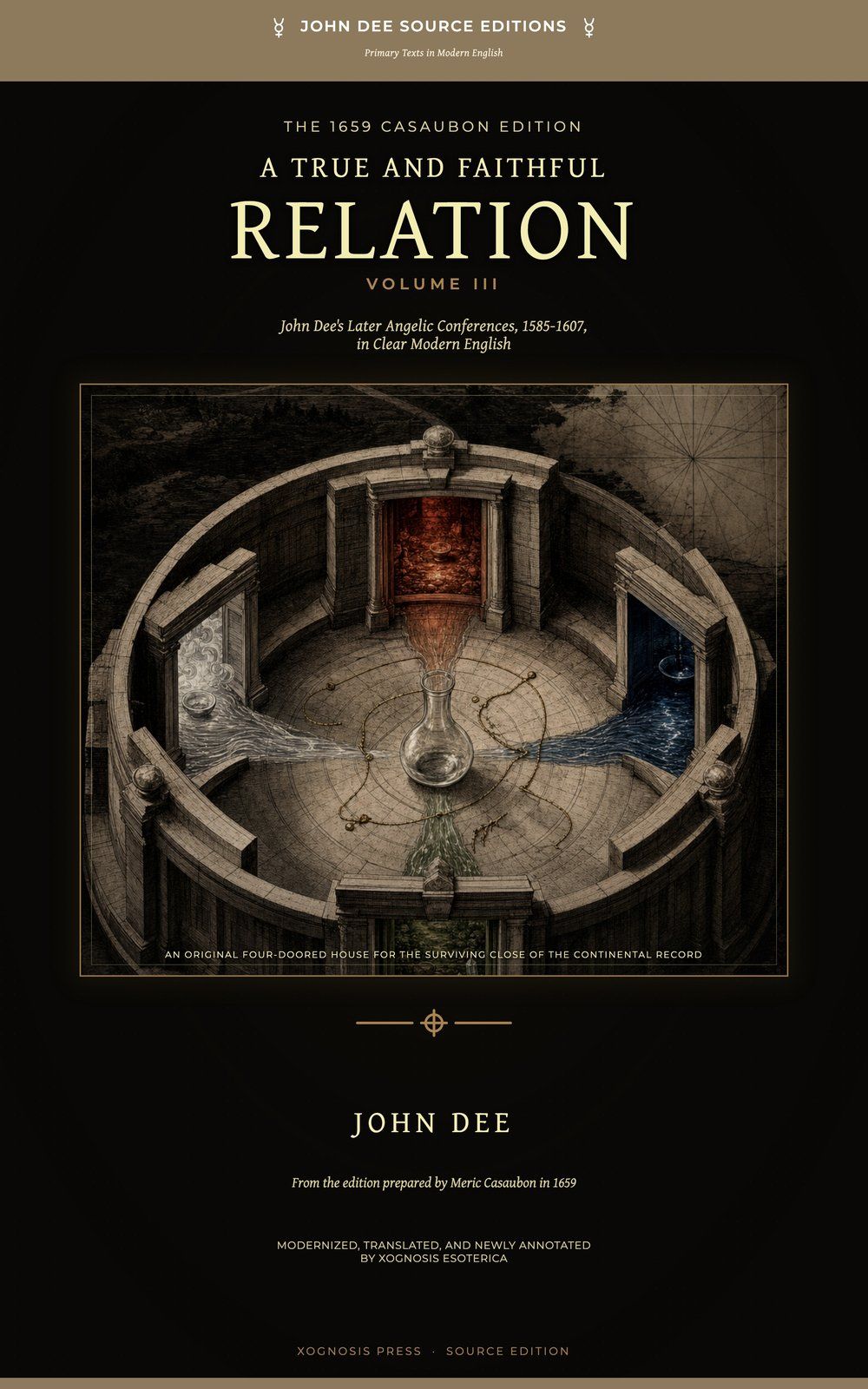
For the reader who wants to confront the cutoff directly, the publisher's edition of A True and Faithful Relation, Volume III carries the later material where the record frays. Pair it with The Private Diary of Dr John Dee, the Halliwell text, and you can watch both records run down in parallel: the almanac margins going quiet around 1601, the angelic sessions limping to their defective close in 1607. Read together, they turn the silence into evidence of its own kind, a record of what an impoverished household could no longer keep.
That is the honest reading, and it has its own dignity. Dee spent his life pursuing a complete account of the cosmos. What survived him is an incomplete account of one man, and the incompleteness is the most factual thing about it.
Read the book
Related Articles
Continue through articles sharing this topic.
Two books sit at the far ends of the esoteric shelf, and they answer the same question in opposite ways.
6 min read
In the summer of 1552, two of the most restless minds in Europe were, as far as anyone can tell, in the same city at the same time.
6 min read
Open a modern edition of A True and Faithful Relation and you meet a problem before you meet a single angel.
7 min read
Open a page of John Dee's Monas Hieroglyphica at random and you see a strange object: a single compound sign, part astronomical, part alchemical, drawn once…
6 min read