 Xognosis EsotericaArcane Publishing Studio
Somewhere in the second century, a Greek-speaking writer imagined a goddess who made a mistake. She wanted, according to one hostile account, "to search into the nature of the Father", and the attempt cost her everything: her position, her light, and nearly her mind.
Share
Somewhere in the second century, a Greek-speaking writer imagined a goddess who made a mistake. She wanted, according to one hostile account, "to search into the nature of the Father", and the attempt cost her everything: her position, her light, and nearly her mind. Her name was Sophia, Wisdom, and the story of her fall was told and retold with such persistence that it survives in at least four independent versions, two of them hostile summaries by a bishop and two of them full mythic narratives, one of which lay buried in the Egyptian desert until 1945. What changes between the tellings is not the outline of the plot. What changes is who Sophia is, what exactly she did wrong, and who her enemy turns out to be. The fall of Sophia is less a single myth than a family of revisions, and reading them side by side is the best way to hear the ancient communities arguing with each other through her.
The earliest account we can date comes from Irenaeus of Lyons, who composed Against Heresies around 180 CE. He was not a devotee. He was a polemicist, and he recorded these myths in order to discredit them, so everything he reports arrives pre-demonized. That caveat matters, because for centuries his summaries were nearly all anyone had.
Irenaeus gives two distinct Sophias. In the Valentinian version (Book I, chapter 2), the youngest of the aeons "suffered passion apart from the embrace of her consort Theletos". Her passion, he explains, "consisted in a desire to search into the nature of the Father; for she wished, according to them, to comprehend his greatness". The attempt fails, and she "brought forth an amorphous substance, such as her female nature enabled her to produce". From ignorance, grief, fear, and bewilderment, the Valentinians said, "material substance had its beginning".
In the Ophite version (Book I, chapter 30), the fallen power descends into the waters, "assumed from them a body", and then "regretted the course it had followed, and made an attempt to escape from the waters and ascend to its mother". Weighted down by matter, she cannot rise. Her son Ialdabaoth boasts that he is God and no one is above him, and his mother rebukes him: "Do not lie, Ialdabaoth". Irenaeus even records, without endorsing it, that "some of them assert that Sophia herself became the serpent" who taught knowledge to humanity.
These are caricatures drawn from life. But in 1907 the scholar Carl Schmidt argued that a neighboring section of Irenaeus, the Ophite myth of chapter 29, paraphrases the Apocryphon of John itself, or a close relative of it. That inference is widely accepted, though it remains an inference. Either way, the bishop preserves the oldest detectable draft of a story that scribes would later copy out in full.
That fuller version surfaced in 1945, when thirteen codices containing over fifty texts were found in Upper Egypt. Among them were three fourth-century copies of the Apocryphon of John; a fourth copy, on parchment in Berlin since 1896, had waited even longer for publication. Scholars date the composition to the second century, based on the Irenaeus parallel. That dating is a consensus, not a documented fact.
Here Sophia is an aeon of the divine Fullness, and her fault is precise: she creates without her partner. "She willed a likeness to appear from within herself without the will of the Spirit", the text runs, "and without her partner and without his consideration. [...] She brought forth." The result is described unsparingly: "an imperfect product appeared from her, and it was different from her pattern because she created it without her partner". She sees what she has made, "a model of a lion-faced serpent" with eyes like lightning, and casts it outside the divine places so the immortals will not see it.
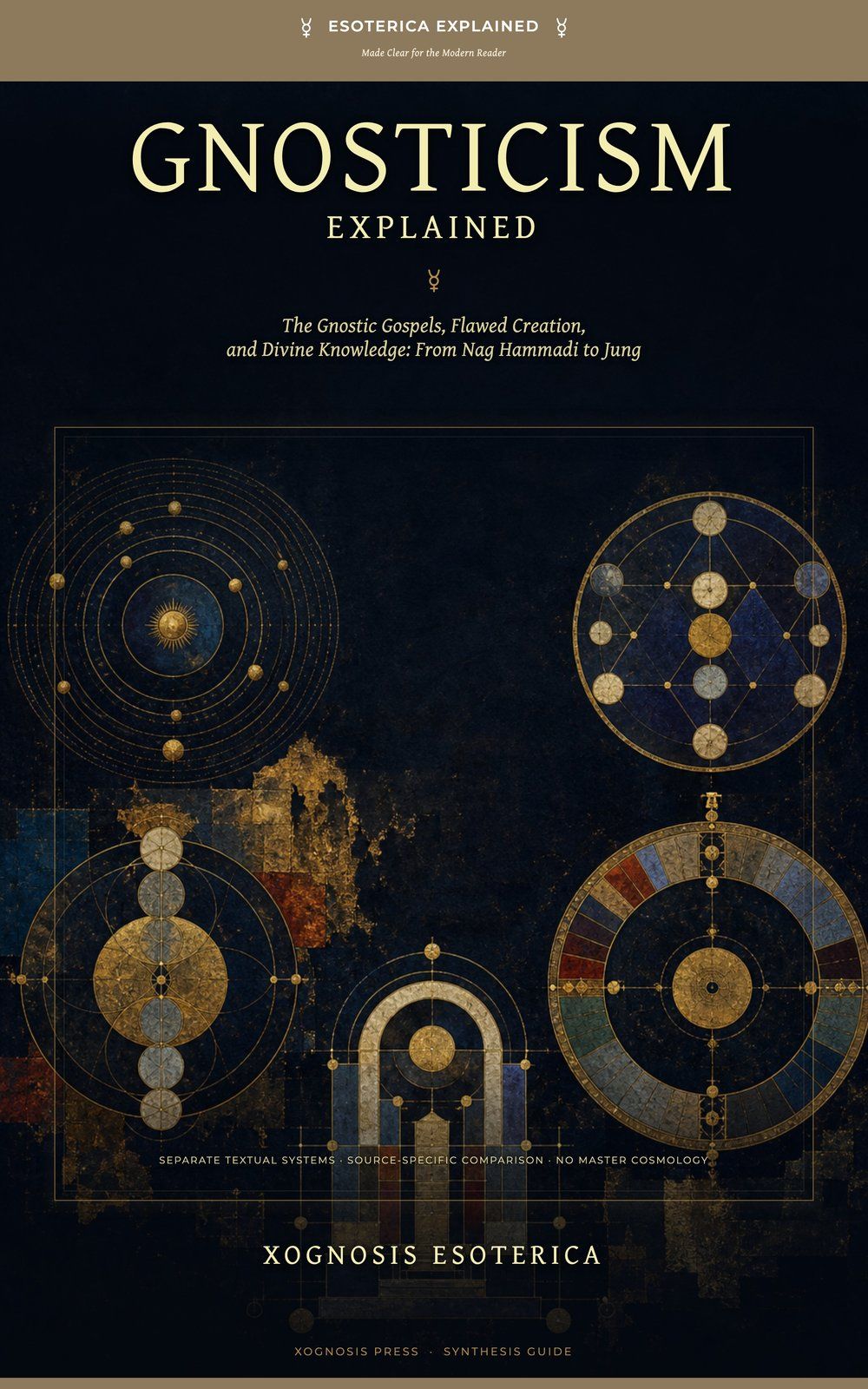
She names him Yaltabaoth, and he becomes the creator of the material world, a blustering demiurge of whom the text says: "Now this weak ruler has three names. The first name is Yaltabaoth. The second is Saklas. The third is Samael." Sophia's repentance follows: "she repented with great weeping". Significantly, her correction happens inside the divine order. She is placed above her son in the Ninth, "until she corrects her deficiency", and the text later says that "Epinoia existed as a correction for the deficiency of the Mother" and that Sophia "came down in innocence in order that she might correct her deficiency". The system absorbs the error and works to repair it. Readers who want the full architecture, from the fall through the demiurge's world to the saving correction, will find it traced in Gnosticism Explained.
The second great narrative, Pistis Sophia, reached modern Europe by a stranger road. A Coptic parchment codex of 178 leaves, copied by two scribes and dated in the British Library catalogue between 301 and 699, it was "sold to the British Museum in 1785 by Dr Antony Askew's heirs, hence its name". Until 1945 it was one of only three known gnostic manuscripts in the world. Its modern title, supplied from a later hand's heading, is itself an interpretation; the subscription at the end of its second book reads "A PORTION OF THE BOOKS OF THE SAVIOUR", which is why some scholars prefer that title. Mead's 1896 translation, revised in 1921, is what most English readers still meet, and the archaic English is part of the book's atmosphere. Composition dates range across scholarly estimates from the third century (Schmidt, whose 1925 title asserts it) to the fourth.
The rewriting starts with rank. Here Sophia is not an aeon of the height but one of the twenty-four emanations of the great Invisible, dwelling in the thirteenth aeon below the Treasury of Light. Her fault has also shifted: instead of generating without a partner, she sets out to take light for herself. "I will go into that region without my pair", she resolves, "and take the light and thereout fashion for myself light-æons". The trigger is devotional. She has "ceased to perform the mystery of the thirteenth æon" to sing praises to a higher light, which provokes the envy of a superior antagonist, "the great triple-powered Self-willed", who emanates "a great lion-faced power" to ambush her.
The lion-faced attacker is no longer her son. In this telling the monster is sent against her by a rival, and the substance drained from her becomes, in the chaos below, a lion-faced ruler the text names Yaldabaoth, a residue rather than a progeny. Her first repentance, chapter 32 in Mead's numbering, is a lament of real force: "when I sought the light, they gave me darkness; and when I sought my power, they gave me matter". She waits for her pair "and he came not". After long cycles of repentance prayers, she is at last led back, but only to where she started: "I took Pistis Sophia and led her into the thirteenth æon, shining most exceedingly". Not into the Treasury. The restoration is real and deliberately bounded.
The same goddess falls in both books, but the Apocryphon's Sophia errs inside the Fullness and is corrected within it, while Pistis Sophia's exile sings her way back only as far as the thirteenth aeon: same tragedy, different theology, and the difference is the point.
The motif traveled further than either masterpiece. The Sophia of Jesus Christ, preserved in the Nag Hammadi find and in the Berlin Codex, contains both a naming ("Some call her 'Pistis'") and a second fall, when Sophia "desired by herself to bring these to existence without her male (consort)". The story was a shared vocabulary, and each community inflected it toward its own doctrine of error, matter, and return.
The Sophia who fascinates modern readers, the tragic heroine of psychological readings descended from Jung and of contemporary retellings such as Pistis Sophia Reimagined, is one more link in that chain of revision. She is a creature of reception as much as of antiquity: a figure rewritten, community by community, from the bishop's sneer to the scribe's careful Coptic hand.
Read the book
Related Articles
Continue through articles sharing this topic.
Esoteric literature has a way of swallowing beginners whole. You pick up one book about alchemy, and within a week you have six tabs open about Renaissance…
7 min read
In January 1896 the German scholar Carl Reinhardt bought a Coptic papyrus codex in Cairo.
7 min read
Every few decades, someone translates the esoteric classics again. New Enoches appear. New Pistis Sophias.
6 min read
Pick a shelf of spiritual books at random and you will find, somewhere in the first twenty pages, the same accusation: you are not actually awake.
7 min read
Related Books
Catalog volumes sharing this article’s lead tag.