 Xognosis EsotericaArcane Publishing Studio
Ask most people who Jabir ibn Hayyan was and you will get a biography with the confidence of an encyclopedia entry: born at Tus in 721, son of a druggist, court alchemist to Harun al-Rashid, father of chemistry. Every clause of that sentence is tradition rather than attested fact.
Share
Ask most people who Jabir ibn Hayyan was and you will get a biography with the confidence of an encyclopedia entry: born at Tus in 721, son of a druggist, court alchemist to Harun al-Rashid, father of chemistry. Every clause of that sentence is tradition rather than attested fact. Some of it was doubted within two centuries of the man's supposed death, and the parts that survived the doubt were dismantled by a young Jewish philologist from Prague working in Cairo in the 1930s and 1940s. His name was Paul Kraus, and his findings, still the standard reference nearly a century later, have never really reached the general reader. This article is an attempt to hand them over.
Start with what the earliest sources actually say. In 987, the Baghdad bookseller Ibn al-Nadim finished the Fihrist, his enormous catalogue of Arabic literature, and included the first biographical notice of Jabir we possess. That notice, translated and annotated by Johann Fück in 1951, already records something startling: some readers of the tenth century denied that Jabir had ever existed at all. The legend was old when the skepticism was old.
The traditional life story is a modern construction in large part. The c. 721 birth date is not attested in any early source; the historian Thijs Delva showed in a 2017 study that it derives from a hypothesis E. J. Holmyard proposed in 1927, namely that Jabir's father was Hayyan al-'Attar, an Abbasid-era activist from Tus. Delva revisited the evidence and rejected the identification. Strip it away and the birth date, the druggist's shop, and the Tus origin lose their anchor.
What remains is thinner but real. The corpus itself presents Jabir as a disciple of Ja'far al-Sadiq, the Shi'ite Imam who died in 765, and late sources report death dates ranging between roughly 806 and 816. So a historical Jabir is possible, perhaps even likely. He is simply not the person the textbooks describe, and he is almost certainly not the author of the books that carry his name.
Roughly 600 Jabirian titles were known to Paul Kraus when he catalogued them; about 215 survive in manuscripts. (The oft-quoted figure of 3,000 treatises counts chapters as well as treatises, and Nomanul Haq has warned against building arguments on that inflated estimate.) The literature is vast, technically dense, and unmistakably the work of many hands.
Kraus's two-volume study, published in Cairo in 1942-1943, reached a conclusion that reset the field. The corpus, he argued at volume I, page lxv, was composed or redacted around 850 to 950, roughly a century or more after the historical Jabir would have died. His evidence was philological: the technical terminology and the Greek translations the texts cite belong to that later period, not to the eighth century. He further showed, in a 1931 study, that the charming stories linking Jabir to the Barmakid family of Harun al-Rashid's court are legendary, and he traced the corpus to a Shi'ite milieu, in his reading one with early Isma'ili connections. A later scholar, Alain Capezzone, argued in a 2020 study that the sect affiliation lies with an independent Shi'ite current instead. And the late dating itself has dissenters: Fuat Sezgin and Nomanul Haq both defend an earlier, more genuinely eighth-century corpus. The majority view stands with Kraus, but it is a strong interpretation, not a settled fact.
Wikipedia's summary of the current consensus is blunt: "Jabir ibn Hayyan is generally thought to have been a pseudonym used by an anonymous school of Shi'ite alchemists writing in the late 9th and early 10th centuries." A school, writing under a dead master's name, over generations. Whether that school had a historical founder at its root is a question the sources cannot currently answer.
The name "Jabir" points to a historical person we can no longer see, a corpus written a century later by a school of Shi'ite alchemists, and a Latin bestseller composed five centuries after that. Three entities, one name, and most popular accounts quietly merge them into one man.
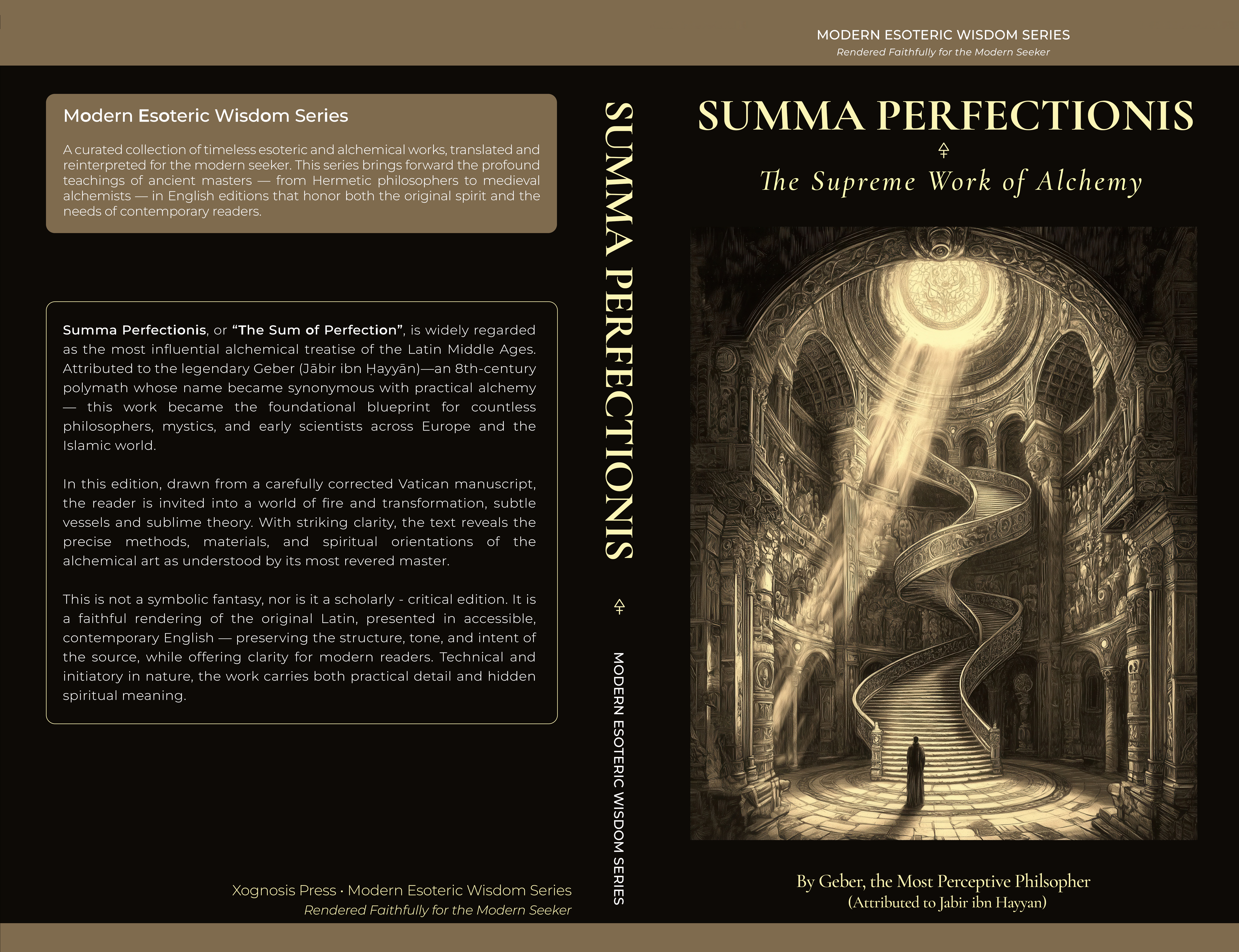
Then there is Geber. From about 1300, Latin Europe read alchemy under that name, above all the Summa perfectionis magisterii, a work of real theoretical power. No reference to it survives from before that date, and it is absent from the writings of Albertus Magnus and Roger Bacon, which tells against any great antiquity. It was first printed in Rome in 1525 and reached English readers through Richard Russell's 1678 translation, The Works of Geber.
The "Geber" of these works cannot be the eighth-century Jabir, and by the twentieth century the chemistry historians were saying so plainly. Holmyard, in his 1957 book Alchemy, judged that "the general impression they convey is that they are the product of an occidental rather than an oriental mind, and a likely guess would be that they were written by a European scholar, possibly in Moorish Spain. Whatever their origin, they became the principal authorities in early Western alchemy and held that position for two or three centuries." He also noted that "the general style of the works is too clear and systematic to find a close parallel in any of the known writings of the Jabirian corpus." William Newman carried the analysis further: in a 1985 article and a 1991 critical edition, he argued the Summa's author was probably Paul of Taranto, a thirteenth-century scholar from southern Italy. A minority voice, Ahmad al-Hassan, still defends Arabic originals behind the Latin texts in work published in 2009, so the door is not fully shut. But the weight of the evidence favors a European author building on Arabic sources, in the decades around 1300.
This matters because the Summa is the book that actually taught the West its alchemy. Readers who want to judge its clarity for themselves can find our edition, with the full text and commentary on the attribution question, in Summa Perfectionis: The Sum of Perfection.
Kraus barely lived to see his volumes circulate. He died in 1944, and his papers now sit in the University of Chicago Library. The two volumes remain the standard reference on Jabir to this day. Yet popular accounts lag by generations. Britannica still introduces Jabir as the father of Arabic chemistry. The 721 birth, the druggist's father, and Harun al-Rashid's court circulate in medical-history journals as fact, though they trace either to the corpus's own self-presentation or to Holmyard's now-rejected hypothesis. The court-alchemist story cannot even claim medieval unanimity: the connection to Harun al-Rashid first appears in the fourteenth century, in al-Jildaki, half a millennium after the supposed events.
The lag is understandable, in a way. "A school of anonymous Shi'ite alchemists writing under a pseudonym over a hundred years" makes a poor birthday for a scientific hero. But the real story is better material, not worse. An unseen master, a sectarian collective guarding his name, a corpus assembled in the shadows of the Abbasid twilight, and a European scholar who borrowed the whole legacy under a Latinized alias: that is a narrative with more torsion than any court biography.
Reading Jabir honestly means holding three things apart: a possibly historical eighth-century figure we know almost nothing about, a ninth- and tenth-century Arabic corpus of genuine scientific interest, and a thirteenth-century Latin masterpiece attached to his name by an accident of translation.
Read the book
Related Articles
Continue through articles sharing this topic.
Esoteric literature has a way of swallowing beginners whole. You pick up one book about alchemy, and within a week you have six tabs open about Renaissance…
7 min read
Somewhere around the year 1310, a Latin author sat down to write a book about furnaces.
6 min read
Sometime around the end of the thirteenth century, a writer working in Latin composed a long, disciplined treatise on the art of alchemy.
6 min read
There is a story about alchemy that almost everyone knows. For centuries, so it goes, clever men wasted their lives stirring molten metals and muttering…
6 min read
Related Books
Catalog volumes sharing this article’s lead tag.
Mutus Liber Reimagined (The Silent Book): A Modern Restoration & Commentary in Full Color Discover the Hidden Wisdom of Alchemy's Most Enigmatic Masterpiece, Now in Stunning Full…
Xognosis Esoterica
Mutus Liber Reimagined (The Silent Book): A Modern Restoration & Commentary in Monochrome Discover the Hidden Wisdom of Alchemy's Most Enigmatic Masterpiece, Now in Striking Monoc…
Xognosis Esoterica
Rendered Faithfully for the Modern Seeker Summa Perfectionis, or "The Sum of Perfection," is widely regarded as the most influential alchemical treatise of the Latin Middle Ages.…
Xognosis Esoterica