 Xognosis EsotericaArcane Publishing Studio
Sigmund Freud published The Interpretation of Dreams in 1900, and the dream became a symptom. Before that date, though, dreams were something else entirely: evidence. They were written down on the morning after, dated, collected into books, argued over by readers who checked them against later events.
Share
Sigmund Freud published The Interpretation of Dreams in 1900, and the dream became a symptom. Before that date, though, dreams were something else entirely: evidence. They were written down on the morning after, dated, collected into books, argued over by readers who checked them against later events. The people who kept these records were not patients. They were a patriarch in a pseudepigraphal text, a Renaissance physician, and an Elizabethan mathematician, and their notebooks still exist. Read in sequence, they show a long tradition of treating the dream as a document worth archiving, centuries before anyone thought to treat it as a message from the repressed.
The Book of Enoch contains a section scholars call the Book of Dream Visions, chapters 83 through 90 in R. H. Charles's numbering. The text presents itself as the antediluvian patriarch's own account, a father instructing his son. It opens with a direct address: "And now, my son Methuselah, I will show thee all my visions which I have seen, recounting them before thee. Two visions I saw before I took a wife."
That claim of authorship is a literary fiction, and scholars are clear about it. The Dream Visions are a Maccabean-era composition, dated by scholarly consensus to roughly 165 to 160 BCE, a period of revolt and persecution (Stone 2022; Charles 1913). What survives is a dream record twice removed: dreams narrated inside a text, and a text that presents itself as a written dream archive handed down within a family. The fiction of transmission is the interesting part. Whoever composed it chose to frame revelation as a dated, remembered, told-again dream rather than as a voice from a whirlwind.
The dreams themselves are anxious ones. The first vision shows the heavens collapsing and the earth swallowed into a great abyss, and the dreamer wakes crying aloud. After the second, longer vision, the narrator returns to the first: "On that night I remembered the first dream, and because of it I wept and was troubled, because I had seen that vision." A remembered dream, recalled years later within its own telling. The mechanics of dream-keeping, the waking fear, the return to an earlier dream, are built into the oldest dream text in this tradition. A modern edition of The Book of Enoch lets you read the Dream Visions in Charles's translation.
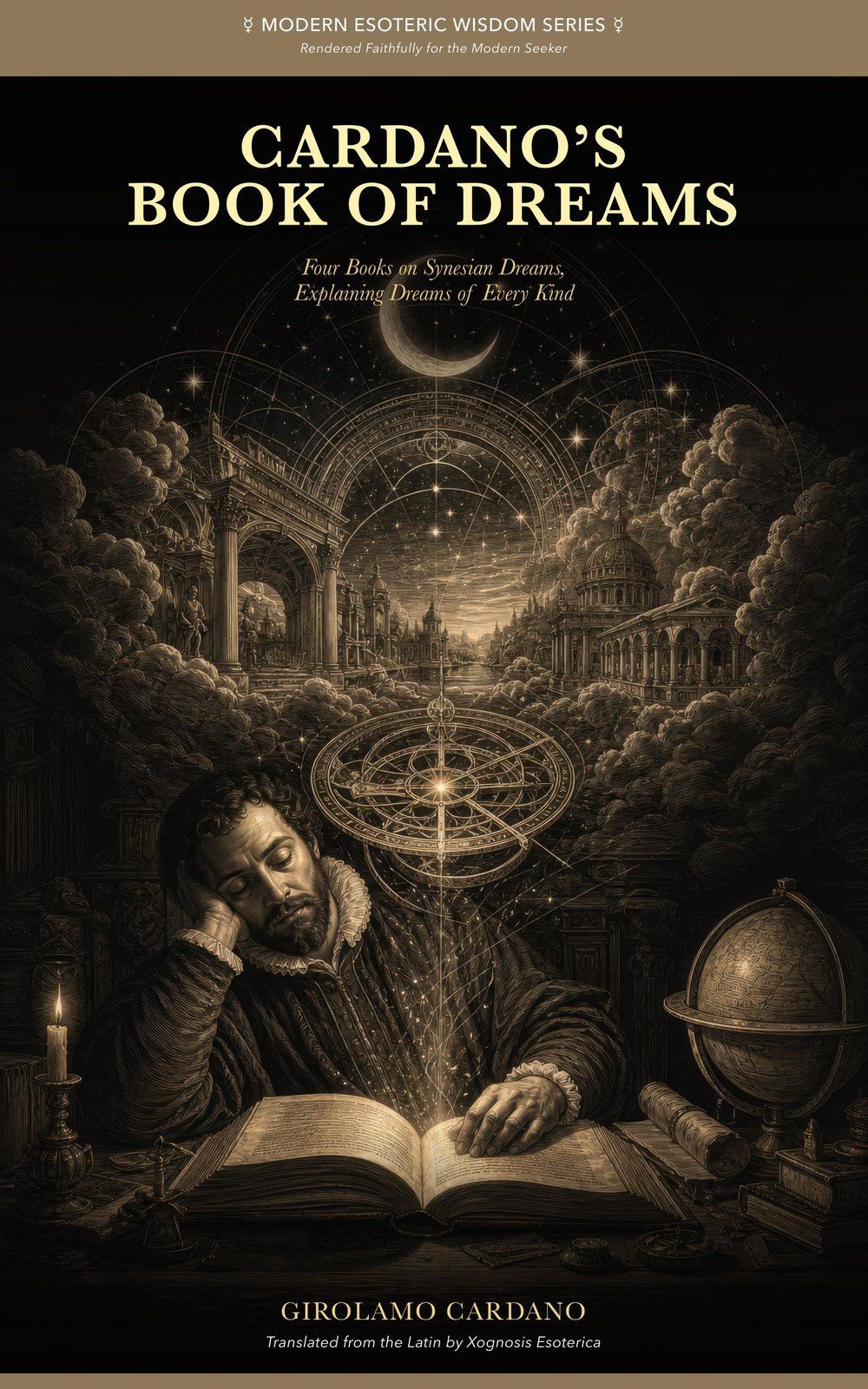
Girolamo Cardano (1501-1576) was a physician, mathematician, and gambler, and in September 1562 the Basel printer Heinrich Petri published his Somniorum Synesiorum libri IIII, four books on dreams. Cardano had conceived the work in the mid-1530s, planning ten books, and then carried the project for a quarter century before publishing it in shortened form (Giglioni 2010). The title names his model: Synesius of Cyrene, the late-antique author of De insomniis, who had argued for taking dreams seriously as a source of knowledge.
What makes Cardano unusual among Renaissance writers on dreams is that he recorded a good many of his own (Browne 1979). He also sorted dreams into a four-part classification by cause: digestive dreams from food and drink, humoural dreams from imbalances in the four humours, anamnestic dreams from the passions, and finally prophetic ones (Royal College of Physicians Heritage Blog, 2018). A heavy dinner could generate a dream; so could a planetary influence; so could a message about the future. The same man who built the classification also tested it against his own nights.
The turn toward intensive personal dream recording had a painful trigger. In 1560 Cardano's son Giambattista was executed, and the period that followed brought what Guido Giglioni describes as intensified dream activity and recording. Giglioni's summary is blunt: "the key episodes in his life were always heralded or accompanied by dreams." Whether or not that claim survives scrutiny, Cardano acted on it. He kept records, checked them, and eventually printed them. The theory was Synesius's; the archive was his own. Readers can trace the whole project in the Xognosis edition of Cardano's Book of Dreams.
John Dee (1527-1609) kept a private diary from 1554 to 1601, printed by the Camden Society in 1842 from the manuscripts then at the Ashmolean Museum. The diary records weather, illness, purchases, astronomical observations, and, scattered among them, dreams with dates attached.
Some are strange and precise. On 10 September 1579 Dee wrote of "my dream of being naked, and my skyn all overwrowght with work like some kinde of tuft mockado, with crosses blew and red." On 24 November 1582: "Saterday night I dremed that I was deade, and afterward my bowels wer taken out I walked and talked with diverse." On 2 August 1589, after his break with Edward Kelly: "my terrible dream that Mr. Kelly wold by force bereave me of my bokes."
The most intimate entry is dated 9 December 1579 and written partly in Greek script, plausibly a privacy measure. In it Dee records, in Greek characters, a dream in which a visitor came to his wife Jane and told her she had conceived, naming the child to come Zacharias. A daughter, Katherine, was born in 1581. The chronology fits; the name and the sex did not. That is a statement about the record, not a claim about prophetic dreams.
The diary must be kept distinct from the more famous angel conversations, which began in 1582 with Kelly as scryer and were published in part by Meric Casaubon in 1659. Legend paints Dee as a conjuror. The documentary record, as Deborah Harkness has argued, shows a mathematician and navigator who treated the conversations as empirical observation under angelic authority, with record-keeping and checks. The diary that contains the dreams is the same instrument: dated, careful, cumulative. It is available as The Private Diary of Dr John Dee.
The three records differ in almost everything else. The Enochic visions are a literary fiction from the second century BCE. Cardano's dream books are a physician's printed theory with a case file of his own nights. Dee's entries are private notes, some in cipher, never meant for print. What they share is method: the dream is written down, attached to a date, preserved, and revisited.
Before the dream was a symptom, it was a document: dated, collected, and checked against what happened next. Freud did not begin the record-keeping. He inherited two thousand years of it and changed what the records were thought to mean.
That distinction matters for how we read these texts now. The interpretations on offer, planetary, humoural, angelic, apocalyptic, belong to their moments in the history of ideas. The practice of keeping the records does not age the same way. When Cardano returned to a dream after his son's death, or Dee logged a nightmare about his books three years into his rupture with Kelly, each was doing something recognizable to anyone who keeps a journal: making the night answerable to the record.
The honest gaps in this history are worth naming. The Enochic text tells us nothing verifiable about any individual dreamer; it tells us how a Maccabean-era author chose to frame dreams as testimony. Cardano's interpretations are his theory, not medicine. Dee's prophetic hits are consistent with the record without being proved by it. None of that diminishes the archive. It was assembled by people who believed a dream was worth the ink, and the paper they used is why we can still read their nights.
Read the book
Related Articles
Continue through articles sharing this topic.
In the summer of 1552, two of the most restless minds in Europe were, as far as anyone can tell, in the same city at the same time.
6 min read
In 1936, C. G. Jung began a seminar in Zurich on children's dreams. Over the following years it grew into something larger: a survey, delivered to a circle…
6 min read
You wake with an image in your head: a staircase, a stranger's face, an eclipse. Days later something happens and the image seems to have known it first.
7 min read
Sometime in 1547, in the Lombard city of Pavia, a quarrelsome professor of medicine went to sleep and did what almost no one in Europe did in 1547: he wrote…
6 min read