 Xognosis EsotericaArcane Publishing Studio
The Mutus Liber, the "silent book" of alchemy, has no text to argue with. A sequence of engraved plates, a title page, and little else: no preface, no instructions, no name you can trust. And yet almost everyone who reads it attentively comes away with the same question.
Share
The Mutus Liber, the "silent book" of alchemy, has no text to argue with. A sequence of engraved plates, a title page, and little else: no preface, no instructions, no name you can trust. And yet almost everyone who reads it attentively comes away with the same question. Somewhere in the middle of the sequence, the plates show figures harvesting dew, sheets stretched over fields, the moisture wrung out and collected. Then the scene returns. The same operation, shown again, at what appears to be another dawn. Why would an author who could not afford a single wasted image spend two of them on one step?
First, what we know as fact. The Mutus Liber was printed in 1677 in La Rochelle by Pierre Savouret, in a run of no more than a few dozen copies; twelve originals survive in major libraries. A Geneva reprint followed in 1702 with new plates, and a very rare third edition appeared in Paris around 1760. The book then went quiet until a long line of modern reprints, from Thibaud in 1867 to Éditions à l'Envers in 2015, kept it in circulation among readers of alchemy.
What we do not know is who made it. The title page attributes the work to "Altus, a scholar in high chemistry of Hermès" and credits one Jacob Saulat, Sire of Marez, as inventor. Both claims were soon proven fictitious. Later historians have proposed a Rochelais doctor named Jacob Tollé (whose very existence has been doubted), Isaac Baulot, or, following Patrick Sembel, a small team: Baulot working with the engraver Abraham Thévenin and either Elie Bouhéreau or Elie Richard on the conception. These are proposals, not conclusions. The book's authorship is an open file.
That anonymity matters for our question. With no text and no author, the doubling of the dew scene has no commentary to explain it. Whatever the reason, we have to read it off the images themselves.
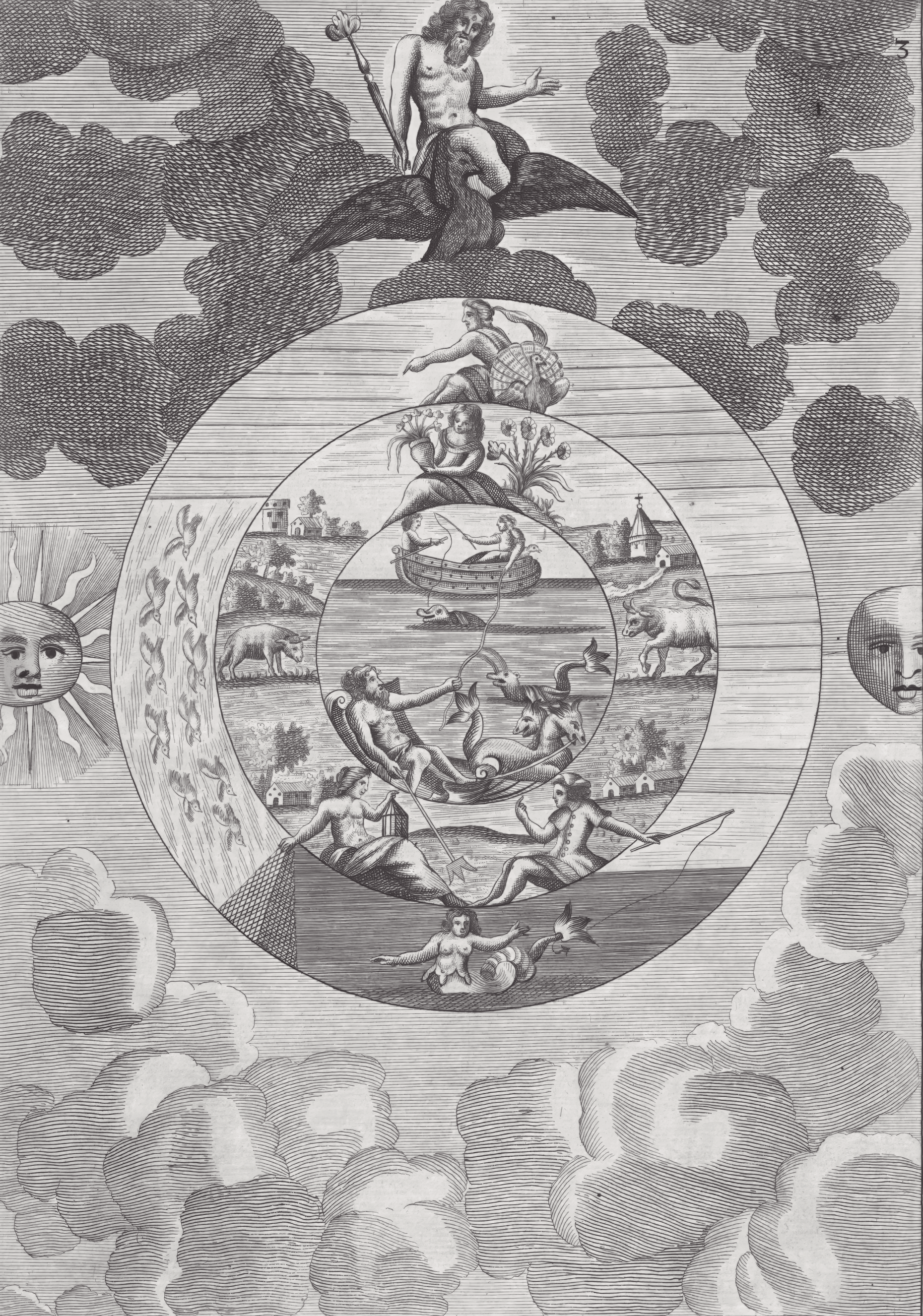
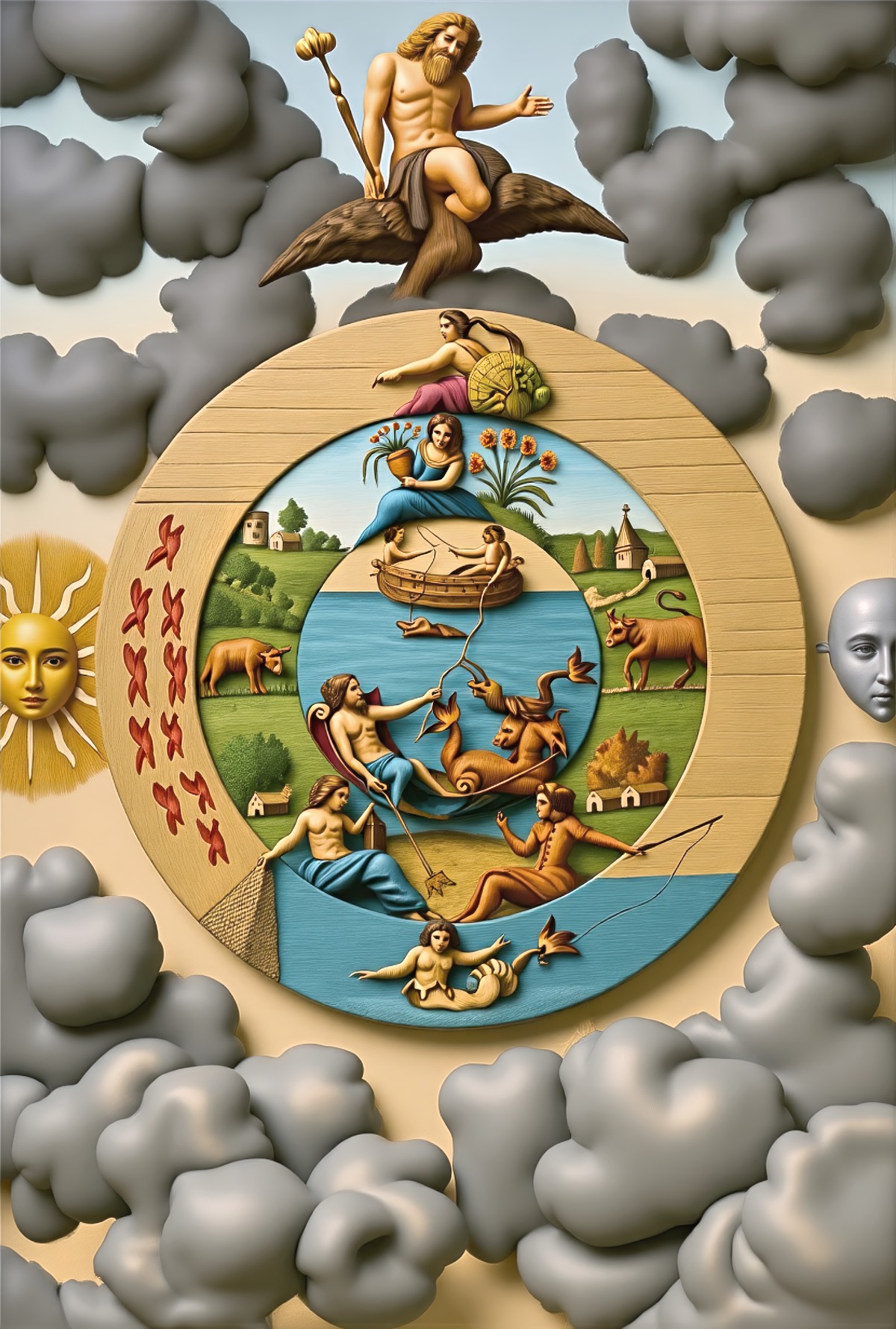
Here honesty requires care. The plate numbering and the placement of the dew scenes may differ between the 1677 original and the 1702 Geneva plates, and descriptions in the secondary literature do not always agree. In the standard reproductions, the scenes show figures collecting dew by dragging canvas or sheets across the ground at daybreak, then wringing them out over basins, an operation traditionally tied to a specific seasonal and astrological window. Any account of which plate carries what should be checked against a facsimile rather than remembered from secondary summaries, and the full-plate reproductions in Mutus Liber Reimagined exist precisely so readers can do that checking themselves.
The doubling, in other words, is real in the reading experience even where the bibliographic details are uncertain. And that gap between experience and certainty is where the interesting answers live.
No verified source records the engravers' intent. Everything offered as an answer is modern interpretation, and each school of reading handles the repeat differently.
The first camp, the one Wikipedia summarizes as the "initiated alchemists" reading, associated with Pierre Dujols, Eugène Canseliet, and Serge Hutin, holds that the book "shows how to proceed to achieve the magnum opus, whose ultimate purpose is to obtain the philosopher's stone." Read this way, the second dew harvest is a second operation: the sequence is a procedure, and the Master Work passes through its cycle more than once. The dew is gathered at the beginning of one phase and again at the beginning of the next. The repeat is the point. Repetition with variation is how a textless book says "again."
The second camp is Jung's. In his alchemical psychology, as the secondary literature renders it, alchemy is "speculative thinking looking for the spiritual equilibrium whose metaphorical form would be the philosopher's stone." A Jungian reader barely notices which plate comes first. Two dawns suggest the doubling of a psychic process, the conscious and unconscious faces of one transformation, or the return of a symbol at a higher level of integration. The second dawn is the same dawn understood differently.
The third approach, closest to Lee Stavenhagen's study of the plates' narrative structure, and to the historical work of Jean Flouret and Patrick Sembel on the La Rochelle milieu, treats the book as a composed sequence rather than a coded message. On this view the question is structural: what does the repeat do to the pace of the whole? A scene shown once is an instruction. A scene shown twice is a rhythm. It tells the reader that this operation, more than any other in the book, is where time and attention concentrate.
There is also a plainer possibility that the scholarly readings tend to glide past. Dew harvesting, as a practical matter, is a repeated labor. You cannot collect enough in one morning. A book that shows the operation twice may simply be showing the operation as it is: iterative, dependent on the right mornings coming around in succession, in the right season, under the right sky. The poetry of that reading is that the book's silence then becomes a kind of accuracy. Where a written treatise would say "repeat as needed," the plates just show you the repetition.
The Mutus Liber never explains why the dew is gathered at two dawns. Every answer we have, magical operation, psychic doubling, narrative rhythm, or plain iteration, is a modern reader's construction laid over an unsigned, textless book. The doubling is the book's most deliberate gesture, and its most durable mystery.
Whichever reading you favor, the doubling earns its place. In a work of images alone, a repeated scene is the loudest statement available. The 1677 engravers, whoever they were, chose to spend their scarce currency of attention on a second morning. Readers who want to weigh the plates against the interpretations will find the full run of fifteen plates, alongside the reimagined versions, in the Xognosis edition. The question of the two dawns is best settled, as the book itself insists, without words.
Read the book
Related Articles
Continue through articles sharing this topic.
Some books resist being read aloud. You can summarize a novel over dinner, and a history book lends itself to bullet points, but a certain strain of…
7 min read
Two books sit at the far ends of the esoteric shelf, and they answer the same question in opposite ways.
6 min read
A book with no sentences is a bold wager. In 1677, at La Rochelle on the French Atlantic coast, the publisher Pierre Savouret printed a slim volume of…
6 min read
The Mutus Liber arrived in 1677 as a book with almost no words in it. Fifteen engraved plates, published in La Rochelle by Pierre Savouret, credited to an…
5 min read
Related Books
Catalog volumes sharing this article’s lead tag.