 Xognosis EsotericaArcane Publishing Studio
Somewhere between the Nag Hammadi library and the internet, Yaldabaoth got a promotion he never asked for. In memes, listicles, and a thousand forum threads he appears as the evil god of Gnosticism, a Satanic architect cackling over his prison-world of matter.
Share
Somewhere between the Nag Hammadi library and the internet, Yaldabaoth got a promotion he never asked for. In memes, listicles, and a thousand forum threads he appears as the evil god of Gnosticism, a Satanic architect cackling over his prison-world of matter. The popular framing is easy to find: even Wikipedia's summary article describes how some Gnostic sects regarded Yaldabaoth as the malevolent God of the Old Testament, though the same sentence concedes that others considered him incompetent rather than malevolent. The texts themselves tell a stranger and sadder story. Read the primary sources and you meet a figure who is blind, boastful, ashamed, and at one point sorry, which is a strange resume for the devil.
The fullest portrait comes from the Apocryphon of John, a Sethian text preserved in four Coptic manuscripts, two shorter and two longer, found at Nag Hammadi and in the Berlin Codex. Its creator-figure carries three names: "The first name is Yaltabaoth, the second is Saklas, and the third is Samael." Then comes the line everyone remembers, with the explanation everyone forgets: "For he said, 'I am God and there is no other God beside me,' for he is ignorant of his strength, the place from which he had come."
That final clause is the whole argument of this essay compressed into one sentence. The boast is attributed to ignorance, not malice. The Hypostasis of the Archons, another Nag Hammadi text, makes the causal chain explicit: "Their chief is blind; because of his power and his ignorance and his arrogance he said, with his power, 'It is I who am God; there is none apart from me.'" Power, ignorance, arrogance. Malice never makes the list. When a voice from incorruptibility corrects him, the text says, "You are mistaken, Samael," and glosses the name as "god of the blind." The pun is the diagnosis. These etymologies, "blind god" among them, are wordplay preserved inside the texts themselves, ancient editorializing rather than settled modern etymology, but they show how the authors wanted him read.
On the Origin of the World adds the pathos. Its prime parent emerges "ignorant of whence he had come into being," sees nothing but water and darkness, and "supposed that it was he alone who existed." When Pistis rebukes him, he is "greatly disturbed." Later, catching sight of the light, "he was amazed. And he was greatly ashamed." Shame and amazement are not demonic registers. They are the registers of a creature discovering his own smallness.
The Apocryphon of John also handles the Old Testament's jealous God with surprising wit. After the archon declares "I am a jealous God, and there is no other God beside me," the text observes: "But by announcing this he indicated to the angels who attended him that there exists another God. For if there were no other one, of whom would he be jealous?"
The boast refutes itself. This is mockery, sure, but mockery of a specific kind: the puncturing of a vain and uninformed superior, not the denunciation of a cosmic criminal. The same text reports that "the arrogant one took a power from his mother. For he was ignorant, thinking that there existed no other except his mother alone." Every fault circles back to not knowing.
Here is the detail that collapses the Satan reading entirely. In the Hypostasis of the Archons, the demiurge's own son Sabaoth sees an angel bind his father and cast him down into Tartaros, and "repented and condemned his father and his mother, matter." Sophia and Zoe then take him in, instruct him, and exalt him as a redeemed figure, "God of the forces, Sabaoth." Repentance inside the creator's own household, followed by elevation, makes no sense in a cosmology where the demiurge's line is pure evil. The myth allows for movement, regret, even repair.
The Apocryphon of John goes further, though the passage needs careful quoting. In the flood episode, the chief archon "repented for everything which had come into being through him," and then, immediately, "planned to bring a flood upon the work of man." His remorse precedes a destructive plan, so this is hardly a conversion scene. Yet even here the emotion is regret over what he has made, the anguish of a botched craftsman rather than the glee of a torturer.
The earliest detailed account we have of Gnostic demiurge mythology comes from outside the movement: Irenaeus, bishop of Lyons, writing Against Heresies around 180 CE. He had every incentive to paint the heretics' creator as diabolical. Instead, reporting the Valentinian system, he wrote that the demiurge "formed the heavens, yet was ignorant of the heavens; he fashioned man, yet knew not man," and that he "imagined himself to be God alone." Then Irenaeus draws a distinction that should end the confusion: "Cosmocrator has knowledge of what is above himself, because he is a spirit of wickedness; but the Demiurge is ignorant of such things, inasmuch as he is merely animal."
Wickedness, for Irenaeus's Valentinians, belongs to a different figure, one who knows exactly what he is defying. The demiurge's defining trait is that he does not know. Even the hostile orthodox witness separates the two categories.
None of this makes Yaldabaoth a sympathetic hero. The Sethian texts are harsh: he traps divine sparks in matter, and his world is a botched and blinded place. But there is a real difference between a jailer who knows the jail and a fool who mistakes his workshop for the universe. The Valentinian sources, as reported by Irenaeus, soften him further, toward a morally neutral ignorance. No single system represents "what Gnostics believed"; these were competing theologies, and flattening them into one cartoon Satan erases their differences along with their nuance.
The pure-evil version is largely a product of later esoteric revivals and internet simplification. It survives because it is a better story, or at least a simpler one.
In the Nag Hammadi texts, the demiurge's fault is ignorance, blindness, and arrogance, and the myths track his shame and his son's repentance. A Satan has nothing to be ashamed of and no one to repent. Yaldabaoth is a botched craftsman, and the texts never let you forget it.
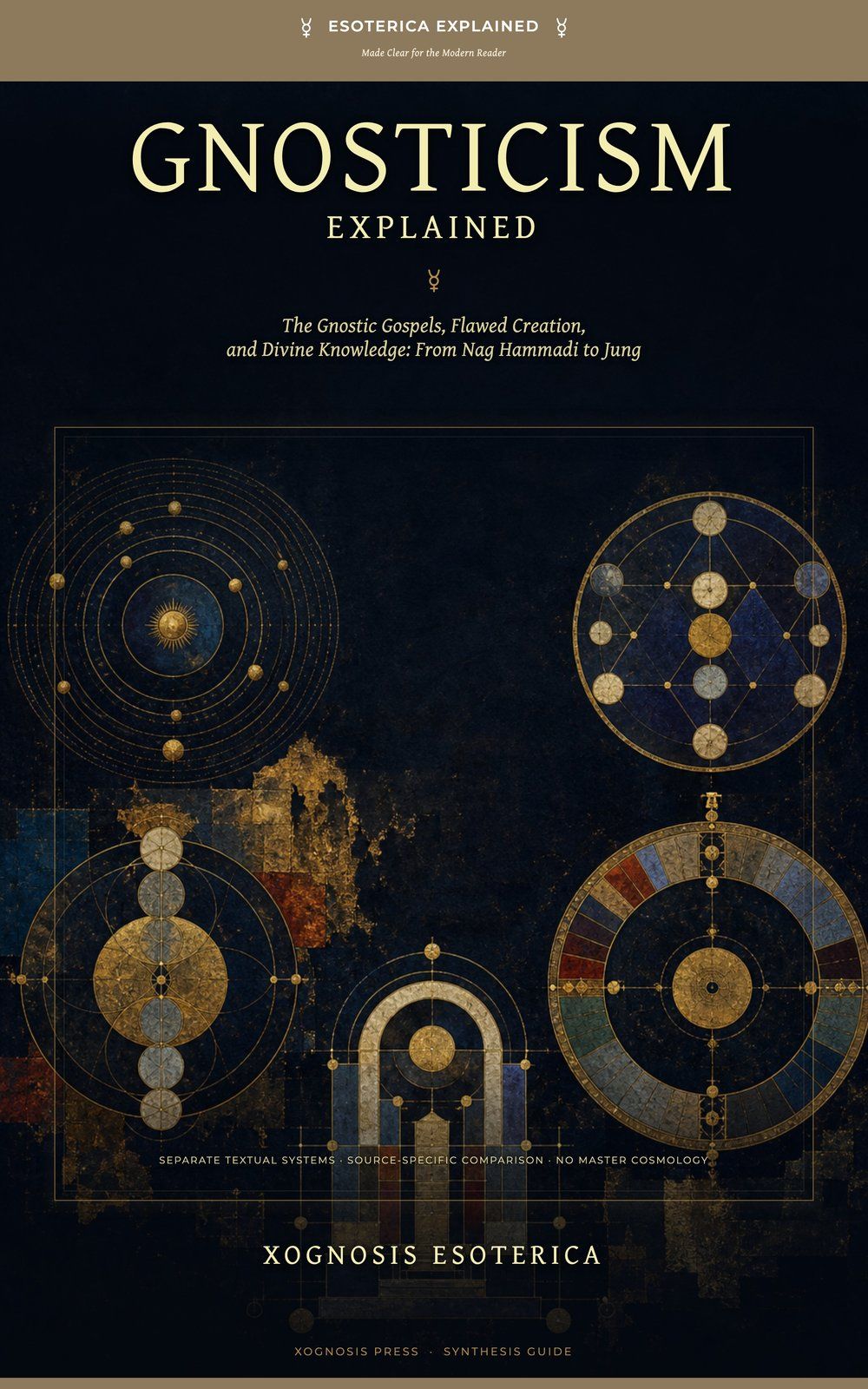
If you want to meet the figure in his own words rather than through the meme, the primary texts are short, strange, and well worth an afternoon, and our edition of Gnosticism Explained walks through them in full context.
Read the book
Related Articles
Continue through articles sharing this topic.
Esoteric literature has a way of swallowing beginners whole. You pick up one book about alchemy, and within a week you have six tabs open about Renaissance…
7 min read
In January 1896 the German scholar Carl Reinhardt bought a Coptic papyrus codex in Cairo.
7 min read
Every few decades, someone translates the esoteric classics again. New Enoches appear. New Pistis Sophias.
6 min read
Pick a shelf of spiritual books at random and you will find, somewhere in the first twenty pages, the same accusation: you are not actually awake.
7 min read
Related Books
Catalog volumes sharing this article’s lead tag.