 Xognosis EsotericaArcane Publishing Studio
Fifteen engravings, not one word of explanation. That was the whole teaching of the Mutus Liber. When it came off the press at La Rochelle on the first of February 1677, it carried fifteen engravings in all, one of them doubling as the title plate, along with a short French note "To the Reader" and a royal privilege leaf, and its author…
Share
Fifteen engravings, not one word of explanation. That was the whole teaching of the Mutus Liber. When it came off the press at La Rochelle on the first of February 1677, it carried fifteen engravings in all, one of them doubling as the title plate, along with a short French note "To the Reader" and a royal privilege leaf, and its author hid behind a single pseudonym: Altus. John Ferguson, cataloguing the Young collection in 1906, described the result plainly: "This is a series of fifteen engraved plates, without a word of explanation, portraying the preparation of the philosopher's stone." Almost 350 years later, we set out to clean those plates digitally, and the cleaning kept turning up history.
The 1677 originals are rare by any measure. Patrick Sembel, whose 2015 study of the editions is the most recent dedicated treatment, estimates the print run at no more than a few dozen copies, with twelve originals accounted for in major Western libraries and perhaps a few more besides. Those figures reach us through citation rather than a direct reading of Sembel's study, so we offer them as his findings, not settled counts.
What survives on each sheet is a copper-plate impression: ink pulled from lines cut into metal. That matters for restoration, because an intaglio print records two histories at once. There is the history of the plate itself, and the history of the paper that received it.
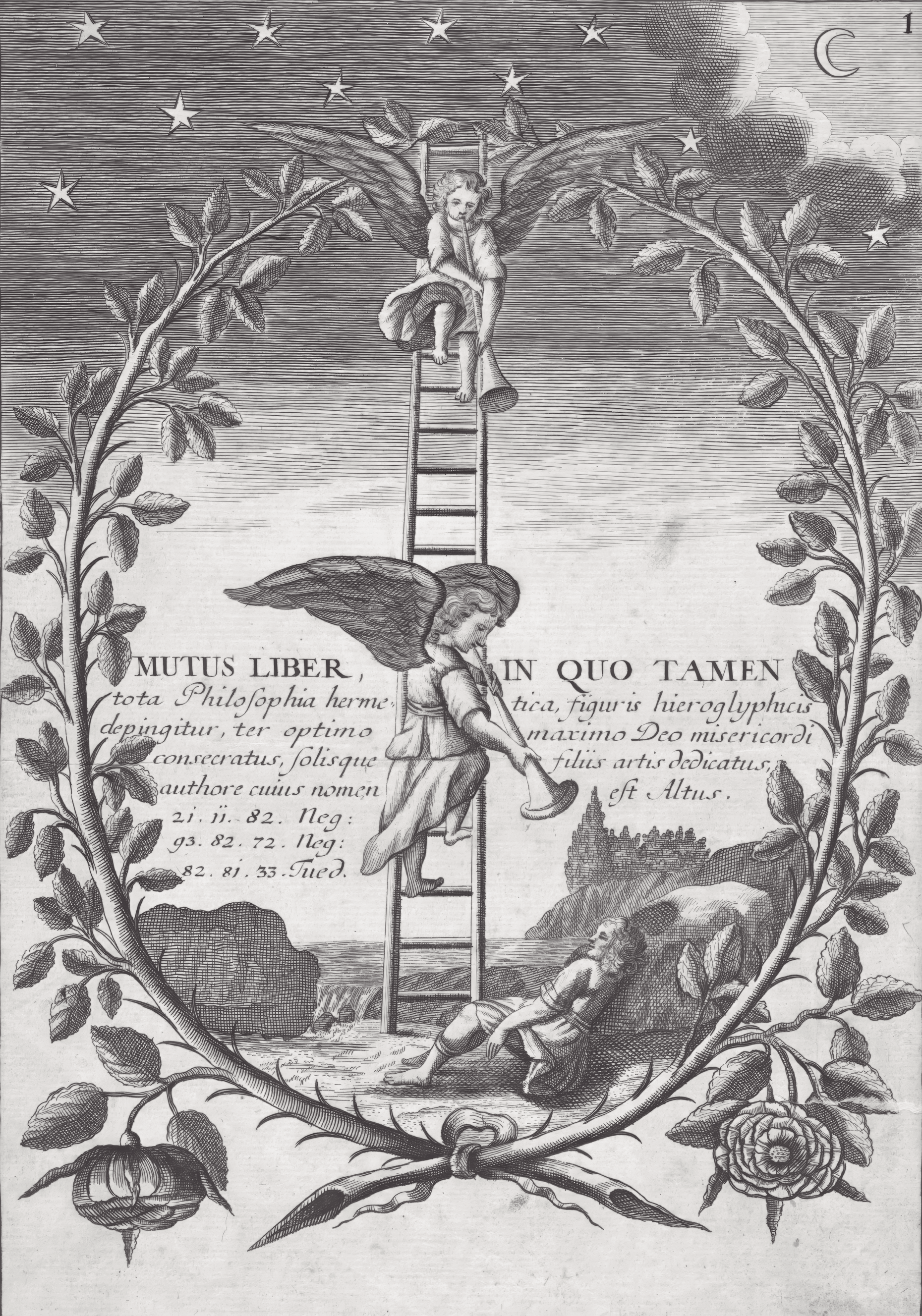
Copper plates are working tools, and they degrade in documented ways. The University of Glasgow's Whistler Etchings project glossary, built from a museum's study of nineteenth-century printing, defines the vocabulary. A burr is "a ridge of metal raised by a drypoint needle or other engraving tool," one that "wears down quickly during printing due to the pressure of the printing press." Pitting arrives later: "The surface of a copper plate can deteriorate over time, and become pitted with irregular holes, through corrosion or rusting." And each deliberate alteration to a plate produces a new "state," in the glossary's definition, so that impressions taken across a plate's life can differ line by line.
This is where a common assumption about the Mutus Liber has to be corrected, including in older reference works that blur the two. The plates issued at Geneva in 1702, at the end of volume one of Jean-Jacques Manget's Bibliotheca Chemica Curiosa, were not pulls from the 1677 coppers. The Library of Congress catalogue states it directly: "The plates, re-engraved after the 1st ed. (published at La Rochelle in 1677) wrer also issued at the end of v. 1 of J. J. Manget's Bibliotheca curiosa, Genevae, 1702." The typos belong to the catalogue, the fact to the bibliographic record.
So a 1702 impression cannot show "wear" on the 1677 plates. It shows a second engraver's hand copying a first, and the comparison between a 1677 pull and a 1702 pull is a comparison between two separate plate campaigns. Eugène Canseliet, whose 1967 Pauvert edition was the first complete reprint of the La Rochelle original, had a sharp opinion of the Geneva versions: he limited "our reproach to his mediocre reproduction of Altus' engravings," and noted that Manget left out the reader's note and the privilege leaf altogether.
Restoring scans of engravings borrows its ethics from the conservation of the objects themselves, so it is worth being precise about what that discipline says. The American Institute for Conservation's wiki defines surface cleaning as "a mechanical cleaning technique used to reduce superficial soil, dust, grime, insect droppings, accretions, or other surface deposits." It also warns that foxing spots and stains "may increase in visibility after surface cleaning," and that a very dirty sheet may shift tonality rather than return to some imagined pristine white. Conservators are counseled to avoid abrasive work on the plate area of intaglio prints altogether, since the compressed surface there is easily roughed up and altered in character.
Our editions, Mutus Liber Reimagined in monochrome and the full color edition, are digital restorations of scans, and we hold them to the same caution. Cleaning a scan can recover line weight that dirt and time had smothered. It cannot recover what the paper never received: a worn-away burr, a pit in the copper, a re-engraver's simplification. Digital work reveals the impression; it does not improve it. Antony Griffiths's standard introduction to printmaking and Max Schweidler's classic 1938 manual on the restoration of engravings remain the anchors for how prints live, age, and have historically been treated. That tradition is subtractive: take off what time put on, add nothing of your own. Nothing in it entertains a "better than original."
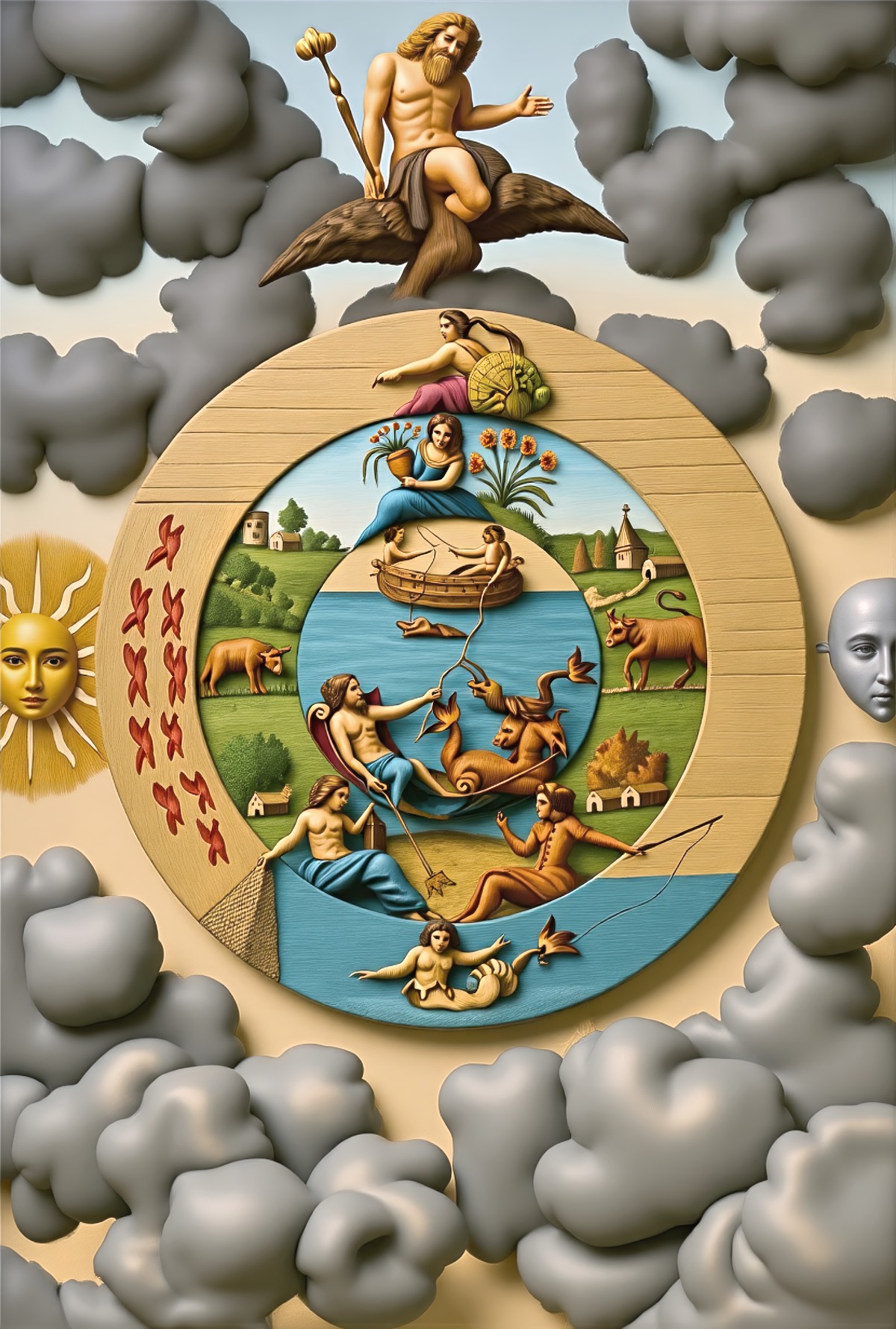
Working plate by plate, the restorations fell into three rough groups. Most sheets responded as dirty paper does: grime lifted, the ink lines stood up, and details that had sunk into general grey separated again into distinct strokes. A few plates had suffered scan or reproduction loss that no cleaning could honestly fill, and there we left the loss visible rather than invent a line. And in a handful of places the cleaning settled small questions about what the engraver drew, because a clean line is evidence in a way a muddy one is not.
The 1677-versus-1702 comparison was the most instructive. Where both editions could be set side by side, the Geneva re-cuts confirmed their own status: lines redrawn by a later hand, occasionally simplified, sometimes strengthened, never identical. Manget even added something the original never had, a page of practical text, including his instructions for May dew: "Take a sufficient quantity of May dew or rainwater, or snow in the same way, obtained in March or the beginning of April, and distil its spirit in the ordinary way." The mute book had acquired a voice, which is precisely what its 1677 author had refused it.
Who Altus was remains genuinely open, and the restoration cannot settle it. The privilege of 1676 names the man who paid for the printing: "Our dear Jacob Saulat, Sieur des Marez, has shown us that a book of the high chemistry of Hermes has fallen into his hands." A bookseller's patron is not necessarily an author. The traveller Balthasar de Monconys had recorded a La Rochelle doctor in 1645 who "labours himself in chemistry, and who also draws, paints and understands perspective," and later writers, from Arcère in 1757 to Barbier in 1824, argued this Tollé was the true hand. Ferguson put the anagram question markingly in 1906: "May Altus not be meant for a kind of anagram of Saulat?" Twentieth-century scholarship, notably Jean Flouret in 1976 and Sembel in 2015, has moved toward Isaac Baulot. These are layers of argument, not fact; the restoration cleans ink, not attributions.
The dirt came off; the questions did not. Digital restoration can return the line an engraver cut in 1677, but the identity of Altus, the size of the print run, and the meaning of the figures remain exactly as open as the scholarship leaves them, and an honest edition says so.
The fifteen plates have now survived three and a half centuries, two re-engraving campaigns, a flea-market legend or two courtesy of Canseliet, and the slow accumulation of grime. What the restoration found, under all of it, was the engraver's own line, still sharp, still silent, still waiting to be read by what the 1677 leaf called all the peoples of the world.
Read the book
Related Articles
Continue through articles sharing this topic.
Some books resist being read aloud. You can summarize a novel over dinner, and a history book lends itself to bullet points, but a certain strain of…
7 min read
Two books sit at the far ends of the esoteric shelf, and they answer the same question in opposite ways.
6 min read
A book with no sentences is a bold wager. In 1677, at La Rochelle on the French Atlantic coast, the publisher Pierre Savouret printed a slim volume of…
6 min read
The Mutus Liber arrived in 1677 as a book with almost no words in it. Fifteen engraved plates, published in La Rochelle by Pierre Savouret, credited to an…
5 min read
Related Books
Catalog volumes sharing this article’s lead tag.